Oslo floating sauna: review, tips and booking
Oslo: self-service public floating sauna ticket, Tjuvholmen
Duration: 1 hour
- Floating sauna
- Fjord swim
| Where | Tjuvholmen, western dock, near Aker Brygge |
| Cost | Around NOK 250–295/adult (public); NOK 800–1 000 whole boat (private) |
| Time needed | 1 hour (public); 1.5 hours (private) |
| Getting there | Tram 13 to Tjuvholmen, or 10-min walk from Aker Brygge |
| Best time | Year-round; winter gives the most dramatic contrast |
Why Oslo’s floating saunas matter
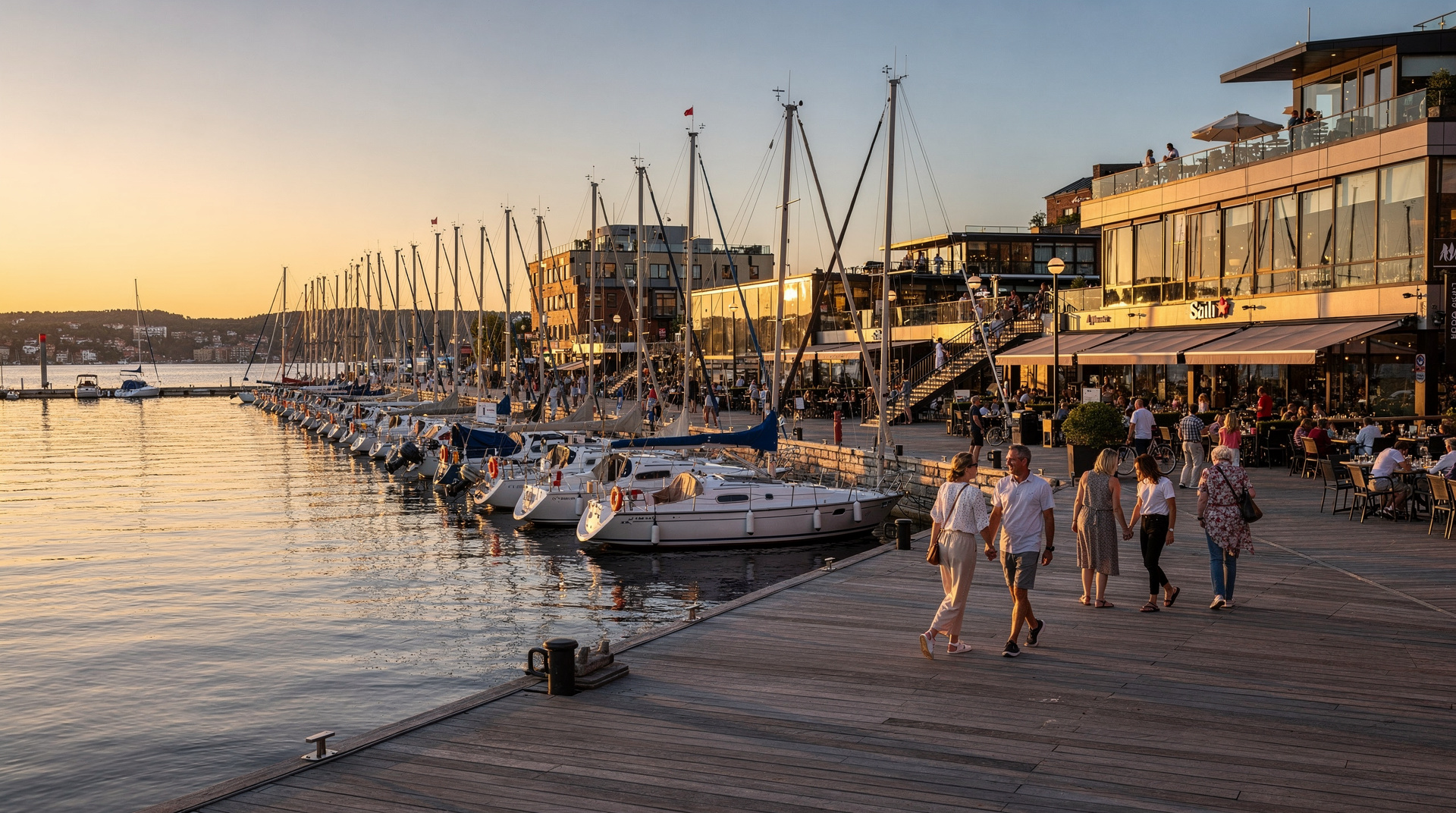
The floating sauna is not a gimmick or a tourist invention. It is an extension of a deeply embedded Scandinavian relationship with the sauna — heat, sweat, cold water, recovery — translated into Oslo’s most dramatic available setting: the Oslofjord itself. Tjuvholmen, the reclaimed-land arts and residential quarter west of Aker Brygge, has become the natural home for these structures since the early 2010s, and on a clear winter evening with the city lights reflecting in the water, floating in the fjord after a sauna session is one of those experiences that Oslo does better than almost anywhere.
Norway does not have Finland’s century-long mass sauna culture, but the sauna tradition is firmly embedded in Norwegian life and has grown significantly in the past decade, particularly in Oslo. The city’s relationship with the fjord — as a swimming spot, a commuting route, a recreational resource — has always been more democratic than in many other European capitals. The floating saunas extend this relationship by making the fjord accessible in winter in a way that ordinary swimming is not.
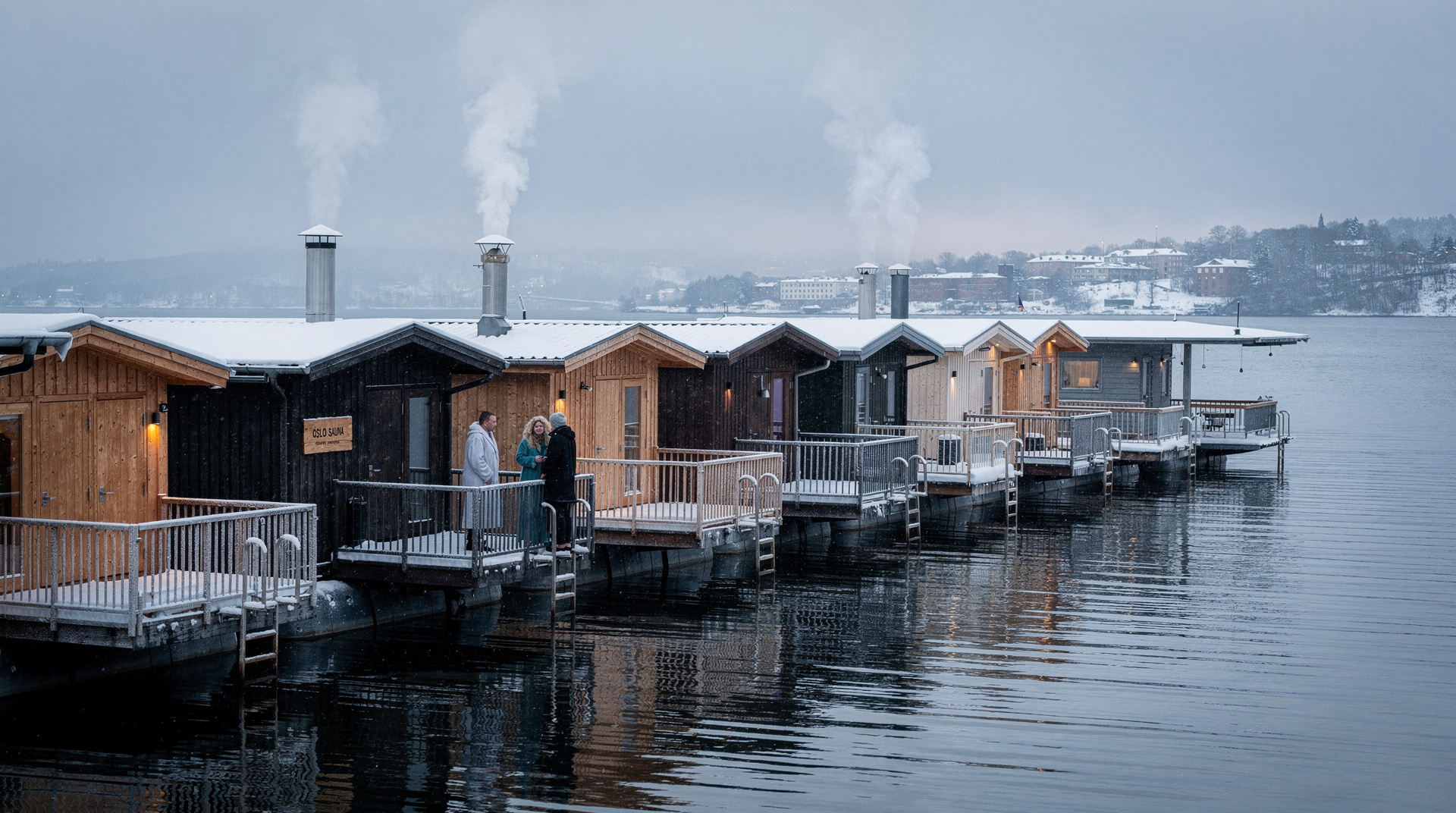
There are currently two main booking options for the floating saunas at this location: the self-service public session, where you share the sauna with a small group of other guests for one hour, and the private “Bragi” session, where your group books the entire sauna boat for 1.5 hours. A third option — the floating sauna and fjord swimming experience — is a slightly different product from a nearby operator and includes guided elements.
The public floating sauna: what to expect
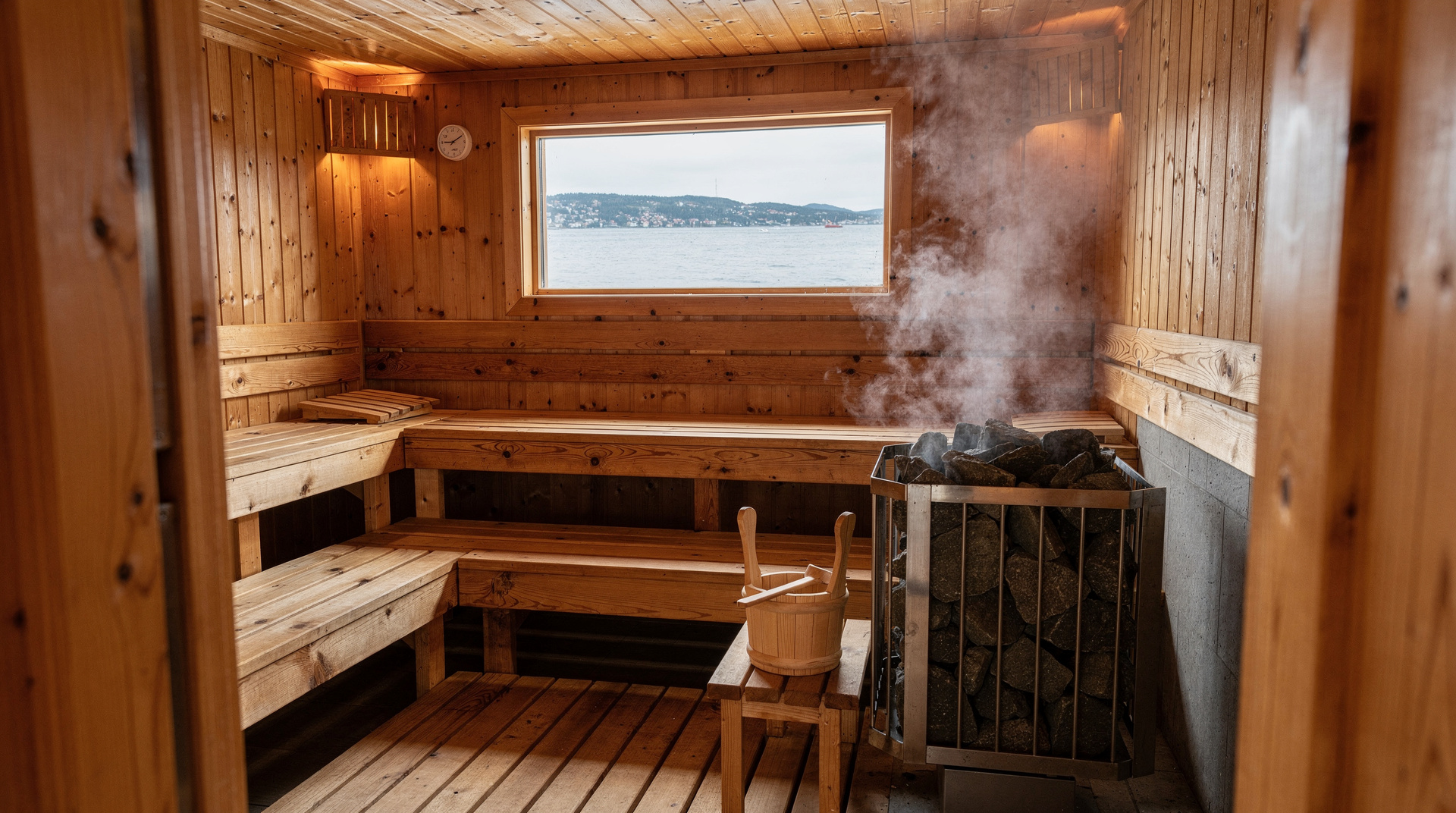
The public session is the accessible entry point. You book a one-hour slot — slots typically run from 07:00 to 22:00, with the specific hours varying by season. Arrive 10 minutes early to change and get settled. The sauna itself is a compact wood-panelled room with tiered benches, a stone stove, and good heat management. Capacity is typically 8 to 12 people per session depending on the specific vessel.
You will share the space with whoever else booked the same slot. On weekday mornings this tends to be Norwegians before work — a notably different atmosphere to a tourist-heavy summer afternoon session. The etiquette is calm: people warm up, step out to plunge in the fjord from the deck or the attached ladder, cool down, and return. Conversation is natural but not forced.
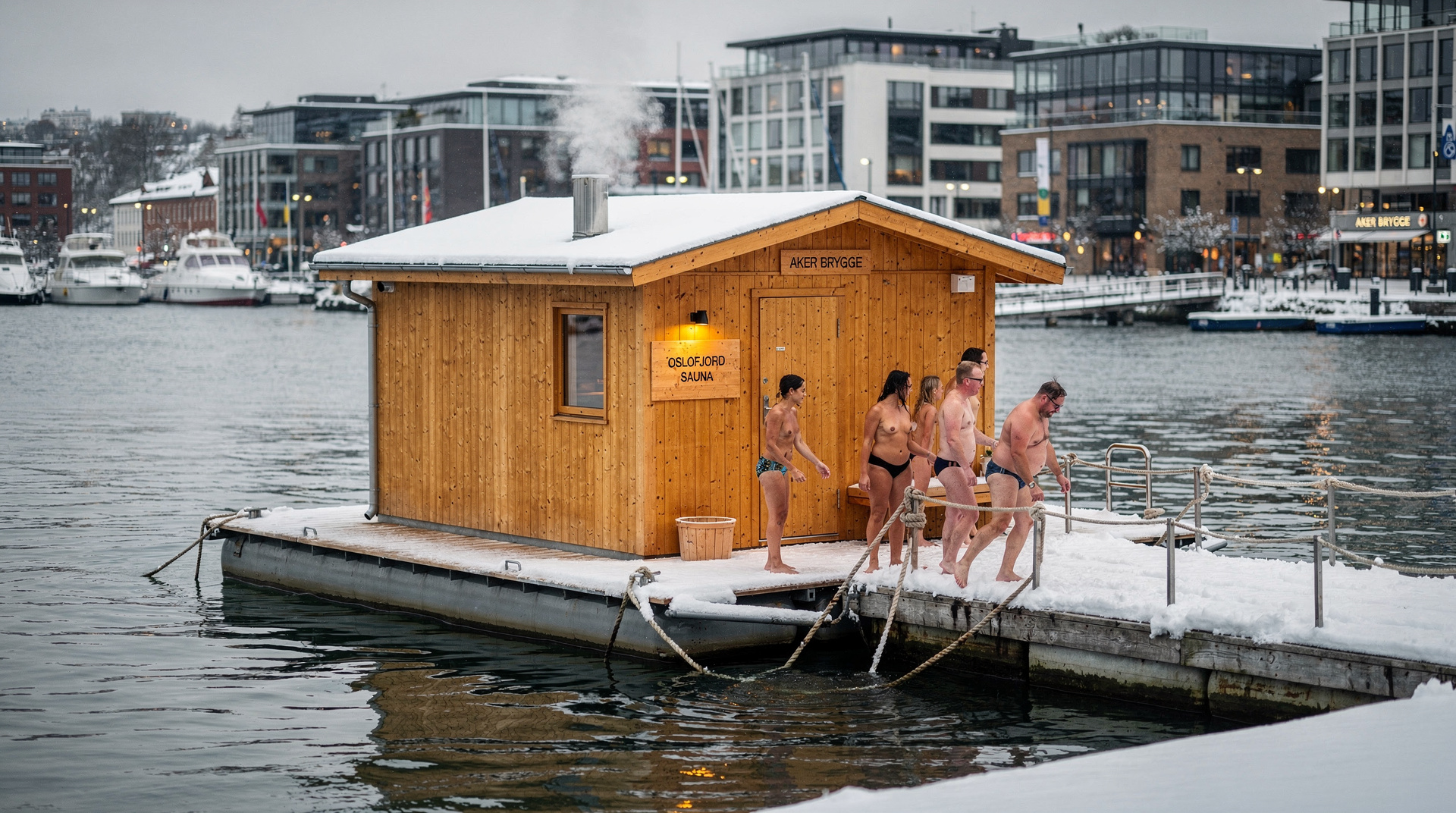
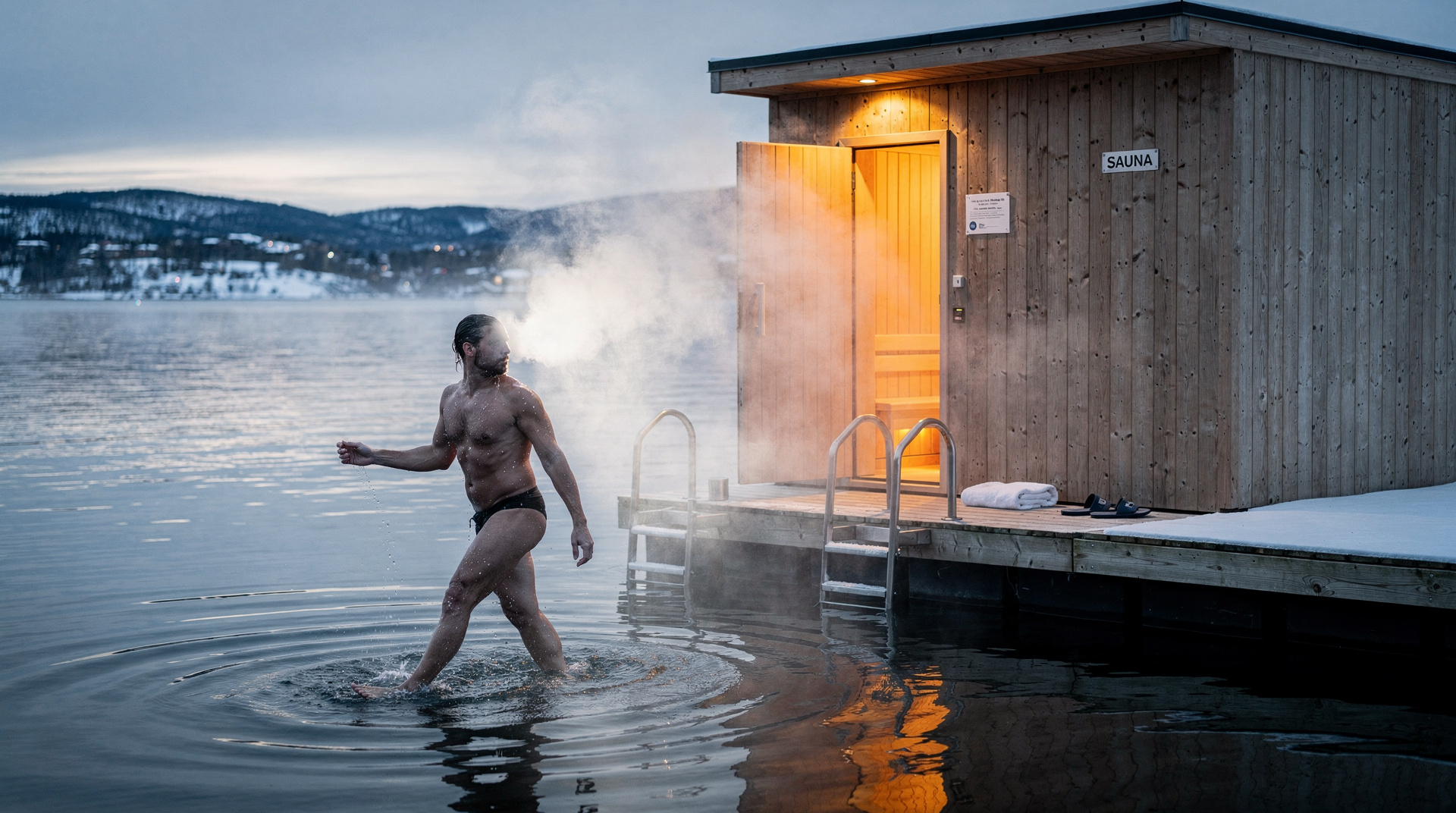
The fjord plunge is off the deck of the sauna boat itself. There is a ladder in the water for re-entry. In summer the jump is refreshing; in winter it is genuinely cold and genuinely invigorating. You do not have to jump — standing on the deck in the cold air between sauna rounds achieves the same cooling effect, and many guests do exactly that.
The price of around NOK 250 to 295 per adult (USD 27 to 32) covers the one-hour slot. This is good value by Oslo standards, where a gym session or a spa visit costs considerably more. Towel rental is available but it is better to bring your own. Lockers or bags can be stored in a small changing area; leave valuables elsewhere or in a locked bag.
The private sauna “Bragi”: what changes
The private session books the entire boat for your group — up to 8 people — for 1.5 hours. The price for the full boat runs around NOK 800 to 1 000 (USD 86 to 108), which divides reasonably among four or more people. For a couple it is harder to justify financially unless privacy matters greatly to you.
The practical benefit is flexibility: you control the temperature, the timing of your fjord plunges, and the atmosphere entirely. No strangers, no social calibration. This makes the private option the natural choice for a birthday celebration, a hen or stag party, a romantic evening, or simply a group of friends who want to make a proper occasion of it.
Bring your own drinks (non-alcoholic beverages are generally fine to bring; check current house rules when booking), snacks, and enough layers for afterward.
Winter versus summer: which season is better
Both are genuinely excellent, but for different reasons. In summer (June to August) the evening light at 21:00 or 22:00 is extraordinary — long shadows, warm gold tones over the water, the city visible in the background. The fjord water is cold enough to be refreshing (around 17 to 20 degrees) without being brutal. Sessions are more social and busy.
In winter (December to March) the combination is more extreme: a sauna at 90 degrees and fjord water at 4 to 5 degrees is a physiological jolt that is hard to describe accurately without experiencing it. The Oslofjord after dark in winter, with city lights and frozen-looking stillness, has an austere beauty. Sessions are quieter and the crowd tends toward committed regulars. Dress warmly for the walk to and from the sauna — the dock area is exposed.
The floating sauna operates year-round; the main thing that changes is daylight, temperature differential, and crowd composition.
The cold-water ritual: why it works
The health claims around cold-water immersion after sauna — improved circulation, reduced inflammation, mood-elevating adrenaline release — have attracted serious scientific interest in recent years, but for most people the appeal is simpler than that. Heat until you cannot bear more heat, then cold until you cannot bear more cold, then warm up again. The contrast is intensely pleasurable in a way that is difficult to explain in advance and immediately obvious in practice.
The body’s response to extreme cold water after a sauna is rapid: blood rushes to the core, breathing deepens involuntarily, the skin tingles. Most first-timers find the initial shock shorter than expected — typically 30 to 60 seconds of adjustment before the cold registers as invigorating rather than painful. After re-entering the sauna to warm up, the relaxation effect is pronounced.
The Oslofjord adds something that indoor cold-water plunge pools in wellness centres cannot replicate: the experience is in an actual fjord, with the city visible in the background, birds overhead, and the mild smell of salt and kelp in the air. This contextual reality is part of what makes the floating sauna feel like an authentic Oslo experience rather than an amenity.
Norwegian sauna etiquette: key points
Norwegian sauna culture is less formal than Finnish sauna culture but still has conventions worth knowing for first-time visitors:
Silence is generally respected in the sauna itself, particularly at busy periods. Quiet conversation is normal; loud groups are not appreciated by other bathers. If you are booking a public session, you are sharing a small, warm room with strangers — Norwegian social norms apply, which means giving people personal space and not commenting on their body or appearance.
On the question of swimwear: both swimwear and nudity are fully accepted at the Tjuvholmen floating saunas. There is no social pressure either way. Most international visitors wear swimwear; many Norwegians do not. Neither is awkward or commented upon.
Rinse with fresh water before entering the sauna if you have been using sunscreen or insect repellent. This is standard practice and considerate to other bathers.
Enter the fjord from the designated ladder or jump platform — do not climb on the mooring structure. Wait until you are clear of other people in the water before jumping.
For a full guide to sauna culture and etiquette in Oslo, see Oslo sauna etiquette.
What to do before and after
The Tjuvholmen neighbourhood itself is worth exploring before or after your sauna session. The Astrup Fearnley Museum of Modern Art (Tuesday to Friday 12:00 to 18:00, weekends 11:00 to 17:00, closed Mondays) sits directly adjacent and has some of the finest contemporary art in Norway. Admission is around NOK 150 per adult.
The Tjuvholmen allmenning — the public waterfront promenade and sculpture beach at the western point of the island — is Oslo’s most architecturally considered public space: commissioned art integrated into the paving, a small natural-looking beach, and views west across the fjord. It is free, open all the time, and worth 20 minutes of walking even without a museum or sauna visit.
Several cafés and restaurants line the Tjuvholmen waterfront. For a post-sauna meal, Kolonihagen at Frogner (accessible by tram 12) is a good mid-range option with a focus on Norwegian seasonal produce. The Aker Brygge waterfront restaurants are closer but vary widely in quality and price.
For the full landscape of Oslo sauna options — bathing houses, hotel saunas, and the various floating options compared — see Oslo saunas compared. The sauna and cold plunge guide goes deeper into the physiological and cultural aspects of the ritual.
Comparing the three booking options
The public floating sauna (oslo-public-floating-sauna) is the most accessible and affordable option. Best for solo travellers, couples, or anyone comfortable sharing an intimate space with a small group of strangers for an hour. The social element is part of the experience.
The private sauna “Bragi” (oslo-private-floating-sauna) books the whole boat for your group exclusively for 1.5 hours. Best for groups of 4 to 8, birthday celebrations, hen and stag parties, work offsites, or anyone for whom privacy is essential. The cost per person drops substantially as group size increases — for a group of 6 the per-person cost is only marginally more than the public session.
The floating sauna and fjord swimming experience (oslo-sauna-fjord-swim) from a nearby operator adds guided instruction in the sauna and cold-water ritual — useful if you want someone to explain the process, manage the timing of sauna rounds, and provide a more structured introduction to cold-water swimming rather than figuring it out independently. This is the best option for absolute first-timers who feel uncertain about the format.
Practical logistics
- Location: Tjuvholmen, western dock — signposted from Tjuvholmen allmenning; look for the boats moored off the end of the sculpture beach
- Getting there: tram 13 to Tjuvholmen stop (2 minutes’ walk); 10-minute walk from Aker Brygge; 20 to 25 minutes on foot from Oslo Central Station along the harbourfront
- Changing facilities: on-site, basic but functional; locker or hook storage; no valuables storage — leave expensive items elsewhere
- Towels: bring your own (this is standard and strongly recommended); rental available for a small fee
- Swimwear: optional; both swimwear and nudity are accepted at all sessions
- Booking: required in advance online; walk-in availability is extremely rare and only possible if a session has a last-minute cancellation
- Hours: approximately 07:00 to 21:00 (weekdays), 07:00 to 22:00 (weekends), with seasonal variation
For the broader picture of what Aker Brygge and Tjuvholmen offer — restaurants, the sculpture beach, the Astrup Fearnley Museum — see the Aker Brygge and Tjuvholmen guide.
Finally: the floating sauna is consistently one of the activities that visitors to Oslo say they wish they had known about and done. Its combination of cultural authenticity, dramatic setting, and accessible cost (relative to other Oslo activities) makes it a strong recommendation for almost any Oslo itinerary that includes at least two nights. Book as early as your plans allow.
Combining the sauna with other Tjuvholmen activities
A well-planned Tjuvholmen half-day might run: mid-afternoon at the Astrup Fearnley Museum, a slow walk around the sculpture beach and allmenning as the light softens toward evening, then a sauna session as dusk settles over the fjord — the changing light over the water is genuinely part of the experience, particularly in the shoulder seasons of April, May, September, and October when sunset happens at a civilised hour rather than the near-midnight glow of midsummer or the mid-afternoon dark of December. Finish with dinner at one of the neighbourhood restaurants, ideally booked ahead if it is a weekend evening.
Health considerations before you book
Sauna heat combined with cold-water immersion is generally safe for healthy adults, but a few groups should check with a doctor first: pregnant women, anyone with uncontrolled high or low blood pressure, heart conditions, or a history of fainting in heat. Alcohol before or during a sauna-and-plunge session is genuinely inadvisable — it impairs the body’s ability to regulate the extreme temperature swings safely and increases the risk of dizziness in cold water. If you feel lightheaded, nauseous, or unusually short of breath at any point, step out of the sauna, sit down, and tell a staff member or fellow bather rather than pushing through it.
First-timers sometimes find the initial cold shock more intense than anticipated psychologically, even though physically the adjustment period is short. Breathing steadily and deliberately as you enter the water — rather than gasping — makes the first 10 to 15 seconds noticeably more manageable. Most people find that after two or three rounds of heat and cold, the anxiety around the plunge disappears almost entirely.
Comparing the cost to Oslo’s other wellness options
At NOK 250 to 295 for an hour, the public floating sauna undercuts most conventional Oslo spa and wellness experiences by a wide margin — a single hotel spa session or day pass typically runs NOK 400 to 700, without the fjord setting. This makes the floating sauna one of the better value experiential activities in what is otherwise a consistently expensive city. Compared to a museum ticket (NOK 150 to 220) or a guided tour (NOK 600 to 900), the sauna sits at the accessible end of Oslo’s paid-activity spectrum while delivering an experience that most visitors rate as a genuine highlight rather than a filler activity.
Compare alternative tours
Frequently asked questions about Oslo floating sauna
How much does the public floating sauna cost?
In 2026 the public floating sauna at Tjuvholmen costs around NOK 250 to 295 per adult (approximately USD 27 to 32) for a 1-hour session. The private sauna 'Bragi' runs about NOK 800 to 1 000 for the whole boat for 1.5 hours. Book online in advance — walk-ups are rarely available.What is the water temperature?
The sauna interior reaches 80 to 95 degrees Celsius. The Oslofjord water is around 3 to 10 degrees Celsius in winter and 17 to 22 degrees in summer. The contrast between the sauna and the fjord plunge is the whole point.Do I need to bring anything?
Bring a towel (rental is available but limited), a swimsuit or be prepared to go without (both are accepted), flip-flops for the wet deck, and a change of warm clothing for after. The sauna provides a bench towel if you book online.Is nudity required or expected?
No. Swimsuits are completely normal and the majority of visitors, especially tourists, wear them. Going without is accepted but not expected. See the full Oslo sauna etiquette guide for cultural context.Can children use the floating sauna?
Children are generally permitted in the public sauna with adult supervision, though the fjord swimming area is unsupervised cold water. The private sauna option gives more control over who is in the sauna with you.How do I get to the floating sauna?
The saunas are moored at Tjuvholmen, a 10-minute walk from Aker Brygge or reachable on tram 13 (Tjuvholmen stop). The specific dock address is signposted from the Tjuvholmen allmenning sculpture beach.Is the floating sauna open year-round?
Yes, and winter is arguably the best season. Jumping into the fjord from a warm sauna when the water is 4 degrees and the air is 0 degrees is a genuinely memorable experience. Summer is lovely too but less dramatic.What is the difference between the public and private floating sauna?
The public session places you in a shared sauna with other guests. The private session 'Bragi' books the entire sauna for your group — up to 8 people. The private option is significantly more expensive but gives complete privacy and flexibility to come and go from the sauna and the fjord as you please.Is the floating sauna safe for weak swimmers?
The fjord plunge is optional and a ladder is always available for re-entry without swimming any distance. Weak swimmers or those uncertain about cold water can simply stand on the deck or dip briefly rather than swim; staff or fellow bathers are generally nearby to assist if needed.Should I eat before or after the sauna?
A light meal beforehand is sensible — sauna heat combined with an empty stomach can cause lightheadedness. Avoid a very heavy meal immediately before, since digestion and intense heat exposure together are uncomfortable. Many visitors save a proper meal for after, at one of the Tjuvholmen or Aker Brygge restaurants nearby.