Holmenkollen — ski jump & city views
Holmenkollen ski jump towers above Oslo with sweeping fjord views, a world-class ski museum, and forest hiking trails — summer and winter.
Oslo: 3-hour Holmenkollen ski jump hiking tour
Duration: 3 hours
- Panoramic views
- Local guide
Quick facts
- Best time to visit
- Year-round; March for the Ski Festival, summer for hiking, winter for skiing
- Getting there
- T-bane line 1 from Nationaltheatret to Holmenkollen station (about 30 min)
- Days needed
- Half a day (more for hiking or skiing)
- Budget
- NOK 160–250 (USD 17–27) for ski jump and museum entry; trails are free
High above the city, a structure built from Norwegian ambition
The Holmenkollen ski jump is visible from the fjord on clear days — a slender concrete arc rising above the forested hillside that forms Oslo’s western backdrop. It is one of Norway’s most recognisable structures and the site of an unbroken tradition of ski jumping competition since 1892. But calling Holmenkollen simply a ski venue undersells it: the hill above Oslo is also the gateway to the Nordmarka forest, a panoramic viewpoint that on clear days extends to the Swedish border, and the site of one of the world’s genuinely good sport-history museums.
The T-bane takes you there in 30 minutes from the city centre. It is one of the best half-day trips available from central Oslo, in any season.
| Where | T-bane line 1, western hills above Oslo |
| Getting there | T-bane to Holmenkollen station, about 30 minutes from the centre |
| Time needed | Half a day; longer for hiking, skiing, or the Ski Festival |
| Cost | Around NOK 160–250 (USD 17–27) for ski jump and museum; trails free |
| Best time | Year-round; March for the Ski Festival, summer for hiking |
Holmenkollen by season: what’s actually worth doing when
| Season | What’s open | Best activity |
|---|---|---|
| Winter (Dec–Mar) | Cross-country tracks, Korketrekkeren sledging, Tryvann alpine slopes | Ski or sledge, then warm up at Frognerseteren |
| March | Full winter programme plus the Ski Festival | Attend the festival if dates align — book months ahead |
| Summer (Jun–Aug) | Ski jump tower, Ski Museum, all hiking trails | Tower views plus a hike to Vettakollen or Frognerseteren |
| Autumn/Spring | Museum and tower year-round; trails muddy at the edges | Museum and a shorter forest walk |
Getting to Holmenkollen
T-bane line 1 (Frognerseteren direction) from Nationaltheatret or any central T-bane station takes you to Holmenkollen station in approximately 30 minutes. Trains run every 15 minutes or so from the centre. The journey is scenic in its own right — the line climbs through the hillside suburbs, emerging into forest before the Holmenkollen stop.
The station sits directly below the ski jump arena. From the platform to the jump base it is a five-minute walk. A Ruter single-journey ticket (NOK 42 / USD 4.50 via app) covers the journey, and the Oslo Pass includes all public transport.
The Holmenkollen ski jump
The current ski jump structure was rebuilt in 2010 for the FIS Nordic World Ski Championships. It is not a museum piece — it is the active venue for the Holmenkollen Ski Festival (held each March) and hosts World Cup ski jumping events regularly. The jump tower stands 64 metres above the landing slope; the hill record is over 140 metres.
Visitors can access the jump’s observation tower and the zip line attached to it (separate ticket, NOK 160 / USD 17 for the tower, more for the zip line). The views from the top of the jump are extraordinary: on a clear day you see the entire Oslofjord spread below, with the Swedish border hills on the eastern horizon. This is genuinely one of the best panoramic viewpoints in Oslo — more dramatic than Ekeberg and less obscured than Frognerseteren in summer.
Allow about 45 minutes for the tower visit.
The Ski Museum
Beneath the ski jump, the Ski Museum (Skimuseet) traces the history of skiing from its origins as a Norwegian practical skill (the world’s oldest ski fragment, found in Norway, is about 5 000 years old) through its evolution into sport and recreation. The exhibition covers every branch of Nordic skiing — cross-country, jumping, alpine — and includes the personal equipment of legendary Norwegian athletes: Bjørn Dæhlie, Gunde Svan, and others.
The museum also has a simulator where you can experience what a jump looks like from inside a ski jumper’s helmet (spoiler: terrifying). Entry is NOK 160 (USD 17) for adults, including access to the observation tower. The Oslo Pass covers both. Allow 60 to 90 minutes.
The Holmenkollen Ski Festival
Held every March (usually the first or second weekend of the month), the Holmenkollen Ski Festival is one of the longest-running annual sports events in the world — held without interruption since 1892 except during wartime. The combined programme includes cross-country races, biathlon, and the ski jumping competition that draws 50 000 to 70 000 spectators to the hillside.
Attending the festival is an exceptional Oslo winter experience: the crowd energy, the outdoor atmosphere, and the quality of the sport combine in a way that is essentially unique in European winter events. Tickets for the main jumping day sell out months ahead; cross-country and biathlon events are easier to access. Accommodation in Oslo during festival weekend must be booked well in advance. See our full Holmenkollen guide for festival planning details.
Hiking from Holmenkollen into the Marka
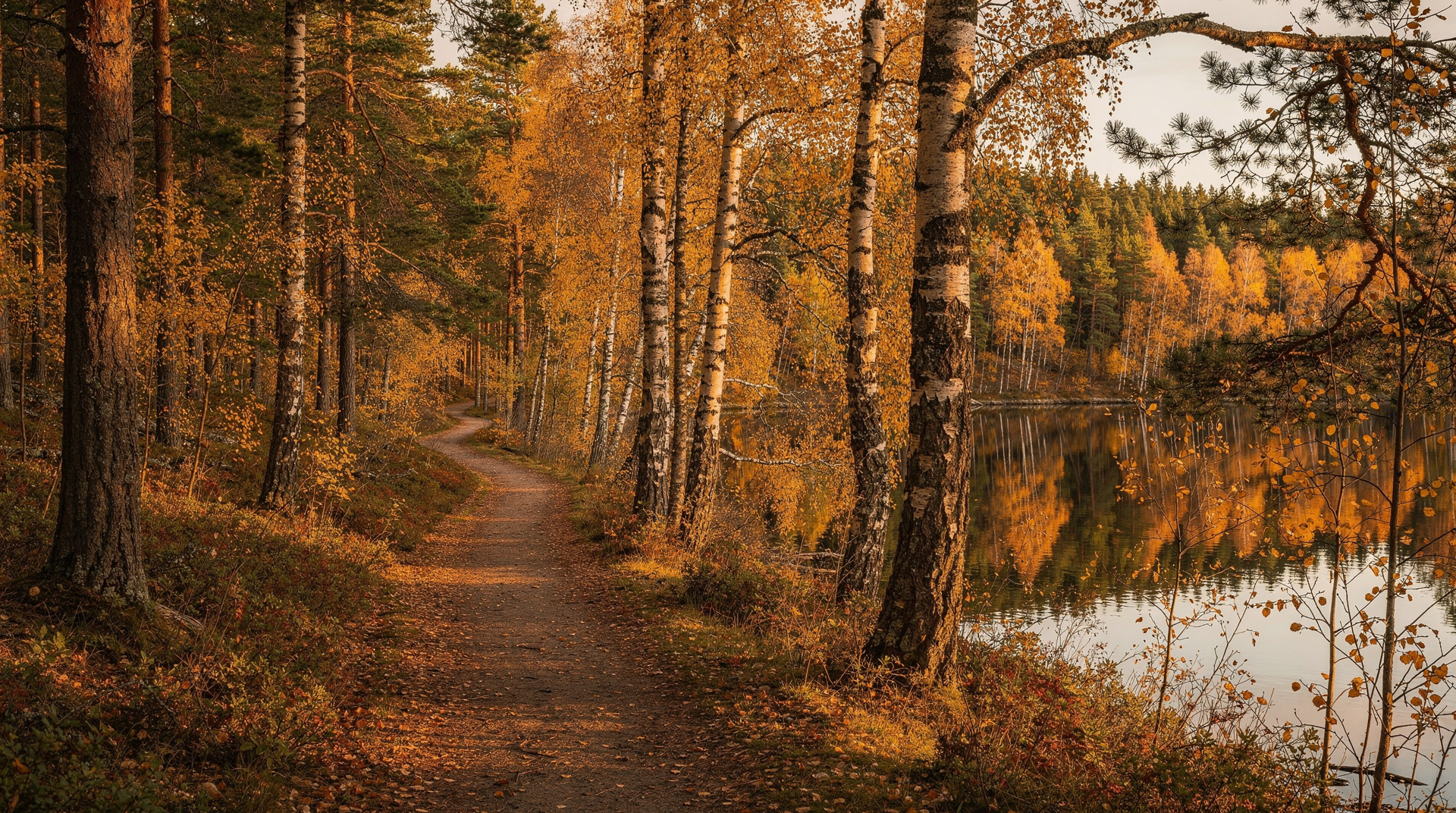
The Holmenkollen T-bane stop is one of the best entry points to the Nordmarka forest system — hundreds of kilometres of marked trails through mixed forest, past lakes, and along ridges with repeated fjord views. The transition from urban to forest happens within minutes of leaving the station.
Short loop (1.5–2 hours): the marked trail from Holmenkollen station to Voksenkollen and back through Frognerseter covers roughly 7 km with modest elevation gain. The restaurant at Frognerseteren (see below) sits at the midpoint.
Vettakollen (2–3 hours one way): one of Oslo’s classic viewpoints, reachable in about two hours from Holmenkollen on foot. The rocky summit at 544 metres offers views comparable to the ski jump tower but achieved under your own power. See the Vettakollen hike guide.
Full Nordmarka day: the trail network connects to Maridalsvannet, Sognsvann, and points north into deep forest. Multi-hour routes with the T-bane for return travel are well-documented in Norwegian hiking resources. See the Nordmarka guide.
Winter skiing: in winter, the hillside around Holmenkollen becomes a cross-country skiing hub with hundreds of kilometres of prepared groomed tracks (løyper). Ski rentals are available at the base. Lit night-skiing tracks operate until 10 pm on weekdays in winter. This is where Osloians actually ski — the Holmenkollen cross-country scene is nothing like an Alpine ski resort and much more accessible for beginners. See cross-country skiing in Oslo.
Korketrekkeren (the Corkscrew)
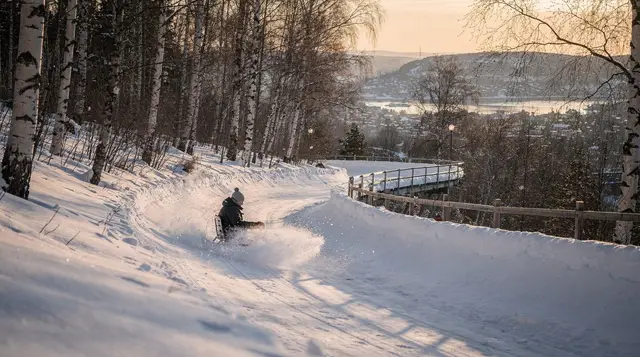
A few minutes’ walk from the Frognerseteren T-bane stop (one stop above Holmenkollen on line 1), Korketrekkeren is a 2 km toboggan run that operates in winter — roughly December through March, snow conditions permitting. You rent a small sled at the top and descend to the Midtstuen T-bane station below. The run winds through forest and achieves speeds up to 60 km/h on the steepest section.
It costs NOK 60 to 80 (USD 7–9) for a sled rental including the run; the T-bane back up is a regular Ruter ticket. This is one of the best family activities in Oslo in winter — genuinely exhilarating, cheap by Oslo standards, and using the T-bane as an integrated part of the experience. See Korketrekkeren guide for conditions and timing.
Frognerseteren restaurant and café
The Frognerseteren restaurant sits in a stave-church-inspired wooden building from 1891 at the end of T-bane line 1, about 10 minutes beyond Holmenkollen. It is one of Oslo’s most atmospheric dining venues: traditional Norwegian architecture, forest surroundings, fjord views from the terrace, and a menu focused on classic Norwegian food — reindeer, elk, fish, and excellent open sandwiches.
The restaurant is not cheap (dinner mains run NOK 300 to 480 / USD 32–52) but the setting justifies the visit. The adjacent café is more casual and less expensive for lunch. Particularly good in winter, when you can ski or hike to the restaurant and eat by the fire before returning by T-bane.
Panoramic bus and tour options
For those who prefer not to navigate independently, panoramic bus tours that include Holmenkollen as part of a wider Oslo circuit operate from the city centre throughout the year. These provide useful context for the ski jump’s history and the city’s relationship with the forest, though self-guided visits give more flexibility and time at each site.
Frequently asked questions about Holmenkollen
Is Holmenkollen worth visiting in summer?
Yes, strongly. The ski jump observation tower provides one of Oslo’s best panoramic views, the Ski Museum is excellent, and the forest hiking from the station is immediately accessible. Summer visits avoid winter’s limited daylight but also miss the obvious ski-related activities. The restaurant at Frognerseteren is particularly pleasant for lunch on a summer day with the terrace open.
How long does the T-bane take from Oslo centre to Holmenkollen?
About 25 to 30 minutes from Nationaltheatret, or 30 to 35 minutes from Oslo S. T-bane line 1 runs every 15 minutes from the centre. The journey passes through the hillside suburbs and into forest — it is a scenic ride in its own right.
Can you ski at Holmenkollen?
You can ski cross-country in the surrounding Nordmarka forest, with extensive groomed tracks accessible from the Holmenkollen area. The ski jump itself is for competitive jumping only. The nearest downhill ski slopes are at Tryvann (a short distance away by T-bane), though serious Alpine skiing generally requires a day trip to larger resorts. See ski day trips from Oslo.
Is the zip line at the ski jump worth it?
If you are comfortable with heights and are looking for an adrenaline experience, the zip line from the top of the jump to the landing area is a distinctive Oslo activity. At around NOK 350 to 400 (USD 38–43), it is one of the more expensive per-minute activities in the city, but the combination of speed, height, and the visual spectacle of the jump’s trajectory makes it memorable. The observation tower visit (included in the basic ticket) is sufficient for those who simply want the panorama.
When is the Holmenkollen Ski Festival?
Usually the first or second weekend of March, with the main jumping competition on Sunday. The cross-country and biathlon events run across the preceding week and weekend. The exact dates vary annually — check the official Holmenkollen programme at holmenkollen.com. Oslo accommodation books up during festival week; plan at least three to four months ahead for popular accommodation.
The Holmenkollen arena and the ski jump: architecture and engineering
The 2010 ski jump structure, designed by the Norwegian firm JDS Architects, replaced a previous structure that had itself been rebuilt more than 15 times since 1892. The challenge was always the same: how do you extend the hill profile to match ever-longer jumping distances while maintaining the visual relationship between the jump and the city below?
The current structure uses a sweeping steel and concrete arc that has been compared to a breaking wave or an airplane wing seen in profile. The K-point (the design landing point) is at 120 metres; the hill record exceeds 140 metres. The take-off table sits 64 metres above the landing slope.
The observation tower above the take-off point is accessible to visitors by elevator (included in the basic ticket), and the exposed platform at the top gives you approximately the same view a ski jumper sees in the final moments before takeoff. Looking down at the landing slope from that height, at the small crowd gathered at the base and the city spread behind them down to the fjord, is genuinely vertiginous even for the non-competitive visitor.
Tryvann and the winter sports cluster
About 10 minutes’ walk from Holmenkollen station, Tryvann is Oslo’s nearest downhill ski facility, with several marked Alpine runs and a ski lift. It is modest by Alpine resort standards — the vertical is limited and the infrastructure minimal — but it is used intensively by Osloians who want to ski on weekday evenings without a two-hour drive. Lift tickets run around NOK 300 to 370 (USD 32–40) per day. Rental equipment is available. Operating season: approximately December through March, depending on snow.
The broader Holmenkollen-Tryvann area is also where Oslo’s most serious cross-country skiers train. The groomed track system extends for hundreds of kilometres into Nordmarka; many tracks are lit for evening skiing. The Skimore.no app tracks current track conditions and lit sections.
Viewpoints above Holmenkollen
Several natural viewpoints within reasonable hiking distance of Holmenkollen station offer perspectives over Oslo that are less visited than the ski jump tower.
Voksenkollen: a plateau to the north of the ski jump, accessible by T-bane (one stop beyond Holmenkollen on line 1) or on foot via a 45-minute trail. The view from here looks south over the jump and the city — a perspective that shows the relationship between the built city, the forested hills, and the fjord simultaneously.
Frognerseteren: at the end of T-bane line 1, the Frognerseteren plateau sits at 460 metres above sea level with panoramic views. The restaurant is excellent for lunch (see above); the surrounding trails lead north into the deeper Nordmarka forest.
Tryvannstårnet: the television and mobile transmission tower on Tryvannsåsen is the highest point in the Oslo region at 529 metres above sea level. The tower itself is not generally accessible to the public, but the ridge it stands on is reachable on foot from Holmenkollen or from Frognerseteren in about 90 minutes and offers 360-degree views in good conditions.
Winter snowshoeing and guided outdoor experiences
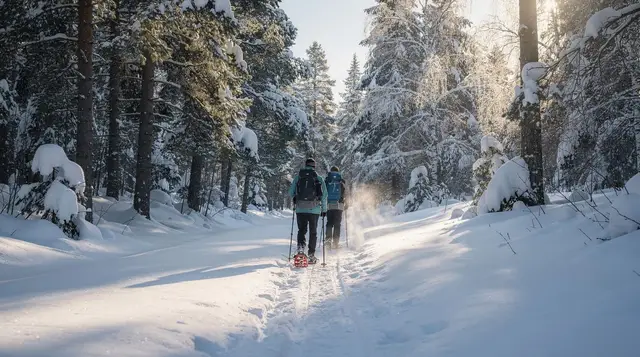
For visitors without skiing experience or equipment, snowshoeing in the Nordmarka hills accessible from Holmenkollen is an excellent winter alternative. No prior experience is needed; guided tours provide snowshoes, poles, and instruction, and cover 4 to 8 km through terrain that is entirely different in character from anything accessible in the summer city. See snowshoeing near Oslo guide.
Getting the most from a Holmenkollen visit
Half-day summer visit (recommended): T-bane line 1 from Nationaltheatret to Holmenkollen station, ski jump and Ski Museum (allow 90 to 120 minutes), lunch at Frognerseteren restaurant (one more T-bane stop), short forest walk on the marked trails, return by T-bane. Total travel plus visit: around four to five hours.
Winter day: same approach, but swap the forest walk for cross-country ski hire and 2 to 3 hours on the groomed tracks. The lit evening tracks mean this also works as a late-afternoon visit after daytime sightseeing in the city centre.
Full hiking day: depart from Holmenkollen station and follow the marked trail to Vettakollen, continuing to Sognsvann lake (4 to 5 hours total). Return by T-bane from Sognsvann station. See Vettakollen hike guide.
For a well-structured winter Oslo programme, see the winter 3-day Oslo itinerary and Oslo in winter guide.
Is Holmenkollen worth it if you’re only in Oslo for one day?
If your Oslo time is genuinely limited to a single day, Holmenkollen competes directly with Vigeland Park and the city centre for your remaining hours, and honestly loses that contest for most first-time visitors — those two are closer to the centre and cover Oslo’s headline sights faster. Holmenkollen earns its place on a two-day-or-longer visit, or for anyone who specifically cares about winter sports, panoramic views, or forest hiking over museums and architecture. See the 1-day Oslo itinerary for how the trade-offs typically get made.
Top experiences
Bookable activities with verified prices and instant confirmation on GetYourGuide.