Best museums in Oslo for kids: Fram, Kon-Tiki, Viking Planet and more
Oslo: The Viking Planet entry ticket with VR movie
Duration: Flexible
- VR experience
- Family friendly
Which Oslo museums are best for children?
Top picks: Fram Museum (board a real polar ship, best for ages 5+), Viking Planet (VR experience, best for ages 7–14), Norsk Folkemuseum (outdoor folk museum, best for ages 4+), and Teknisk Museum (hands-on science, best for ages 6+). All are accessible by public transport and covered by the Oslo Pass.
Oslo’s best museums for children: the honest ranking
Oslo has a genuinely strong museum scene — some of the best collections in Scandinavia — but not all of it translates well for children. The Munch Museum is extraordinary for adults and baffling for most under-12s. The National Museum of Art is magnificent and best experienced by people who will stand quietly in front of large canvases. Neither is a bad museum; both are wrong for family mornings.
This guide focuses on the Oslo museums that specifically work for children, with honest assessments of what age groups they suit, how long to allow, and whether the Oslo Pass or individual tickets make more financial sense. The Viking Ship Museum gets a separate note — it is closed until approximately 2027, and options in the interim are covered below.
| Where | Mostly Bygdøy peninsula, plus Rådhusplassen (Viking Planet) and Kjelsås (Teknisk Museum) |
| Best age range | 4–14, varies by museum (see below) |
| Cost | NOK 75–285 per person; free with Oslo Pass |
| Time needed | 2–4 hours for a Bygdøy museum day |
| Getting there | Bus 30 from Nationaltheatret (year-round); seasonal ferry from Aker Brygge |
Fram Museum: the best single Oslo museum for families
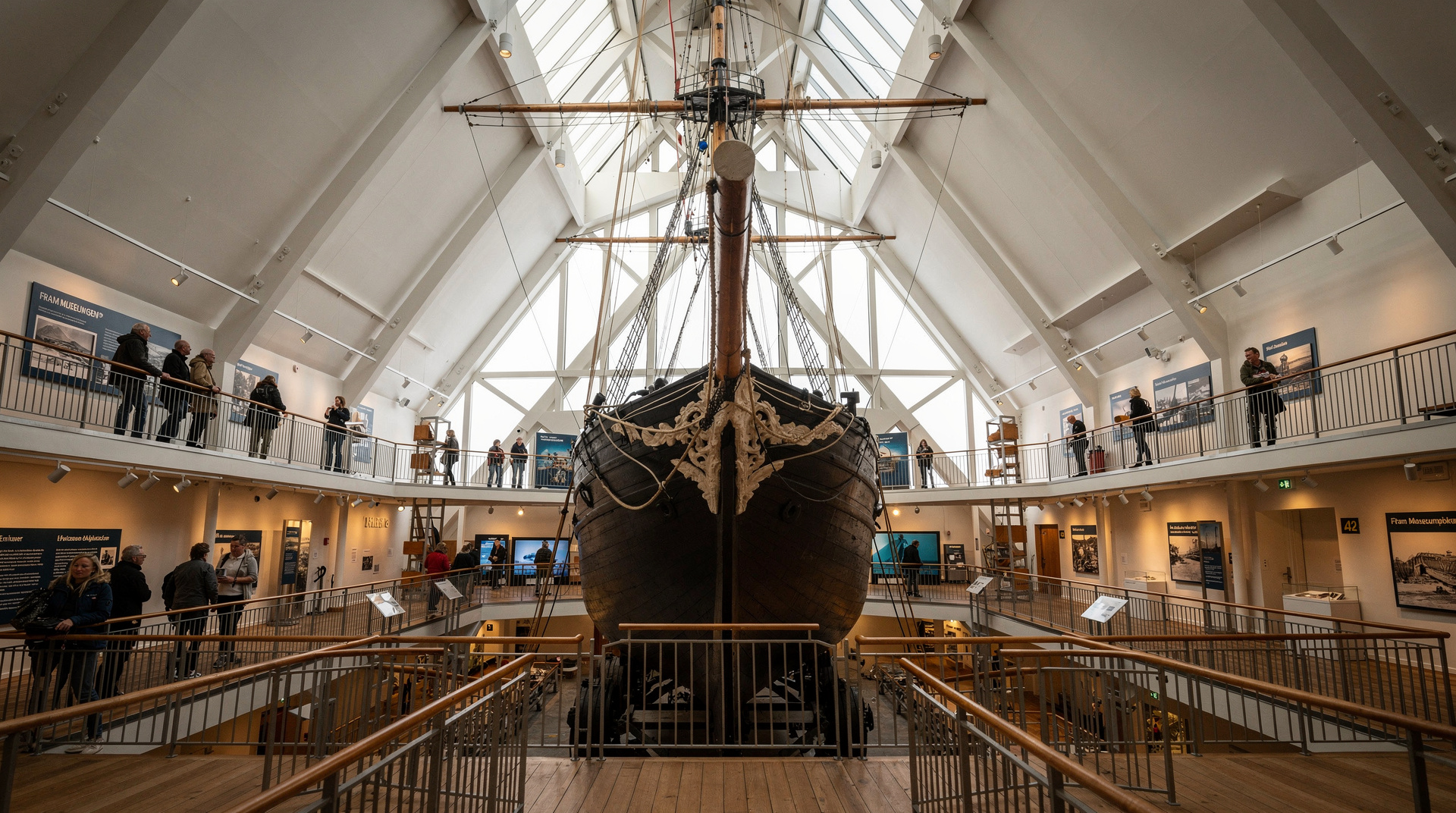
Frammuseet on Bygdøy earns a straightforward recommendation as Oslo’s top family museum. The reason is simple: the actual ship Fram — the polar exploration vessel that carried Fridtjof Nansen toward the North Pole in 1893 and Roald Amundsen to the Antarctic in 1910–1912 — is inside the building, fully accessible, with gangplanks you cross to board it and cabins you can enter.
Children can sit in the crow’s nest (a reconstruction), turn the ship’s wheel, and stand on deck while looking down at the museum displays below. The exhibits on the deck explain the expeditions with maps, equipment, and photographs. Below deck, the tiny crew cabins — genuinely small, with bunks, personal items, and the smell of wood and old varnish — make the human reality of polar exploration tangible in a way that no interpretation board can achieve alone.
The museum works for children as young as 4 or 5 (the gangplank and ship climbing is exciting at any age) and is engaging up to adulthood. The primary sweet spot is ages 7–14 — old enough to understand the expedition narrative and young enough to be genuinely excited about climbing a ship. Allow 75–90 minutes.
Entry: NOK 185 (USD 20) adults, NOK 85 (USD 9) children 4–16, under 4 free. Free with Oslo Pass.
Getting there: Bus 30 from Nationaltheatret, stop Bygdøynes. Or walk/cycle the waterfront (3 km from Aker Brygge). See the Bygdøy destination guide.
Norsk Folkemuseum: outdoor history with children in mind
The Norwegian Folk Museum is the largest open-air museum in Norway, covering 14 hectares of the Bygdøy peninsula. Over 150 historic buildings — farmhouses, stave church, urban townhouses, a Sami camp — were relocated from across Norway and arranged in a permanent outdoor exhibition of Norwegian vernacular architecture from the 13th century to the 20th.
For children, this is primarily a space to move through rather than study. The buildings are genuinely old and interesting; the stave church (from about 1200) is one of the most beautiful wooden structures in the country. But what holds children’s attention most is the demonstration areas — in summer, staff demonstrate traditional crafts (bread-baking, wool spinning, blacksmithing), sometimes with horses or farm animals visible in the farmyard sections. The outdoor space means children can run between buildings rather than having to walk quietly.
In summer (June–August), the full museum is active — demonstrations, folk dance shows, most buildings accessible. In winter, many outdoor areas close and the experience is primarily the indoor Ibsen exhibition and a few key buildings. Summer is the right time for family visits.
The museum is large enough that you could spend 3–4 hours without exhausting it. A good family pacing is 2–2.5 hours, combining the stave church, one or two farmstead clusters, and the demonstration areas.
Entry: NOK 220 (USD 24) adults, NOK 110 (USD 12) children 6–17, under 6 free. Free with Oslo Pass.
Getting there: Bus 30 from Nationaltheatret, stop Bygdøy (before Bygdøynes). A 10-minute walk from the Fram Museum.
Viking Planet: interactive Vikings when the real museum is closed
The Museum of the Viking Age (historic Viking Ship Museum) at Bygdøy is closed for renovation until approximately 2027. Until it reopens, Viking Planet at Rådhusplassen in central Oslo is the main Viking-focused attraction the city offers, and it has been deliberately designed as an interactive replacement rather than a passive exhibition.
The key attraction for children: VR headset experiences that place you inside a virtual Viking Age Norway — sailing a longship, experiencing a raid, navigating Norse mythology. The films are produced specifically for this context and are impressive by the standards of museum VR. Children aged 7 and up typically find this genuinely exciting rather than gimmicky.
Beyond the VR, there are reconstructed environments, a combat simulator, and exhibits on Norse culture and exploration. The museum acknowledges the difference between the popular “horned helmet” Viking mythology and actual Norse culture, which is handled well for families wanting both entertainment and some accuracy.
The honest comparison: Viking Planet is more exciting and interactive than a traditional museum and less historically rigorous. For the authentic Viking ship experience (the preserved Oseberg and Gokstad ships), you’ll need to wait for the Museum of the Viking Age to reopen, or visit the Kulturhistorisk Museum’s Viking collections. See the Viking Planet guide for full details.
Entry: NOK 285 (USD 31) adults, NOK 150 (USD 16) children 6–16, under 6 free. Free with Oslo Pass.
Getting there: Walking distance from Aker Brygge and the Nobel Peace Center. Tram 12 to Aker Brygge then 5 minutes on foot.
Teknisk Museum: the best hands-on science museum
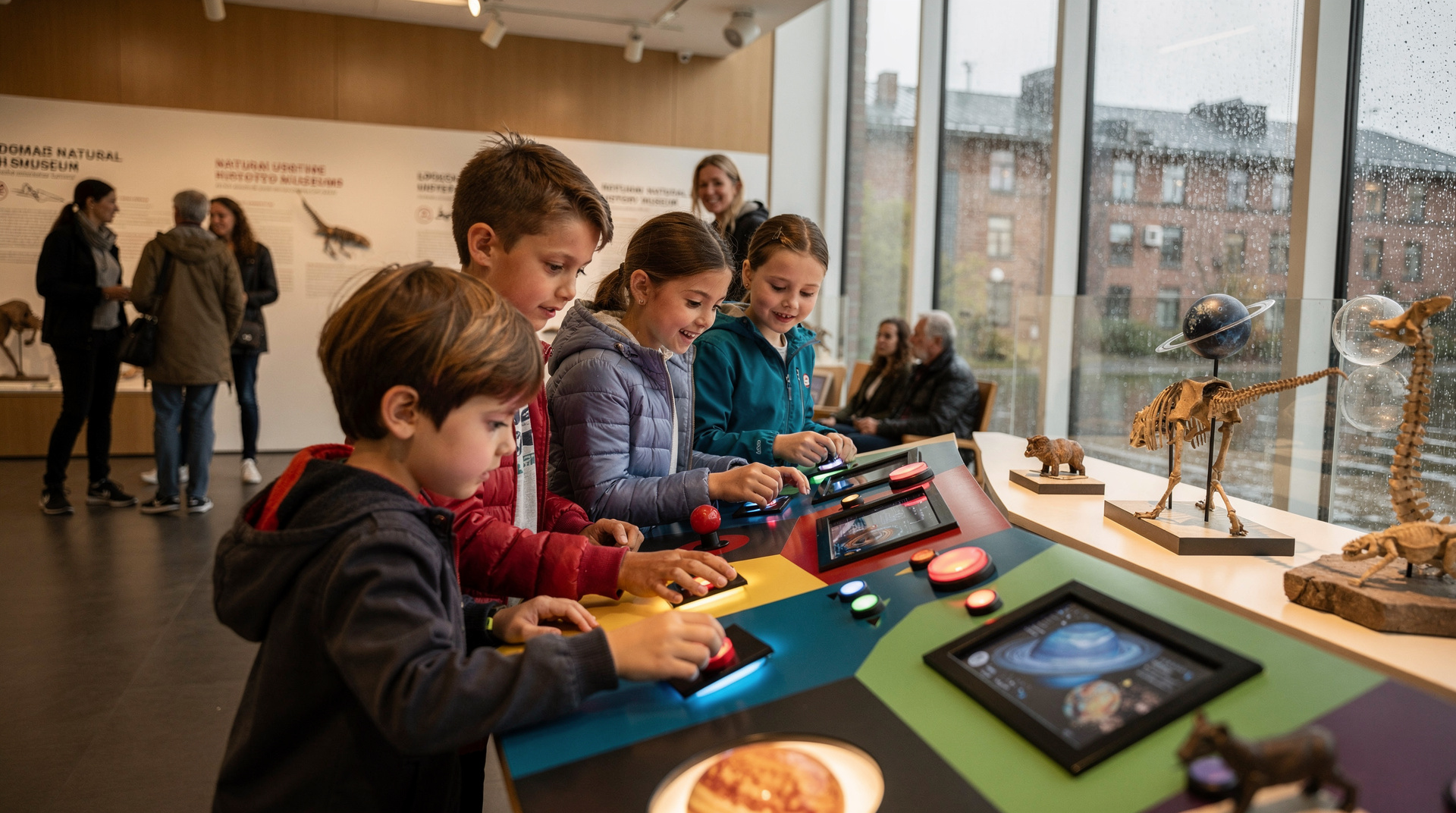
The Norwegian Museum of Science and Technology (Teknisk Museum), about 6 km north of the city centre at Kjelsås, is the most physically interactive museum in Oslo and often the one children remember most enthusiastically. The exhibits run from industrial history to digital technology, but the defining feature is that almost everything can be touched, operated, or explored.
Specific highlights for children:
- The energy hall, where you can run experiments with water, wind, and electricity
- The transport exhibition, with vehicles to climb on and interactive controls
- The IT and digital history section — surprisingly engaging for children who live entirely within digital technology and have never considered its physical history
- The space section, with models and simulators
Teknisk Museum suits ages 5–14 best. Children under 5 can use the interactive elements but the narrative context is too complex. Teenagers often get more from it than they expect — it’s not as “childish” as the exterior suggests.
The museum is a 15-minute metro ride from the city centre (metro line 5 direction Ellingsrudåsen or Vestli, stop: Kjelsås, then 5 minutes on foot). This makes it slightly less convenient than Bygdøy but not difficult. Allow 2–2.5 hours.
Entry: NOK 195 (USD 21) adults, NOK 75 (USD 8) under 16, under 3 free. Free with Oslo Pass.
Kon-Tiki Museum: best for older children with an adventure bent
The Kon-Tiki Museum on Bygdøy houses the original balsa raft Kon-Tiki — on which Thor Heyerdahl and five crew members crossed the Pacific from Peru to Polynesia in 1947 — plus the Ra II papyrus reed boat from the 1970 Atlantic crossing. The expeditions were extraordinary and the vessels are physically impressive.
For children, the museum works best for ages 10 and up who can engage with the narrative: understanding why someone would attempt an ocean crossing on a raft made of logs requires some historical and geographical context that younger children often don’t have. When the story lands, though, it lands hard — Heyerdahl’s expeditions are objectively one of the more dramatic pieces of 20th-century adventure history.
Children under 9 will find the Kon-Tiki impressive as a physical object but may not be engaged by the exhibition content. The visit is relatively short (45–60 minutes) and fits naturally with a Bygdøy day that includes Fram and Norsk Folkemuseum.
Entry: NOK 160 (USD 17) adults, NOK 80 (USD 9) children, under 4 free. Free with Oslo Pass. See the Kon-Tiki Museum guide for the full exhibit description.
Historical Museum: for the Viking artefacts while the big museum is closed
The Kulturhistorisk Museum (Museum of Cultural History) on the University of Oslo campus holds the national collection of Viking Age artefacts — jewellery, weapons, everyday objects, and the context for the ship burials that make Norway’s Viking heritage significant. This is where serious Viking history lives while the Museum of the Viking Age remains closed.
For children, the museum is more demanding than Viking Planet — it requires engaging with display cases and reading interpretation boards rather than wearing VR headsets. The artefacts are genuinely extraordinary; the challenge is whether the children you’re with can engage with static displays. Best for ages 10 and up with an interest in history. The mummy room (Egyptian collection) unexpectedly fascinates many children.
Entry: Free. Open Tuesday–Sunday. See the Historical Museum guide.
Building a museum day on Bygdøy
The natural combination for a single day is:
- Morning: Fram Museum (90 minutes) — board the ship, read the polar expedition story
- Lunch: picnic on the Bygdøy grass or the museum café
- Afternoon: Norsk Folkemuseum (2 hours) — outdoor farm circuit, stave church, demonstrations
This covers the two best family museums without overloading. Add Kon-Tiki (45 minutes) between them if energy allows — it’s a 10-minute walk between Fram and Kon-Tiki.
Bus 30 from Nationaltheatret serves both museums; the stops are Bygdøy (for Norsk Folkemuseum) and Bygdøynes (for Fram and Kon-Tiki, 5 minutes further). The return bus runs until around 11pm. The full Oslo with kids guide sequences the museum visits into a broader multi-day family itinerary.
Oslo Pass for museum visits: does it make sense?
For a family planning 2–3 museum days:
- 2 adults, 2 children (ages 8 and 11)
- Oslo Pass adult: NOK 695 (USD 75) for 48 hours
- Children under 16 enter free with paying adult
Calculation for Bygdøy day: Fram (NOK 370 for 2 adults), Norsk Folkemuseum (NOK 440 for 2 adults), transport (NOK 238 for 2 Ruter day passes) = NOK 1,048 without pass vs NOK 1,390 for 2 adult 48-hour passes. The pass pays off with 3 museums and full transit use.
Use the Oslo Pass calculator with your specific museum list for an accurate comparison. The Oslo Pass guide explains what the pass includes and excludes.
Food and breaks on a Bygdøy museum day
Bygdøy has limited food options compared to central Oslo, so plan around what’s actually there rather than assuming you’ll find something spontaneous. The Fram Museum and Norsk Folkemuseum both have on-site cafés serving simple Norwegian lunch fare (open sandwiches, waffles, soup) at NOK 90–160 (USD 10–17) per person — reasonable by Oslo standards. Bringing a picnic is also easy: Bygdøy has grassy areas near both museums, and a supermarket picnic for a family of four typically costs NOK 200–300 (USD 22–32), noticeably cheaper than two café stops.
Build in a genuine break between museums rather than rushing straight from one to the next. Children under 8 in particular do better with 20–30 minutes of unstructured outdoor time — the Bygdøy grass areas and the short walk between sites work well for this — before the next round of exhibits.
Age-by-age quick picker
If you only have time to choose one or two museums, use age as the deciding factor:
| Age | Best pick | Why |
|---|---|---|
| Under 5 | Norsk Folkemuseum | Outdoor space, farm animals, room to run |
| 5–9 | Fram Museum | Climbable ship, no reading required |
| 7–14 | Viking Planet | VR immersion holds attention longest |
| 10+ | Kon-Tiki Museum or Historical Museum | Narrative and artefacts reward context |
This table is a starting point, not a rule — a curious 6-year-old can love the Kon-Tiki raft, and a bored teenager can find the Fram genuinely exciting. Match the museum to the specific child where you can.
Rainy day museum backup
Oslo’s weather changes quickly, and a wet day changes the calculus for Bygdøy — the walk between museums and the bus stops is outdoors. On a genuinely wet day, consider swapping toward museums with more continuous indoor space, like Teknisk Museum, or check the dedicated rainy day museums guide and rainy day with kids guide for a fuller wet-weather plan. Bygdøy itself is still workable in rain — the museum interiors are the point — but pack proper rain layers for the walk between Fram and Norsk Folkemuseum.
How this fits a longer Oslo trip
A single Bygdøy museum day works well as one day within a longer family stay. The Oslo with kids guide sequences a full multi-day family itinerary, and the Oslo’s best museums ranked guide places these family picks alongside the adult-oriented collections (Munch Museum, National Museum) for parents wanting to fit in a museum visit without children in tow. The Bygdøy destination guide covers the peninsula’s beach and café options for combining museums with downtime.
Frequently asked questions about Best museums in Oslo for kids
Are Oslo museums suitable for very young children?
Yes, several work well for under-5s. The Norsk Folkemuseum's outdoor spaces, farm animals, and historic buildings engage toddlers well. The Fram Museum's ship is visually exciting for any age. Teknisk Museum has interactive elements suitable from about age 3–4. The Munch Museum and National Museum are less suited to young children.What is the Viking Ship Museum status?
The original Viking Ship Museum at Bygdøy is closed for major renovation and is not expected to reopen until approximately 2027, under the new name Museum of the Viking Age. In the meantime, Viking Planet in central Oslo offers an interactive VR-based Viking experience. For authentic Viking artefacts, the Historical Museum at the University of Oslo has significant collections.Do Oslo museums offer family tickets or discounts?
Most Oslo museums offer discounted children's rates (typically 40–50% of adult price) and some offer family tickets for 2 adults and 2–3 children. The Oslo Pass gives free entry to most museums for children under 16 when accompanied by a paying adult Oslo Pass holder — this is often the best family discount.How much does it cost to visit Oslo museums with children?
Typical adult museum entry: NOK 160–285 (USD 17–31). Children's rates: NOK 75–150 (USD 8–16). A family of four without any pass would spend NOK 600–900 (USD 65–97) per major museum. With the Oslo Pass, children under 16 enter free with a paying adult.Can you do multiple museums in one day on Bygdøy?
Two museums in one Bygdøy day is very manageable. Three is possible but tiring for children under 10. The recommended combination is Fram Museum (90 minutes) plus Norsk Folkemuseum (2–3 hours), which covers the maritime-polar and cultural heritage respectively. Add Kon-Tiki (45 minutes) if energy allows.
Top experiences
Bookable activities with verified prices and instant confirmation on GetYourGuide.