Oslo Airport to city centre: every transfer option compared
Oslo: Oslo Pass with public transport and free museum entry
Duration: 24-72 hours
- Instant confirmation
- Free public transport
- Skip museum queues
What is the best way to get from Oslo Airport (OSL) to the city centre?
For speed, take Flytoget (airport express train): 19 minutes to Oslo S, NOK 243 (USD 26). For value, take the Vy regional train: 25–30 minutes to Oslo S, NOK 124 (USD 13). Both depart from the same underground station at Gardermoen and arrive at Oslo S (Central Station). Taxis cost NOK 700–900 (USD 75–97) and are rarely worth it for solo travellers.
Finding the train at Oslo Gardermoen Airport
| Fastest option | Flytoget, 19 min, around NOK 243 |
| Best value | Vy regional train, 25–30 min, around NOK 124 |
| Distance | ~47 km / 29 miles north of the city centre |
| Frequency | Every 10–20 minutes, both operators |
| Ruter zone | Airport is zone 4V — separate ticket needed |
Oslo Gardermoen Airport (OSL) is one of the most straightforward major airports in Europe for getting into the city. The train station sits directly below the terminal building — follow signs for “Tog” (train) from arrivals. Both Flytoget and Vy regional trains depart from the same underground platforms. You do not need to take a shuttle bus or exit the building to reach the trains.
The airport is roughly 47 km north of Oslo city centre, and the city skyline is visible on the approach from the south. Getting there without a car is genuinely easy.
The train from Gardermoen suits most arrivals, but a private transfer can make more sense if you land late, travel with a group or carry heavy bags to an address away from the station. Compare the fixed price against the combined train fares for everyone in your party, and give the driver your flight number so a delay does not leave you waiting. You can reserve a car to the city through Kiwitaxi for an Oslo transfer.
Option 1: Flytoget (airport express train)
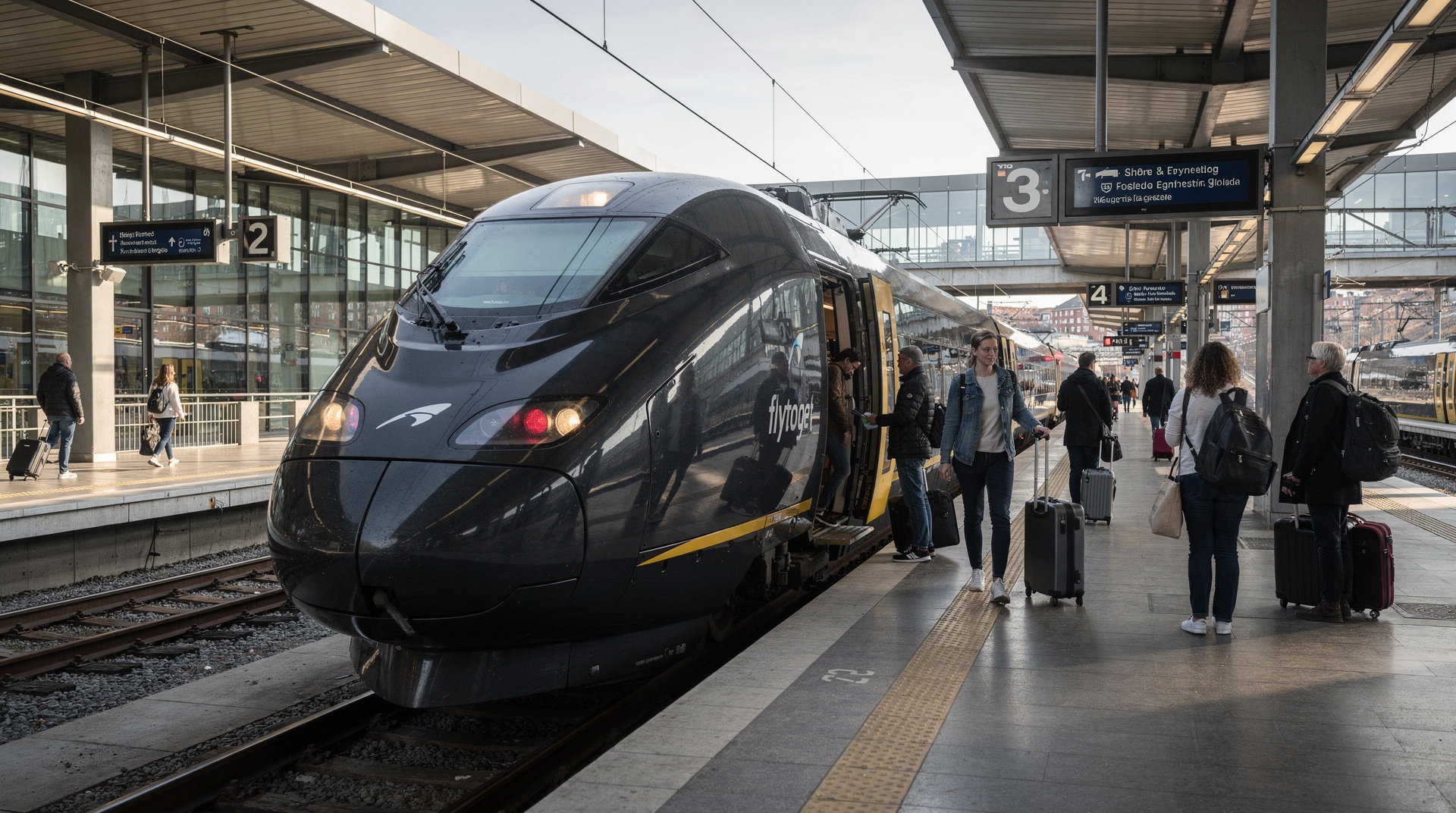
Time: 19 minutes to Oslo S (Central Station) Frequency: Every 10 minutes during the day Price: NOK 243 / USD 26 one-way (standard adult, 2026) Advance booking: Not required; buy at machines in the terminal, at the Flytoget desk, or via the Flytoget app Notes: Free Wi-Fi, power outlets at each seat, dedicated luggage racks. The trains are clean, modern, and punctual.
Flytoget is the clearest choice if speed matters above all. The 19-minute journey to Oslo S is the fastest available, and the service runs from around 05:30 until 00:30. At NOK 243, it is not cheap, but the time saving over the Vy train is about 10 minutes — worth it if you’re catching an onward connection.
Flytoget also stops at Oslo Airport Gardermoen, Lillestrøm, and Oslo S. A small number of services continue to Nationaltheatret (one stop west of Oslo S), useful if you’re staying near Aker Brygge or the Royal Palace area.
Who it suits: Business travellers, people with tight connections, travellers who value predictability and speed.
Option 2: Vy regional train
Time: 25–30 minutes to Oslo S Frequency: Every 10–20 minutes depending on the hour Price: NOK 124 / USD 13 one-way (standard adult, 2026, booked in advance or via app) Advance booking: App or ticket machine; no advance booking required but app booking is slightly cheaper Notes: Same platforms as Flytoget; slightly older rolling stock on some services; also stops at Eidsvoll, Dal, and Lillestrøm on some routes.
The Vy regional train is the most popular choice for cost-conscious travellers. At roughly half the price of Flytoget and only 6–10 minutes slower, it is excellent value. The trains are perfectly comfortable and the journey is the same scenic approach into Oslo.
One practical point: on some Vy trains, you need to choose the correct service. The L12 Vy line to Oslo S is the direct service. Slower trains to Oslo S via more stops also run on the same track — check the departure board for your train’s exact stopping pattern.
Who it suits: Solo travellers, families, budget-conscious visitors, anyone without a tight connection.
Head-to-head comparison
| Flytoget | Vy regional | |
|---|---|---|
| Time to Oslo S | 19 min | 25–30 min |
| Price (single adult) | NOK 243 / USD 26 | NOK 124 / USD 13 |
| Frequency | Every 10 min | Every 10–20 min |
| Wi-Fi | Yes | Yes (on newer trains) |
| Luggage space | Dedicated racks | Standard overhead/end |
| Accepts Ruter pass? | No | Some zone configurations |
For a deeper analysis, see the dedicated Flytoget vs Vy comparison guide.
Option 3: Flybussen airport bus
Time: 45–60 minutes to Oslo Bussterminal Frequency: Every 20–30 minutes Price: NOK 149–199 / USD 16–21 one-way Notes: Drops at multiple hotels and stops in the centre; useful if your accommodation is not near Oslo S.
The bus is slower due to traffic, especially during morning (07:00–09:00) and evening (16:00–18:00) peak hours. On a good run with light traffic, 45 minutes is possible. In heavy traffic, count on 70 minutes or more. The advantage is hotel drop-offs: Flybussen stops at several central hotels that are inconvenient to reach directly from Oslo S.
If you land at 22:00 on a weekday and your hotel is on the western side of the city centre, the bus is a reasonable choice. If you land at 08:30 and need to be at your hotel quickly, take the train.
Option 4: Taxi or private transfer
Time: 35–50 minutes (highly traffic-dependent) Price: NOK 700–900 / USD 75–97 standard taxi; fixed-price transfers from around NOK 750 / USD 81 When it makes sense: Travelling with three or more people and luggage, early morning or late night with no train service, or if you need to reach a specific address on the western side of Oslo.
Licensed taxi ranks are directly outside arrivals. Always confirm the fare before getting in — Oslo Airport has fixed-rate zones posted at the rank. Avoid unlicensed taxis that approach you inside the terminal.
Pre-booked private transfers (available via Oslo Airport’s official site and various apps) offer a fixed price and a driver with a sign. These typically cost NOK 800–1 000 / USD 86–108 and are worth booking if you’re arriving with a large group.
Option 5: Rent a car at the airport
Car hire desks are in the arrivals hall. A car is unnecessary for the city itself — Oslo’s parking is expensive (NOK 50–80 / USD 5–9 per hour in central zones) and the public transport network is excellent. However, if you’re planning day trips into rural Østfold, Hadeland, or further afield in Telemark and Hedmark, picking up a car at the airport on arrival can make logistical sense.
Read the full do you need a car in Oslo guide before deciding.
From Oslo S: getting to your accommodation
Oslo S (Oslo Sentralstasjon) is the central hub for all onward transport within the city. From here:
- Tram line 11, 12, 13 runs west along Storgata toward Nationaltheatret and beyond
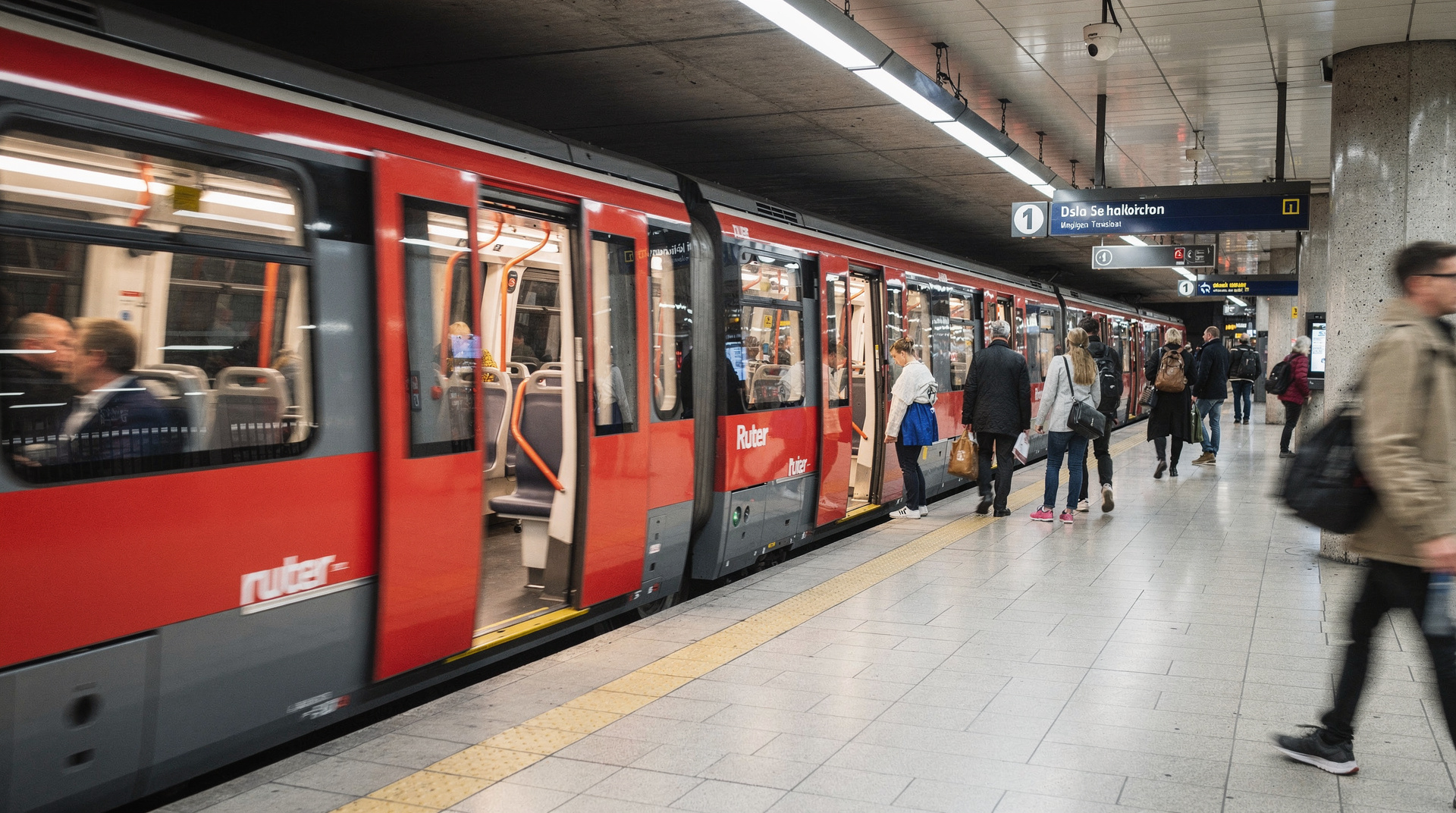
- T-bane (metro) connects to all five lines from Jernbanetorget station (directly below Oslo S)
- Bus lines from Bussterminalen next door
- Tram line 18 and 19 south toward Ekeberg
A single Ruter ticket (zone 1) costs NOK 42 / USD 4.50 (buy in the Ruter app — cheaper than at machines). For the full guide to getting around the city once you’ve arrived, see getting around Oslo and the detailed Ruter transport guide.
Practical tips
Buy tickets in the app before landing: Both the Flytoget app and the Vy app allow ticket purchase before you land. This saves time at the ticket machines and is sometimes marginally cheaper.
Validate before boarding: On Vy trains especially, make sure your ticket is validated (done automatically in-app; for paper tickets, use the yellow validators on the platform).
Night connections: Flytoget runs until approximately 00:30 from the airport. After that, the only options are taxi or Flybussen night services. If you land very late, check the last departure times before you travel.
Mobile data: Norwegian SIM cards are available from vending machines in arrivals. Alternatively, most EU/UK data plans now work in Norway. Check with your provider.
Currency and cashless: There are no currency exchange booths needed for the journey — every ticket machine at the airport accepts Visa, Mastercard, and most contactless methods. Norway is almost entirely cashless.
What to do immediately after arriving at Oslo S
Once you arrive at Oslo S (Oslo Sentralstasjon), you’re in the heart of the city’s transport network. Here’s an orientation for first-time visitors:
Orientation at Oslo S: The station has two levels. The upper ground level faces the plaza and tram stops. The lower level has the T-bane (metro). Jernbanetorget (the square in front of the station) is the city’s main transport hub — all tram and many bus lines pass through here.
Left luggage: Luggage storage is available at Oslo S in the main hall (Narvesen kiosk area, or self-service lockers). Prices approximately NOK 50–120 / USD 5.40–13 per bag per day depending on locker size. Useful if your hotel check-in isn’t until 15:00 and you want to explore before dumping bags.
Buying Ruter tickets: If you haven’t already downloaded the Ruter app, do so at the station before boarding any city transport. The Ruter ticket office at Oslo S sells multi-day passes; machines at Jernbanetorget sell single tickets. The app is consistently the cheapest option.
Getting to your hotel: Most central Oslo hotels are reachable from Oslo S within 15–25 minutes by tram or metro. For the Aker Brygge area: tram 12 from Jernbanetorget, direction Majorstuen (3 stops). For Frogner: tram 12, several stops. For Grünerløkka: tram 11 or 13 from Stortorvet. See the getting around Oslo guide for full routing.
The airport itself: Gardermoen orientation
Knowing the airport layout helps you use your transit time efficiently.
Terminal 2 (T2): The main international terminal. All intercontinental and most European arrivals. The train station is directly below T2 — follow “Tog” (train) signs from any point in the terminal. Walk time from the furthest gate to the train: approximately 12–18 minutes including baggage claim.
Terminal 1 (T1): Used primarily by Scandinavian regional flights and some low-cost carriers. Connected to T2 by a short walk; also has train access.
Arrivals area (ground floor, T2): Norwegian SIM card vending machines, car rental desks (Hertz, Avis, Europcar, Sixt, Budget), taxi rank outside the main doors, and the Flytoget desk for tickets.
Luggage: Gardermoen’s baggage reclaim is efficient by major airport standards. Allow 20–30 minutes from landing to the platform.
Special situations
Early-morning arrivals (before 06:00): Flytoget starts at approximately 05:32 from Gardermoen; the first Vy regional train is at a similar time. If you land before 05:30, the taxi or Flybussen is your only option. Check current first-departure times on the Vy and Flytoget apps before travelling.
Late-night arrivals (after 00:30): The last Flytoget from Gardermoen departs approximately 00:30. The last Vy regional direct train is similar. After this, Flybussen night service (less frequent) or taxi are the options. Book a taxi in advance if you’re arriving at 01:00+ to avoid long waits.
Flight diversions: On rare occasions, flights destined for Gardermoen divert to Sandefjord Torp (TRF) or Rygge (RYG) airports south of Oslo due to weather. Sandefjord Torp is about 110 km south; the Torp Ekspressen bus serves Oslo Bussterminal in about 2 hours. Rygge has closed as a commercial airport. In the event of a diversion, check with your airline for ground transport options.
Connecting to Bergen, Trondheim, or other Norwegian cities: Gardermoen is the main hub for domestic connections. If you’re flying onward to Bergen (BGO) or Trondheim (TRD), you don’t need to enter Oslo at all — connect through T2. SAS and Norwegian handle most domestic connections.
Luggage and transit tips
Luggage-friendly transport: Both Flytoget and Vy trains have generous luggage space — purpose-built racks at the end of each car. The trains are much more comfortable with large bags than, for example, the Heathrow Express (which has minimal overhead space). Take the train confidently with full-size suitcases.
Customs: Norway is not in the EU but is in Schengen. Non-EU travellers arriving from outside Schengen go through passport control; EU/Schengen travellers go through the Schengen lane. Customs allowances include 1 litre of spirits or 3 litres of wine for adults. Alcohol is significantly cheaper outside Norway — many travellers bring their duty-free allowance.
Currency at the airport: There are ATMs and a handful of exchange desks at Gardermoen. However, Norway is essentially cashless and you do not need local currency for transport or most shops in Oslo. Your international debit or credit card will work everywhere. If you do need NOK, an ATM gives a better rate than an exchange desk.
Comparing all options: final summary
| Method | Time | Cost (adult) | Best for |
|---|---|---|---|
| Flytoget | 19 min to Oslo S | NOK 243 / USD 26 | Speed, certainty |
| Vy regional (L12) | 25–30 min | NOK 124 / USD 13 | Value, same route |
| Flybussen | 45–60 min | NOK 149–199 / USD 16–21 | Hotel drops, cheap |
| Standard taxi | 35–50 min | NOK 700–900 / USD 75–97 | Groups, luggage |
| Rental car | Variable | NOK 500+ / USD 54+ per day | Day trips from airport |
For most solo and couple travellers, the Vy regional train is the clear choice. For the full head-to-head analysis, see the dedicated Flytoget vs Vy comparison.
Connecting through Gardermoen without visiting Oslo
If you’re transiting through Oslo Gardermoen on the way to Bergen, Trondheim, Stavanger, or another Norwegian city, you don’t need to leave the airport at all — domestic connections operate from the same terminal (T2), and SAS and Norwegian handle the vast majority of these routes with generous minimum connection times built into most itineraries. Only consider leaving the airport for a city stop if your layover exceeds roughly 5–6 hours and your bags are checked through; otherwise the roundtrip into Oslo and back eats most of a shorter layover without leaving meaningful time in the city itself.
Travelling with a family or group
Groups of three or more with luggage change the maths. Flytoget and Vy prices are per person, so a family of four pays four full fares either way — at NOK 124 per person, the Vy train for four costs around NOK 496, still meaningfully cheaper than a taxi at NOK 700–900 flat, and only marginally slower.
Groups of five or more, or anyone travelling with a lot of luggage and small children, may find a pre-booked private transfer worth the premium simply for the door-to-door convenience and fixed price certainty. There is no group discount on either Flytoget or Vy tickets; multi-day Ruter passes bought after arrival (for city travel) do sometimes offer family or group rates, covered in the Ruter transport guide.
First-time arrival: a simple decision tree
If your priority is speed and you’re travelling alone or as a couple without heavy luggage: take Flytoget. If cost matters more than 6–10 minutes: take the Vy regional train — the experience is nearly identical. If your hotel is not near Oslo S and you’d rather avoid a connecting tram: take Flybussen, accepting a longer journey for a direct hotel drop-off. If you’re arriving very late at night, very early in the morning, or in a large group with substantial luggage: book a taxi or private transfer in advance rather than hoping for availability on arrival.
Planning the rest of your arrival day
Getting into the city is only the first step, and a little planning makes the first hours far more pleasant. If you are still deciding where to base yourself, the where to stay in Oslo guide explains how each area feels, which helps you pick the right end of the journey before you even board the train. Arriving travellers who are unsure how long to allow for the whole trip will find the how many days in Oslo guide useful.
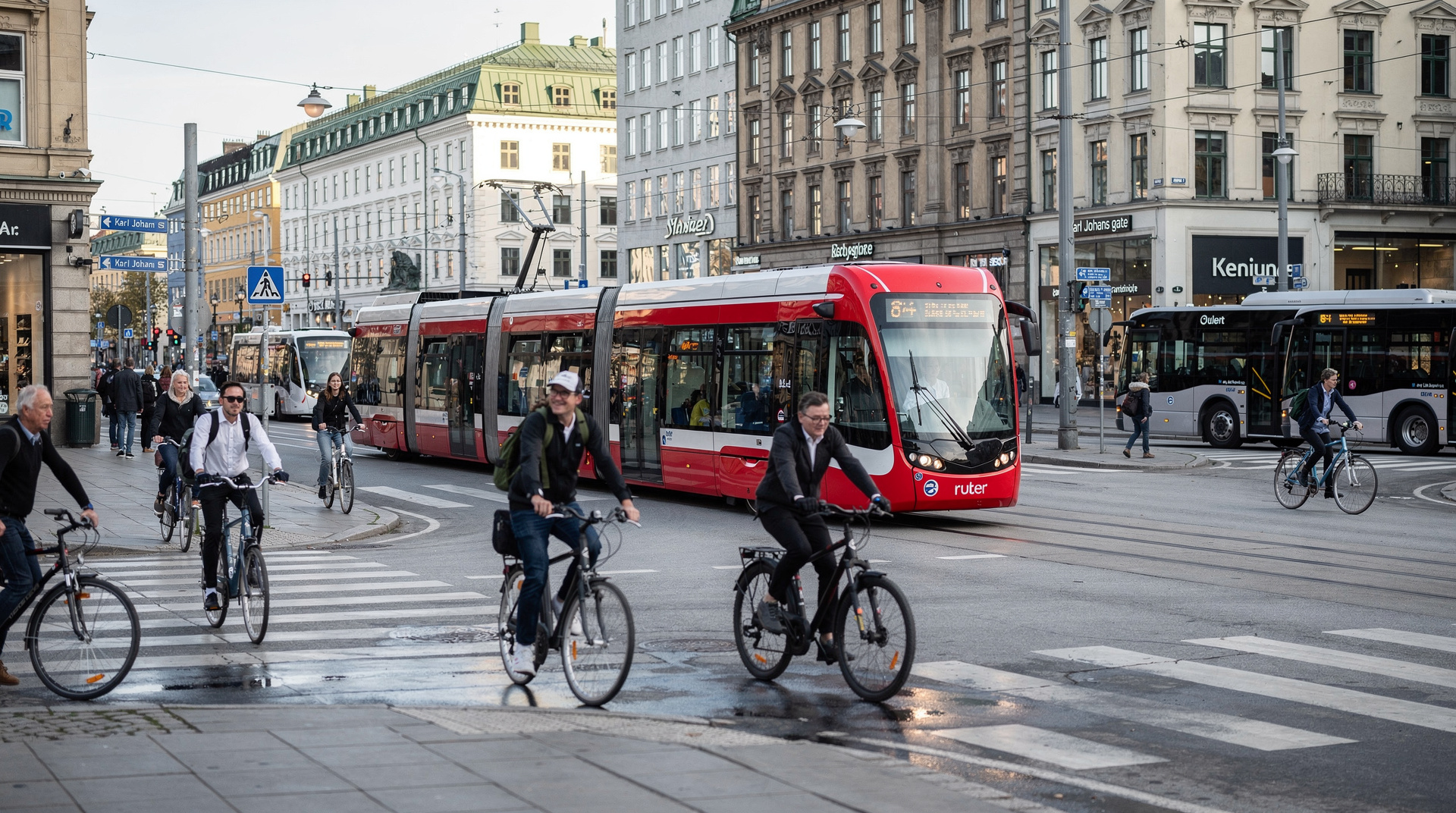
Once your bags are dropped, an easy first outing is a stroll along Karl Johans gate, the main street leading up to the Royal Palace. It is close to Oslo S, needs no tickets and works well when jet lag has taken the edge off your energy. The wider Sentrum neighbourhood guide lists what else sits within a short walk, and the Oslo city centre destination page gives the bigger picture.
If you land in the evening and want something simple, head to where to eat in Oslo for honest suggestions, and read the Oslo overpriced food warning before you sit down at the first restaurant near the station. Prices in Norway surprise many first-time visitors, so the is Oslo expensive guide and the Oslo trip cost breakdown are worth a look while you ride the train.
For a ready-made plan that starts from the moment you arrive, the Oslo in 2 days itinerary and the Oslo in 1 day itinerary show how to fit the main sights around an airport transfer. Travellers weighing up a city pass can compare options in the Oslo Pass guide before buying anything at the station. A few more tips from people who have made the trip are collected in the blog post on Oslo airport tips.
If your trip continues beyond the capital, the Oslo to Bergen options guide covers the onward routes, and the main Oslo destination page is a good place to start exploring once you are settled in.
Frequently asked questions about Oslo Airport to city centre
How far is Oslo Airport from the city?
Oslo Gardermoen Airport (OSL) is approximately 47 km (29 miles) north of the city centre by road, or about 50 km by rail. Journey time is 19 minutes on Flytoget or 25–30 minutes on the Vy regional train.Does the Ruter city transport ticket work to/from the airport?
No. The airport is in Zone 4V (Viken zone), outside the standard Ruter zones. You need a separate airport train ticket from Flytoget or Vy, or a Ruter zone 4V ticket for the Vy regional trains. Some Ruter multi-zone tickets cover the journey — check the Ruter app before buying.How much does a taxi from Oslo Airport cost?
Expect NOK 700–900 (USD 75–97) for a standard taxi to the city centre. Fixed-price airport taxis are available from licensed operators at the rank outside arrivals; always confirm the price before getting in. Shared transfers and private shuttles are also available.Is there a bus from Oslo Airport to the city?
Yes. Flybussen (airport bus) runs to Oslo Bussterminal (next to Oslo S) and several hotels in the centre. The journey takes 45–60 minutes depending on traffic and costs NOK 149–199 (USD 16–21). Not ideal at peak hours, but fine for late-night or early-morning when trains are less frequent.What about the Flytoget merger with Vy?
Flytoget AS is expected to be integrated into Vy (the state rail operator) around late 2027 or 2028. Until then it operates as a separate service with its own pricing and tickets. There will be no change to the travel time or route.Can I take public transport straight from the airport with luggage?
Yes. Both Flytoget and Vy trains have dedicated luggage space. The airport station has lifts between platforms and the terminal. Oslo S is step-free and well-signed to connecting tram and metro lines.Can I buy a combined airport train and Ruter ticket?
Not as a single ticket — Flytoget and Vy airport fares are separate from the Ruter city zone system, since the airport sits in zone 4V outside standard Ruter coverage. Buy the airport train ticket for the Gardermoen–Oslo S leg, then a separate Ruter ticket or pass for onward city transport once you arrive.Is it cheaper to buy airport train tickets online or at the station?
Buying in the Flytoget or Vy app before you land is usually the same price or marginally cheaper than station machines, and it saves time queuing on arrival. Neither app requires booking a specific departure — tickets are typically valid for a window of time rather than a fixed train.
Top experiences
Bookable activities with verified prices and instant confirmation on GetYourGuide.