Royal Palace Oslo: changing of the guard, summer tours, and Slottsparken
Oslo: city highlights walking tour
Duration: 2.5 hours
- Free cancellation
- Local guide
Can tourists visit the Oslo Royal Palace?
The palace exterior and Slottsparken (the surrounding park) are free and open year-round. The interior is open for guided tours only during approximately late June to mid-August — these are popular and sell out fast. Tickets are sold through Nationaltheatret and must be booked weeks in advance. The changing of the guard happens daily at 1:30pm.
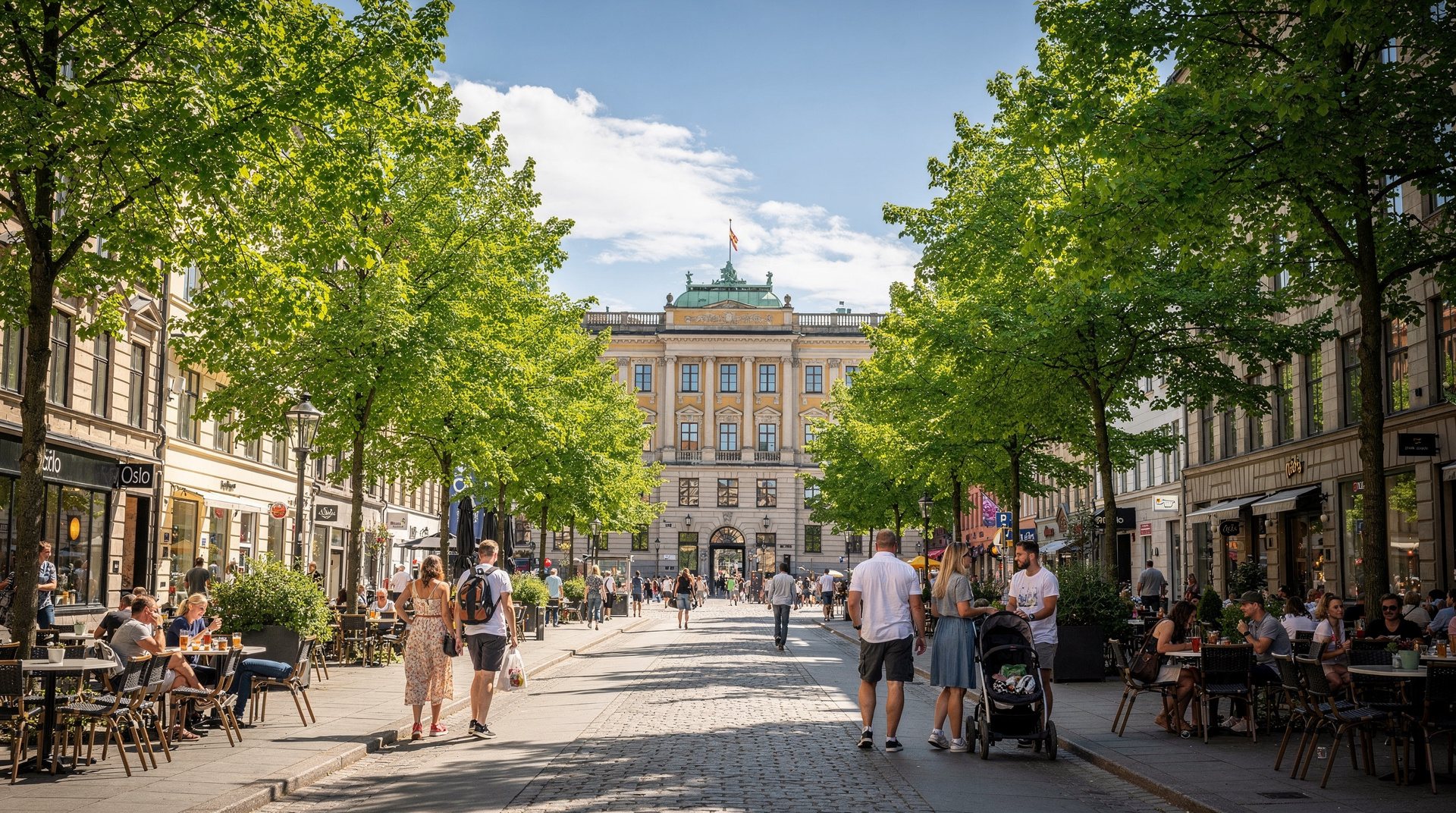
Oslo’s Royal Palace sits at the head of Karl Johans gate, and it is one of the few genuinely free, genuinely worthwhile stops in the city centre regardless of season or budget. Here is the practical shape of a visit before the detail below.
| Where | Top of Karl Johans gate, Slottsplassen |
| Cost | Free (park, exterior, guard change); ~NOK 175 for summer interior tour |
| Time needed | 15 min (guard change) to 2 hrs (interior tour + park walk) |
| Getting there | 15-20 min walk from Oslo S, or tram/metro to Nationaltheatret |
| Best time | 1:20pm for the guard change; late June-mid August for interior tours; 17 May for the full spectacle |
The palace at the top of the street
Every major European capital has a royal palace at the end of a ceremonial boulevard. Oslo’s is refreshingly understated. The Royal Palace at Slottsplassen is a neoclassical building completed in 1849, white-painted, with a front courtyard and a park extending down toward the National Theatre. By the standards of Buckingham Palace, Versailles, or the Stockholm Royal Palace, it is modest — and that restraint is part of what makes Oslo’s monarchy feel different.
The park is free, the changing of the guard is free, and the exterior walk is among the most pleasant in Oslo. Interior tours, rare and popular, open for a few weeks each summer.
The changing of the guard
The vaktskiftet — changing of the guard — takes place at 1:30pm every day at the palace main courtyard. It’s free to watch from the gates on Slottsplassen.
The ceremony involves the outgoing guard from the palace walkway meeting the incoming guard from their barracks, with a formal inspection, march, and handover. The full ceremony runs about 20 minutes. On Sundays and major public holidays, the Royal Guard band accompanies the ceremony and the crowd is correspondingly larger.
This is not as elaborate as the British ceremony at Buckingham Palace, but it is genuinely more accessible — you can stand 10 metres from the guards during the ceremony, not behind a distant fence. Come 10-15 minutes before 1:30pm for a good position.
What to expect: Uniformed guards in khaki uniforms with rifles and white helmets. The ceremony is military rather than theatrical. If you’ve grown up watching more elaborate royal ceremonies elsewhere, it may feel low-key. If you want an honest Oslo experience, this is it.
Summer interior tours: what you see inside
The palace interior tours run for approximately 7-8 weeks in summer — historically from around 25 June to 17 August, though exact dates vary by year. The tours are conducted in English and Norwegian. Check nationaltheatret.no for the current year’s dates and booking.
Cost: approximately NOK 175 (USD 19) for adults; NOK 90 (USD 10) for children. Not covered by the Oslo Pass.
What the tour covers: The tour moves through the palace’s state rooms over 60 minutes:
The Banquet Hall: the largest room in the palace, used for state dinners. The painted ceiling and the portraits of Norwegian monarchs from Haakon VII onward are the highlights. The room seats up to 200 guests for formal occasions.
The Throne Room: white and gold, with the Norwegian lion on the throne canopy. Used for investiture ceremonies and formal receptions. More intimate than the title suggests.
The Mirror Hall: a smaller corridor-gallery modelled loosely on European palace traditions, with mirrors and painted panels.
The Council Chamber: where the King meets with the cabinet (Council of State) each Friday — a constitutional obligation that dates to the 1814 constitution.
The Guard’s Hall and Staircase: the ceremonial approach to the upper floors, with portraits of 19th-century Norwegian military officers.
The building has been adapted and extended since 1849 but remains fundamentally a working royal residence rather than a museum. The state rooms are actively used several times per year; some have been redecorated by the current royal family.
Book early. Tours on Saturdays and Sundays in July fill within days of booking opening. Weekday tours have more availability. Book at nationaltheatret.no the moment dates are published.
Slottsparken: the free park
The palace sits at the upper end of a landscaped park — Slottsparken — that extends down a gentle slope to the National Theatre at Karl Johans gate. The park covers 22 hectares with mature oak, lime, and chestnut trees, formal flower borders, and the equestrian statue of King Karl Johan at the lower end.
In summer, Oslo residents use the park as a sunbathing and picnic area — one of the better places in the city centre to sit on the grass without paying for a terrace. In winter the paths through the park are a quiet alternative to Karl Johans gate below.
The park borders the Norwegian royal stables (not open to the public), the Chancellor of the Exchequer’s residence, and the government quarter. Walking from the National Theatre to the palace gates takes about 10 minutes uphill — a pleasant approach from the city centre.
The equestrian statue and the palace terrace
Karl Johan’s equestrian statue at the lower end of the park faces down Karl Johans gate toward the parliament and the Central Station — a 19th-century monument to the Swedish-Norwegian union king. The statue is a useful orientation point: when you face down the street from here, you’re looking at the spine of central Oslo.
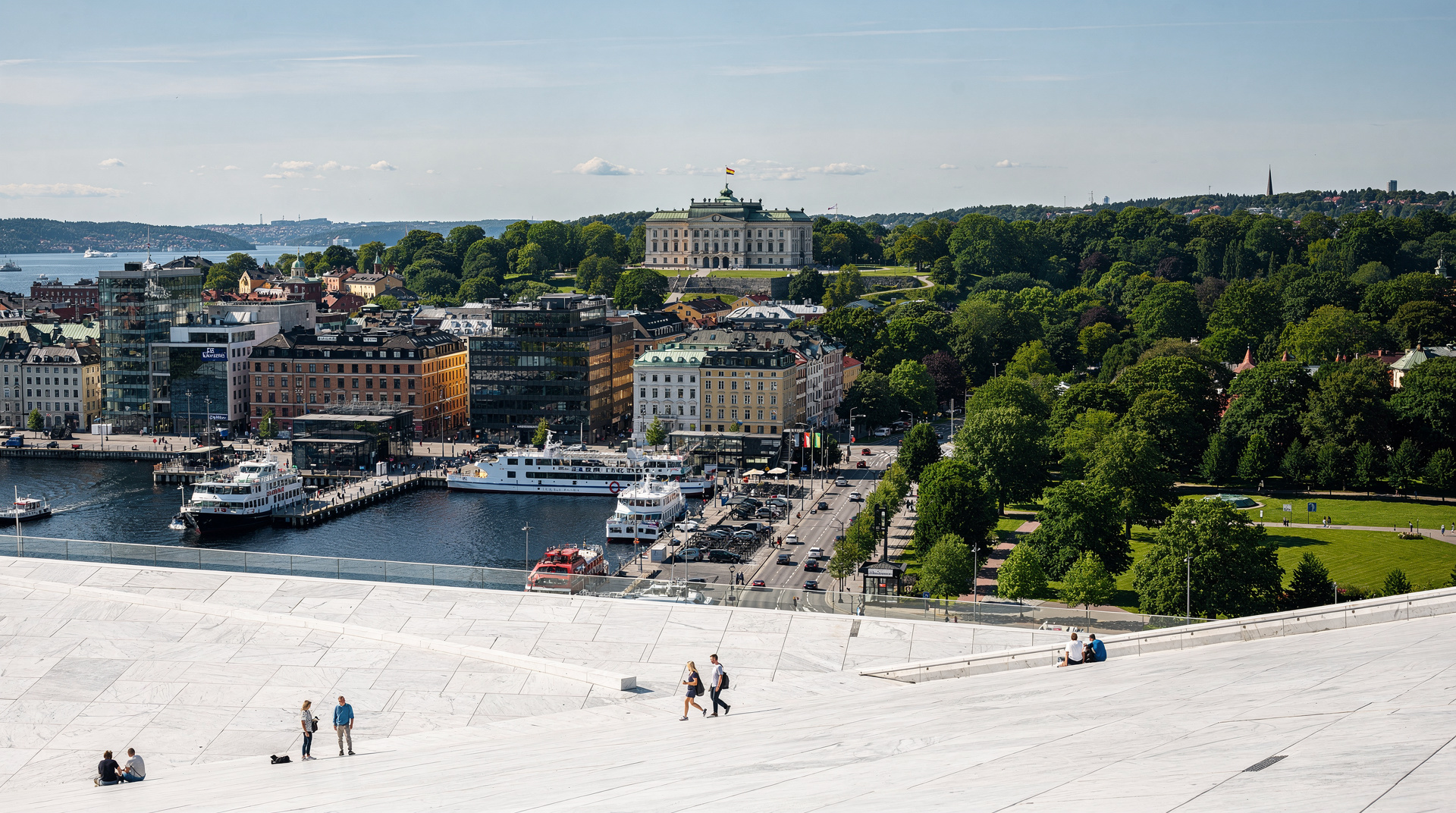
The terrace in front of the palace gate offers a different view — looking down Slottsparken and beyond toward the fjord. On a clear day you can see the Oslofjord from here. This terrace is a popular spot for watching Norway’s national day (17 mai) parades, when the palace balcony is crowded with the royal family and Oslonians in traditional bunad dress stream up the street.
The royal family and the Norwegian monarchy
The Norwegian monarchy is one of Europe’s most openly accessible royal institutions. King Harald V and Queen Sonja, who have been on the throne since 1991, maintain a public profile significantly less formal than the British royals. Crown Prince Haakon and Crown Princess Mette-Marit are even more so — both regularly participate in public events and have made sustainability and inclusion visible royal priorities.
The palace’s public openness reflects this character. There is no equivalent of the Changing of the Guard spectacle at Buckingham Palace — the Oslo ceremony is military and brief. There are no gift shops in the palace grounds. The guards are soldiers, not performers. The monarchy projects an image of public service rather than spectacle.
The flag above the palace signals the King’s presence: the royal standard (lion on gold) when the King is in residence; the national flag when he is not. This small detail is noticed by Oslonians — on major public occasions when the standard is flying, the city has a particular energy.
17 mai: the best day to be at the palace
Norway’s national day on 17 May (Syttende mai) is the best day to visit the Royal Palace — and one of the most distinctive experiences in Europe. The national day celebrates the 1814 constitution rather than a military victory, and the tradition is resolutely civilian: children in traditional bunad dress lead the parade up Karl Johans gate, waving flags and singing. Adults line the street. The royal family appears on the palace balcony.
The effect, repeated since the 1820s, is genuinely moving if you encounter it without prior knowledge: a European capital where the national day parade is led by primary school children and the crowd cheers without irony. If you are in Oslo on 17 May, rearrange your day around this.
Arrive at Slottsplassen by 10am. The palace balcony appearance happens around midday after the children’s parade has come up the street. Bring water and patience — the crowds are significant but good-natured.
The palace in Norwegian literature and culture
The palace appears throughout Norwegian cultural life in ways that go beyond ceremonial function. Ibsen’s plays reference court life; Bjørnstjerne Bjørnson wrote the national anthem while a young man engaged with Norwegian nationalism; the tradition of the literary prize gala held at the Grand Hotel nearby gives a sense of how tightly the cultural and royal spheres are woven in 19th-century Oslo identity.
The building’s relatively unassuming scale compared to Versailles or Buckingham Palace is itself a cultural statement. The Norwegian elite of the 1840s built a palace they could actually use rather than a monument they could display. Whether this was pragmatism or republican modesty, the effect is a royal residence that feels like a large country manor rather than a dynastic fortress.
Photography at the palace
The palace grounds are photographed by thousands of visitors daily. A few notes:
From Slottsplassen: The frontage of the palace is best photographed in the morning when the light comes from the east and the white facade glows. The equestrian statue in the foreground is the standard composition.
From inside Slottsparken: Walking through the park toward the palace gives a more intimate view with trees framing the building. The park side of the building is less formally photographed but more atmospheric.
Guard change: The 1:30pm ceremony is worth photographing for the uniformed guards against the palace backdrop. Arrive 10 minutes early for a clear position near the gates.
17 mai: The most photographed day at the palace. Bring a long lens if you want to capture the balcony; for street-level parade photography, a standard lens suffices.
Getting to the Royal Palace
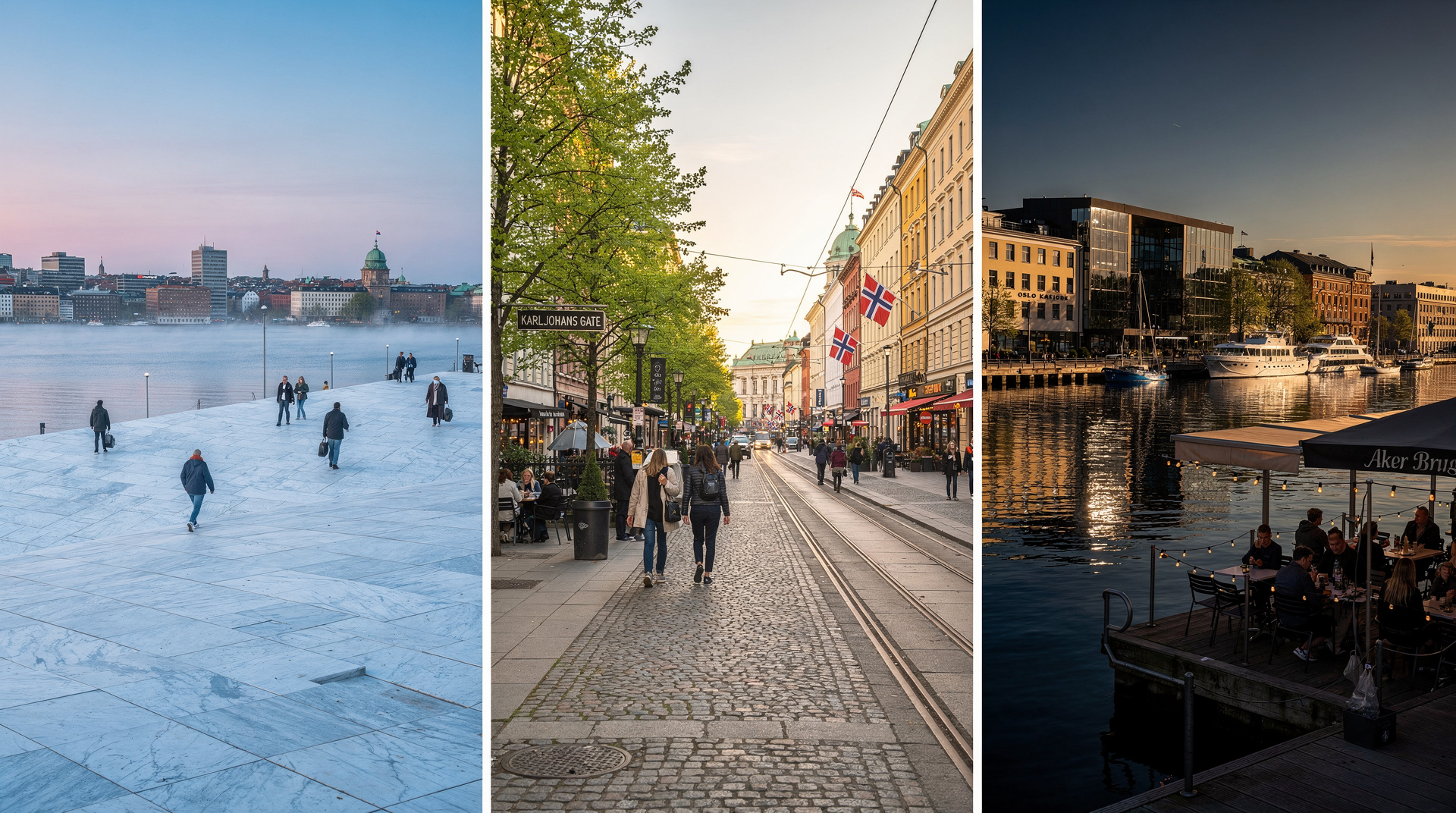
On foot: Walk up Karl Johans gate from Oslo Central Station — uphill, past the Parliament building, Grand Hotel, and University buildings, to the National Theatre at the top. Continue past the theatre into Slottsparken. About 15-20 minutes.
Tram: Trams 11, 12, 17, and 18 stop at Nationaltheatret — the tram stop is at the foot of Slottsparken. From there walk uphill through the park (10 minutes) to the palace gates.
Metro: Nationaltheatret station (all lines) is two minutes’ walk from the tram stop.
Combining the palace with Karl Johans gate
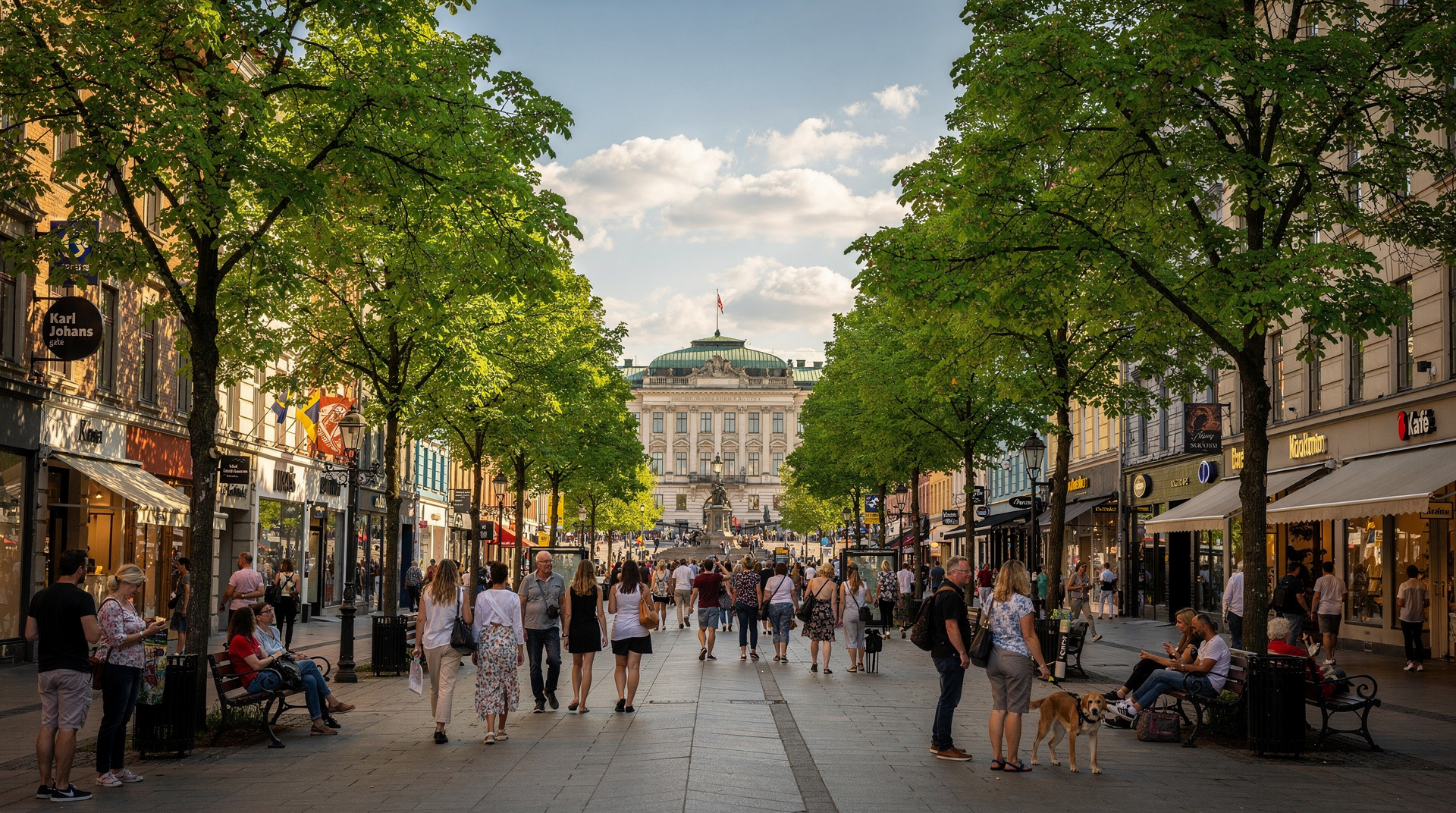
The palace and Karl Johans gate form a natural circuit. Walk up the main street from Central Station to the palace, do the guard change at 1:30pm, walk through Slottsparken, then loop back down via the National Theatre and the University area. This covers Oslo’s monumental centre in about two hours and is entirely free.
See the honest Karl Johans gate guide for which restaurants on this street are worth stopping at (few) and which are tourist-trap territory (most). The best coffee between the station and the palace is not on the main street — it’s on the side streets.
For a full first-day itinerary incorporating the palace, Akershus, Aker Brygge, and the Opera House, see Oslo in 1 day. If you’d rather have someone else narrate the walk, our Oslo walking tours compared guide covers which guided options include the palace and guard change in their route.
Is the palace worth building your day around?
For most visitors, the honest answer is: build a morning around it, don’t build a whole day. The park, the exterior, and the guard change together take under an hour and cost nothing — that alone earns the palace a firm place on any top things to do in Oslo list and on the free things to do shortlist. The interior tour is a genuinely different proposition: a narrow summer window, advance booking, and a fee, in exchange for rooms that are otherwise never open. If you’re only in Oslo outside late June to mid-August, don’t plan around the interior — the free exterior experience is still worthwhile on its own.
The palace neighbourhood
The Royal Palace sits at the convergence of several of Oslo’s most pleasant walking areas. The National Theatre immediately below is one of Oslo’s best 19th-century neoclassical buildings. The University campus to the east has the Aula with its Munch murals (the artist’s largest public commission — available on summer guided tours). Vigeland Park is 1.2 km to the west — a logical combination with a palace visit.
The immediate neighbourhood of Slottsplassen is quieter and more residential than the lower part of Karl Johans gate. The streets around the palace — Parkveien, Drammensveien — have Oslo’s most expensive residential real estate and some of its most architecturally intact 19th-century apartment buildings. Walking through this area shows a different Oslo from the tourist circuit.
Useful nearby services: The National Theatre complex has a café (basement level). A pharmacy and several coffee shops are on Stortingsgata, two minutes’ walk east. The nearest grocery stores are on Hegdehaugsveien, a five-minute walk.
Pairing the palace with the rest of the centre
The palace works best as one stop in a longer walk rather than a destination on its own. If you are still deciding how the centre fits together, the Oslo city centre overview and the Sentrum neighbourhood guide show how the palace relates to the streets, squares and waterfront below it.
From the palace, the natural next steps depend on your mood. For art, the National Museum is an easy continuation. For history with a harbour view, head down to Akershus Fortress, and for something more reflective the Nobel Peace Center sits on the way. If you would rather stay outdoors, Frogner Park and the Vigeland sculptures pair naturally with the park you have just walked through; the wider Frogner park guide explains how to spend longer there.
Planning around transport, passes and season
You do not need a car or a taxi for any of this. The Ruter public transport guide explains how tickets work if you prefer to ride up to Nationaltheatret rather than climb Karl Johans gate on foot. Since the park, exterior and guard change are free, a pass rarely changes the maths for the palace itself; the Oslo Pass guide is worth a look only if you are weighing it for the museums around it.
Timing matters more than money here. The summer tour window, the long evenings and the 17 May crowds all shape what the visit feels like, so the best time to visit Oslo is a useful companion if your dates are still flexible.
Practical checklist
- Guard change: Daily 1:30pm at the main courtyard gate. Free.
- Summer interior tours: Approximately 25 June to 17 August. Book at nationaltheatret.no weeks in advance. NOK 175 (USD 19). Not covered by Oslo Pass.
- Slottsparken: Always open, free.
- 17 mai: The best day to visit. Plan to be in position by 10am.
- Photography: Permitted everywhere in the public grounds.
- Dogs: Welcome in Slottsparken; not permitted at the palace gates.
- Nearest café: The café in the basement of the National Theatre building (5-minute walk) is among the closest options. The park itself has no food vendors.
Frequently asked questions about Royal Palace Oslo
What time is the changing of the guard at the Oslo Royal Palace?
The changing of the guard (vaktskiftet) takes place daily at 1:30pm at the main courtyard. It takes approximately 20 minutes. The ceremony is free to watch from the public viewing area at the palace gates. The Royal Guard band accompanies the ceremony on Sundays and some public holidays.How do you book Royal Palace interior tours?
Interior tours run from approximately 25 June to 17 August each year. Tickets are sold through visitoslo.com and nationaltheatret.no. Tours fill quickly — book at least 2-3 weeks in advance for weekend slots. Each tour is 60 minutes with a guide, covers the state rooms and throne room, and costs approximately NOK 175 (USD 19).Is the Oslo Royal Palace still used by the royal family?
Yes. The palace is the official residence of King Harald V and Queen Sonja. The flag flying above the palace indicates whether the monarch is in residence. When the royal family is not in Oslo, the palace remains closed except during the summer tour season.Can you walk through Slottsparken?
Slottsparken — the landscaped park surrounding the palace — is free and open to the public year-round. The park connects to Karl Johans gate at the lower end. It has mature trees, flower borders in summer, and pleasant walking paths. The National Theatre is at the park's lower east corner.Where is the Royal Palace in Oslo?
The Royal Palace sits at the upper western end of Karl Johans gate, Oslo's main pedestrian street. It's about 1.2 km from Oslo Central Station on a direct uphill walk, or a short ride on tram 11, 12, 17, or 18 to Nationaltheatret.
Top experiences
Bookable activities with verified prices and instant confirmation on GetYourGuide.