The Oslo Opera House: why Snøhetta's building changed the city
Oslo: city highlights walking tour
Duration: 2.5 hours
- Free cancellation
- Local guide
How a building turned Oslo’s industrial waterfront into a destination
When the Oslo Opera House opened in April 2008, the stretch of Bjørvika waterfront it occupied was one of the least appealing corners of the city — a tangle of motorways, freight yards, and the back end of Oslo Central Station. Nobody walked there voluntarily. Sixteen years later, that same stretch of water has become the most photographed location in Norway, and the Opera House is the reason.
| Where | Bjørvika waterfront, 10-minute walk from Oslo Central Station |
| Cost | free to walk the roof and public areas; tickets from NOK 250 |
| Time needed | 30–60 minutes for the roof, longer with a performance |
| Getting there | walk east from Oslo S along the waterfront promenade |
| Best time | early morning or the hour before sunset |
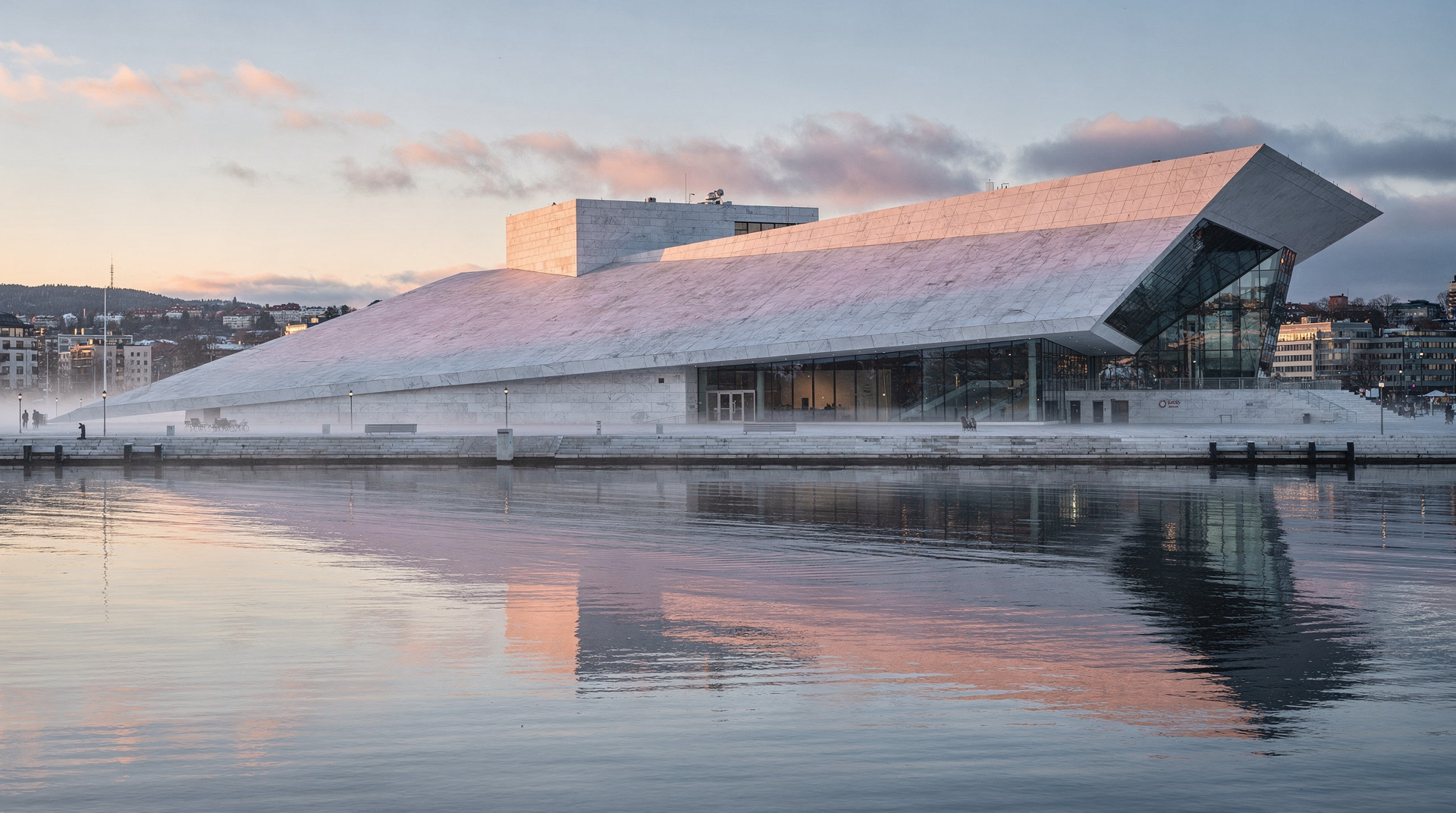
The building was designed by Snøhetta, the Oslo-based architectural firm that has since become one of the most recognised practices in the world. They won the international competition in 2000, and what they built exceeded almost every expectation. The brief asked for a world-class opera house. What they delivered was also a public plaza, a mountain, a beach, and a meditation on what a civic building can mean.
The roof: Oslo’s most unusual public space
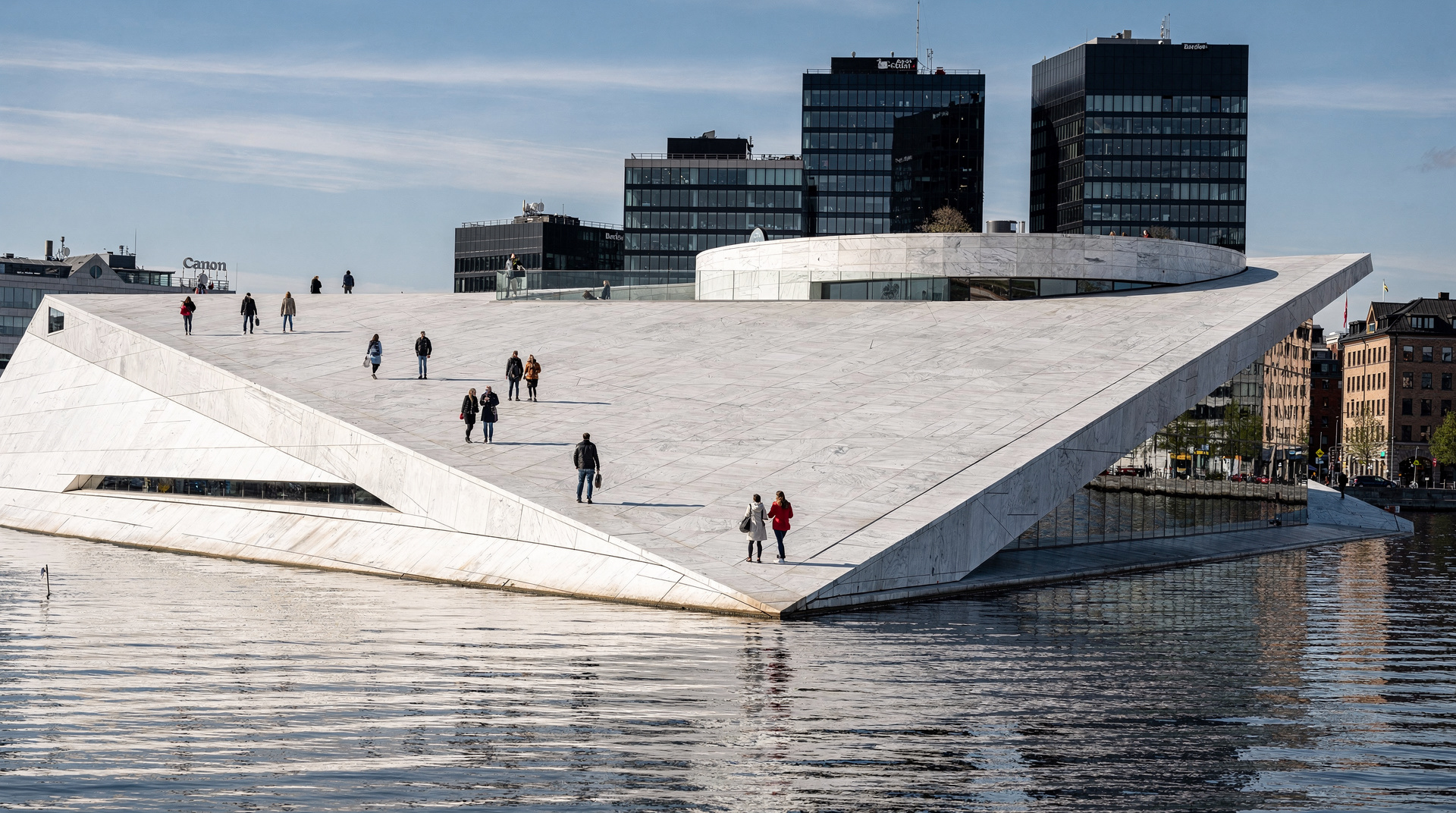
The defining gesture of the building is the sloping white marble and granite exterior that rises from the waterline to the roofline at a gentle angle. You do not admire the roof from a distance — you walk on it. There is no fence, no charge, no reservation system. You simply walk up.
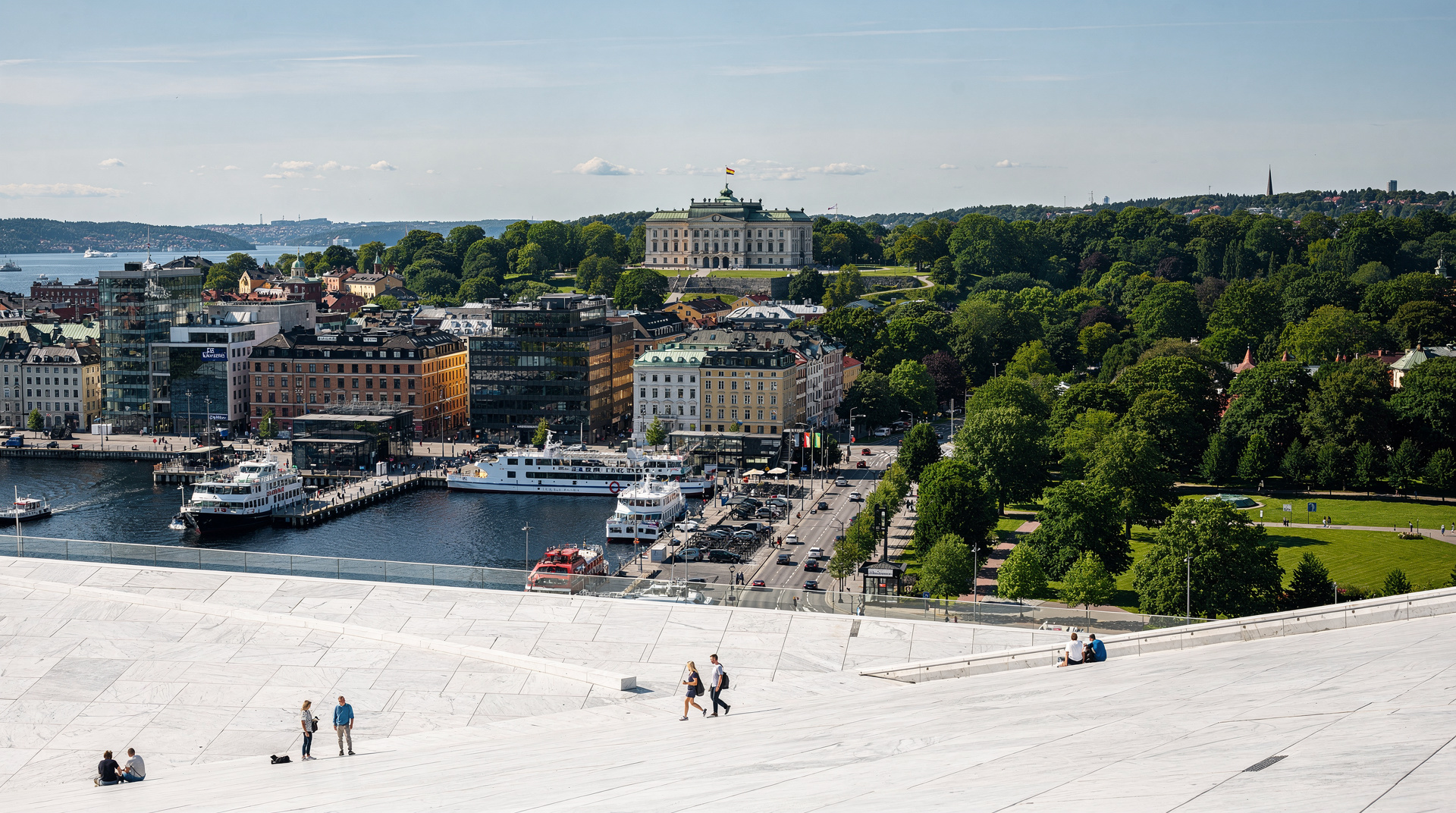
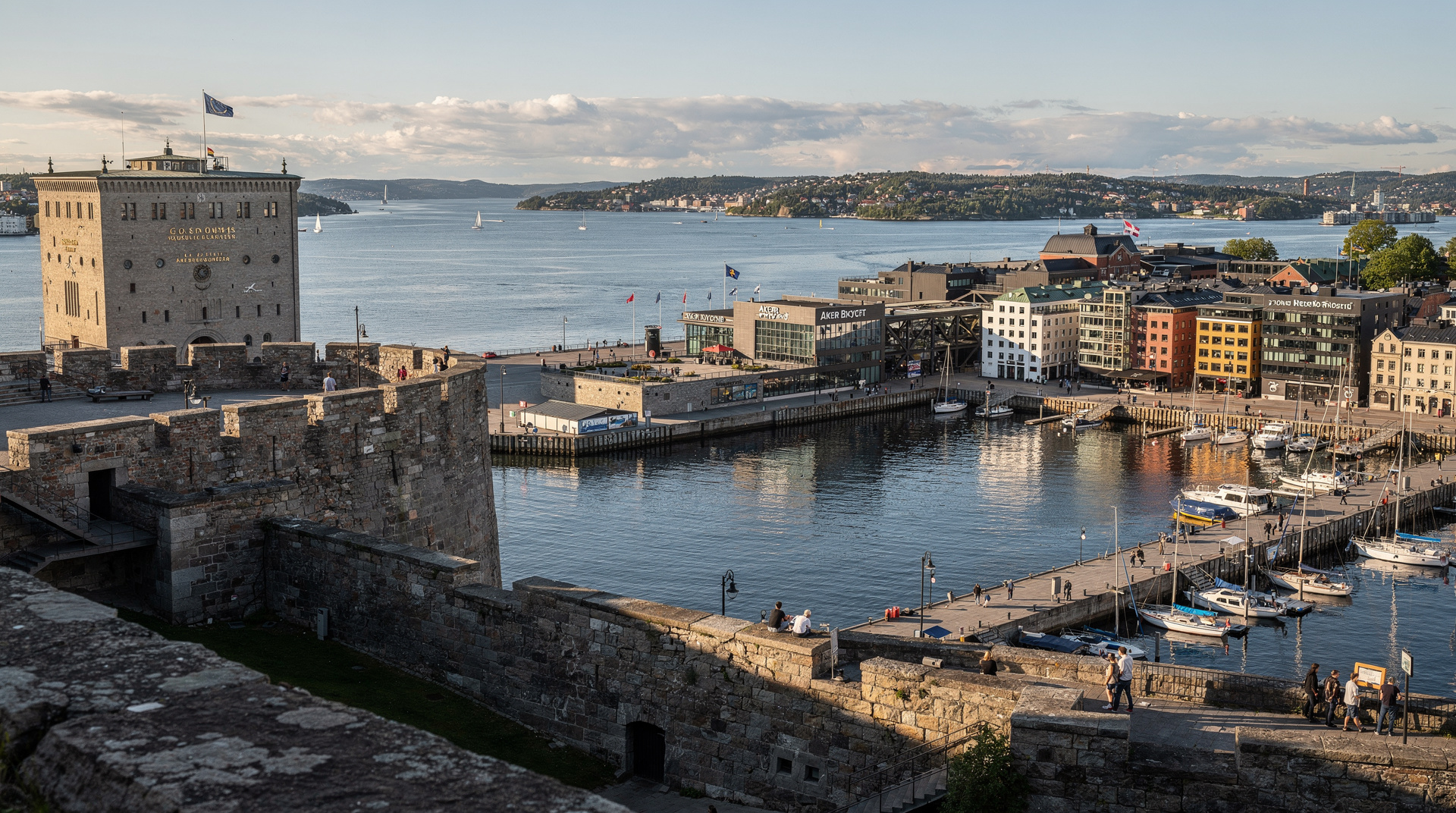
On a clear summer day, this is one of the finest experiences Oslo has to offer. The city opens up around you — the harbour below, the Akershus Fortress and castle to the west, the Oslofjord extending south toward the sea. The roof is busy on warm evenings; locals come after work, tourists come all day, and the transition between them is seamless. It is the most democratic piece of architecture we know — the same view for everyone, regardless of whether they have a ticket to tonight’s performance.
The surface is a combination of white Carrara marble and Italian granite, and the choice matters. Snøhetta wanted a material that would look different in every season and light condition — blinding white in midsummer, grey and moody under autumn cloud, almost luminous under a dusting of snow. In November, when Oslo is at its most atmospheric, the roof has a quality that is hard to describe in print. Our full practical guide to visiting the Oslo Opera House covers opening hours, performance schedules, and the interior in more detail.
Inside: the wave wall and the main hall
The interior is as considered as the exterior. The main foyer is dominated by what the architects call the “wave wall” — a curved wooden cladding made from oak and cherry that wraps across the ceiling and walls in a way that manages to feel both warm and slightly vertiginous. It is the kind of detail that reveals itself slowly; you might not notice it on your first visit, but on a second you find yourself standing in the middle of the foyer just looking up.
The main auditorium seats 1,360 and is acoustically in the same class as the great European opera houses. Getting into a performance is the ideal way to experience the building properly — tickets start around NOK 250 (USD 27) for standing places and reach NOK 1,200–2,500 (USD 129–269) for premium seats. Booking several weeks in advance is advisable for popular productions.
Even without a ticket, you can walk most of the building’s public areas freely. The ground-floor corridor that runs beneath the stage gives you a strange, submarine sensation — glass walls look out at the waterline, and you are aware of the weight of the entire building above you. It is one of our favourite architectural moments in Oslo.
The context: how Bjørvika changed
The Opera House was the first completed element of the Bjørvika redevelopment — a long-running plan to relocate Oslo’s central motorways underground and build a new urban quarter on the reclaimed land. If you want to understand what has happened to this corner of Oslo, you have to hold two images in mind: the 2005 aerial view (motorways, freight yards, a few warehouses) and the 2024 view (the Munch Museum, the Barcode towers, the opera, a promenade, parks, a swimming area).
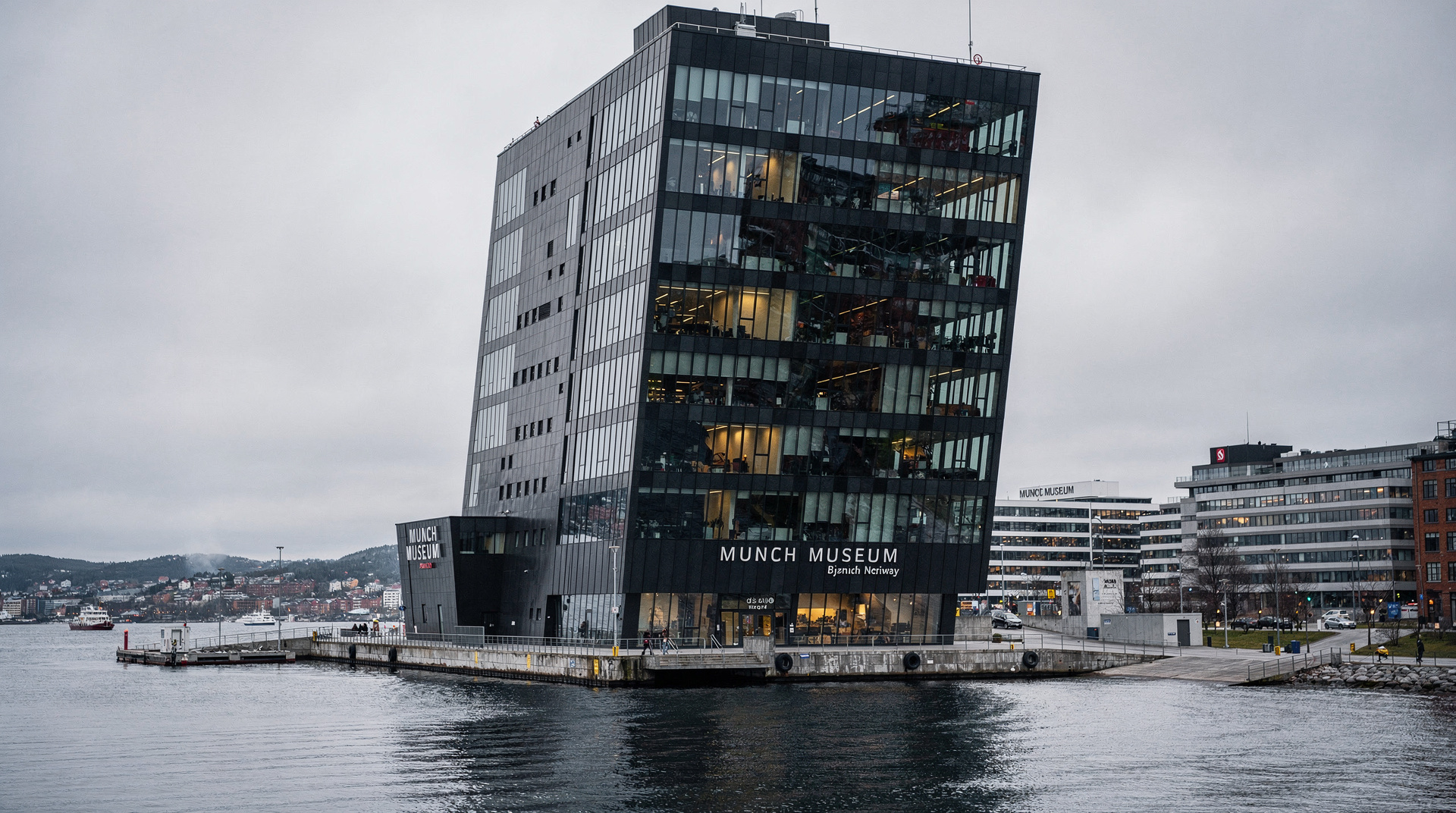
Not all of it is beautiful. The Barcode development — a row of tall office towers along Dronning Eufemias gate — was controversial and remains divisive. The towers are competently designed but architecturally unremarkable. They read as generic European financial-district development rather than anything distinctly Norwegian. The Munch Museum, by contrast, is wildly distinctive. Designed by the Spanish studio Estudio Herreros and completed in 2021, it is either an act of architectural courage or a mistake of scale, depending on who you ask. We find it genuinely interesting, if not universally loveable.
The Opera House sits between these developments and belongs to neither category — it is simply excellent, and it ages better with every passing year.
If the redevelopment sparks your curiosity, it helps to see Bjørvika as one chapter of a larger story. The wider Oslo city centre is where the older, more traditional streets sit, and walking from there down to the waterfront makes the change of scale obvious. Our Sentrum neighbourhood guide and the stroll along Karl Johans gate show the city the Opera House was built to complement rather than replace.
Seeing it alongside the Munch Museum
Because the Munch Museum sits directly across the water in Bjørvika, most visitors naturally see both on the same visit, and the contrast is worth doing deliberately rather than as an afterthought. Walk the Opera roof first, then cross the pedestrian bridge to the Munch Museum for its Lambda tower and the collection inside, then finish with a coffee looking back at the Opera House from across the water — the reverse view, with the marble roof catching the light, is arguably the better photograph of the two buildings. Budget about three hours for the combination including one museum visit.
Snøhetta: the firm that defined the building
Snøhetta was founded in 1989 and built its international reputation with the Bibliotheca Alexandrina in Egypt, completed in 2001. The Oslo Opera House was a homecoming of a different order — a chance to build something definitive in their own city. They succeeded in a way that few architectural firms ever do.
Since the Opera House opened, Snøhetta has continued to shape Oslo. They designed the renovation of the National Museum at Tullinløkka (reopened 2022, one of the finest art museum buildings in Europe), and their urban planning work has influenced how the entire Fjord City project — the long-term plan to return Oslo’s waterfront to its citizens — has evolved.
If you are interested in Norwegian architecture more broadly, a walk through Bjørvika followed by a look at the National Museum in Sentrum gives you a good cross-section of what Norwegian architecture is currently capable of.
Practical notes for a visit
The Opera House is a 10-minute walk from Oslo Central Station along the waterfront promenade — follow the water east from the main station exit. There is no entrance fee for the building’s public areas and roof. Guided architecture tours run on selected dates and cost around NOK 110 (USD 12); check the Opera House website for the current schedule.
The best time to walk the roof is either early morning (few tourists, golden light over the fjord) or in the hour before sunset on a clear evening. Summer evenings in particular can be magical — Oslo’s long summer days mean usable light until well past 10 pm in June and July, and the roof becomes a spontaneous gathering point for the whole city.
Because the roof costs nothing, it pairs well with a tight budget. Our guides to free things to do in Oslo and Oslo on a budget place it alongside other no-cost highlights. Visitors who want to understand the light and seasons that shape the marble can check Oslo daylight hours by season before choosing when to go, and anyone arriving by rail will find the getting around Oslo guide useful for the walk from the station. For a more personal take on the city’s skyline, see our blog post on the best views over Oslo.
For the broader context of why Oslo’s waterfront has been transformed so thoroughly in the last two decades, our top things to do in Oslo guide and the 2-day itinerary both put the Opera House in the context of a full visit. It is not a building you need to be an architecture enthusiast to appreciate. It is simply one of the best public spaces in Europe — and it is free.
Top experiences
Bookable activities with verified prices and instant confirmation on GetYourGuide.
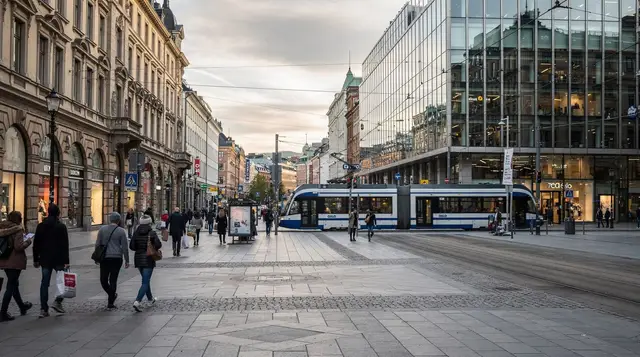
Oslo: old town walking tour and fjord cruise tickets
- Walk + cruise
- Local guide
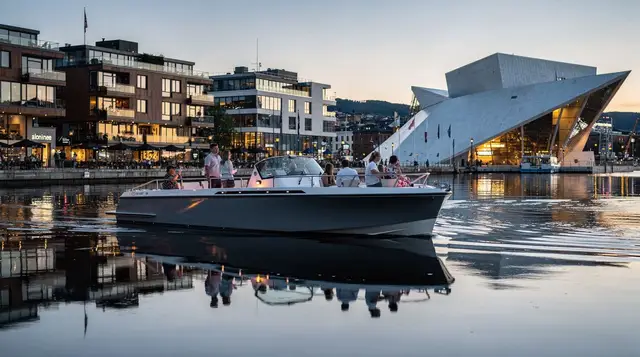
Oslo: guided sightseeing fjord cruise on a premium silent electric boat
- Silent electric boat
- Free cancellation
- Best seller
Oslo: Oslo Pass with public transport and free museum entry
- Instant confirmation
- Free public transport
- Skip museum queues