Oslo Opera House guide: walk the roof, architecture, and Bjørvika
Oslo: guided walking tour of central Oslo with a local guide
Duration: 2 hours
- Local guide
- Small group
Can you walk on the Oslo Opera House roof for free?
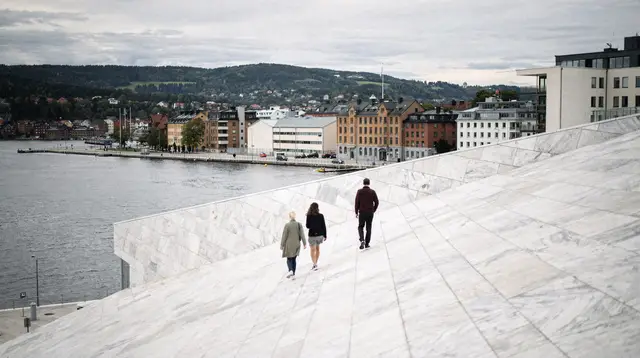
Yes. The sloping marble roof of the Oslo Opera House is public space, always open, and completely free. No ticket, no registration, no guided tour required. Just walk up the white stone slope from the waterfront to the peak 22 metres above the Oslofjord. It's open 24 hours.
The building Oslo didn’t know it wanted
When the Oslo Opera House opened in April 2008, it transformed a derelict industrial harbour area into the city’s most-visited piece of public architecture. The building has since become Oslo’s most photographed structure — not because of the opera inside (though the programme is excellent), but because of the roof.
Snøhetta’s design solves a problem most opera houses never attempt: making the building itself a reason to visit even if you’re not attending a performance. The sloping marble surface that sweeps down from the building’s peak to the waterline is a public square in the shape of a glacier. You walk up it. You sit on it. You photograph Oslo from it. None of this costs anything.
| Where | Kirsten Flagstads plass 1, Bjørvika |
| Cost | Free (roof + foyer); performances NOK 250–1,100 |
| Time needed | 30–45 min roof, 60 min guided interior tour |
| Getting there | 5 min walk from Oslo S, or Jernbanetorget metro |
| Best time | Early morning or summer evening (before 10am / after 7pm) |
The roof: what to expect
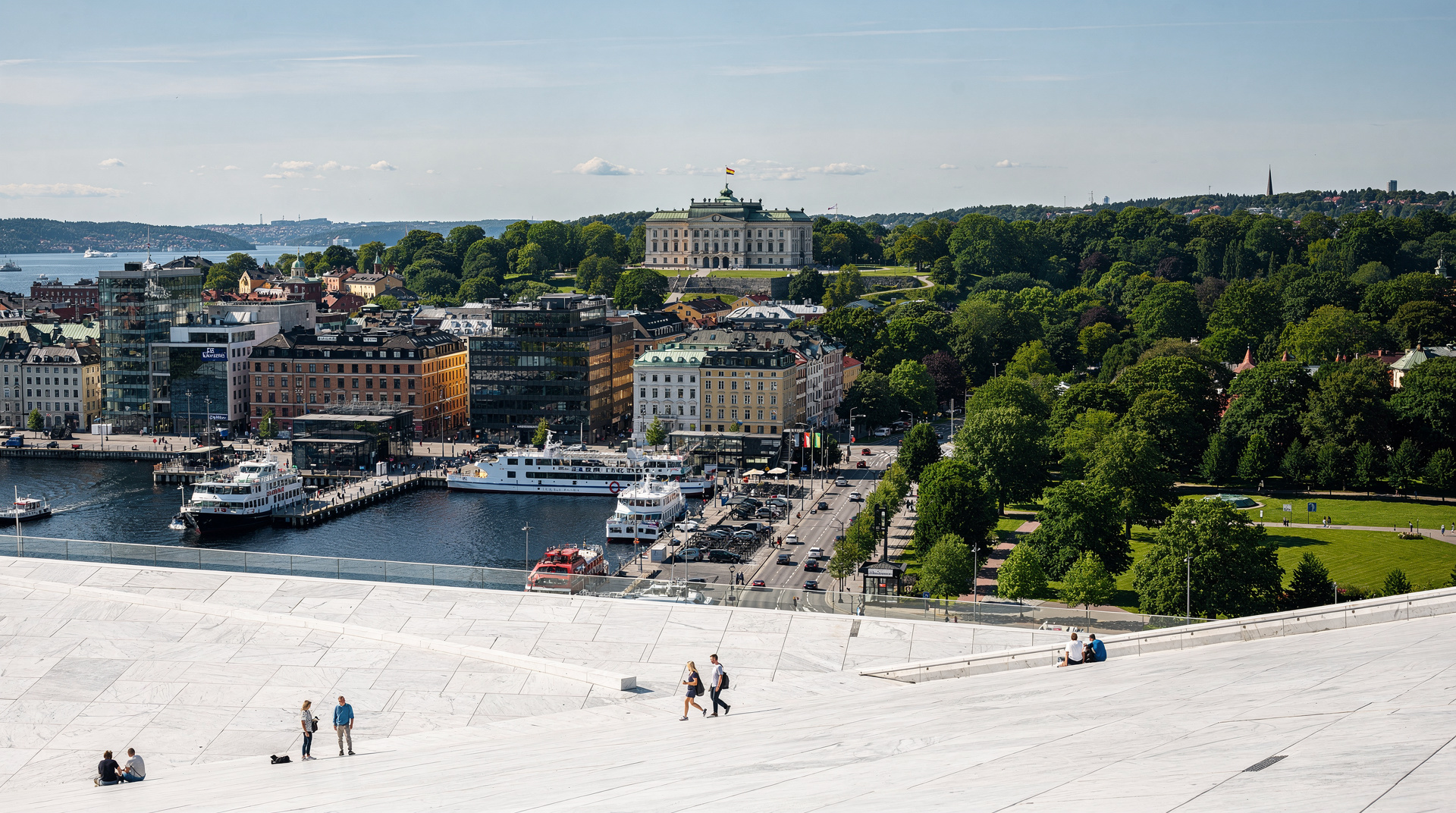
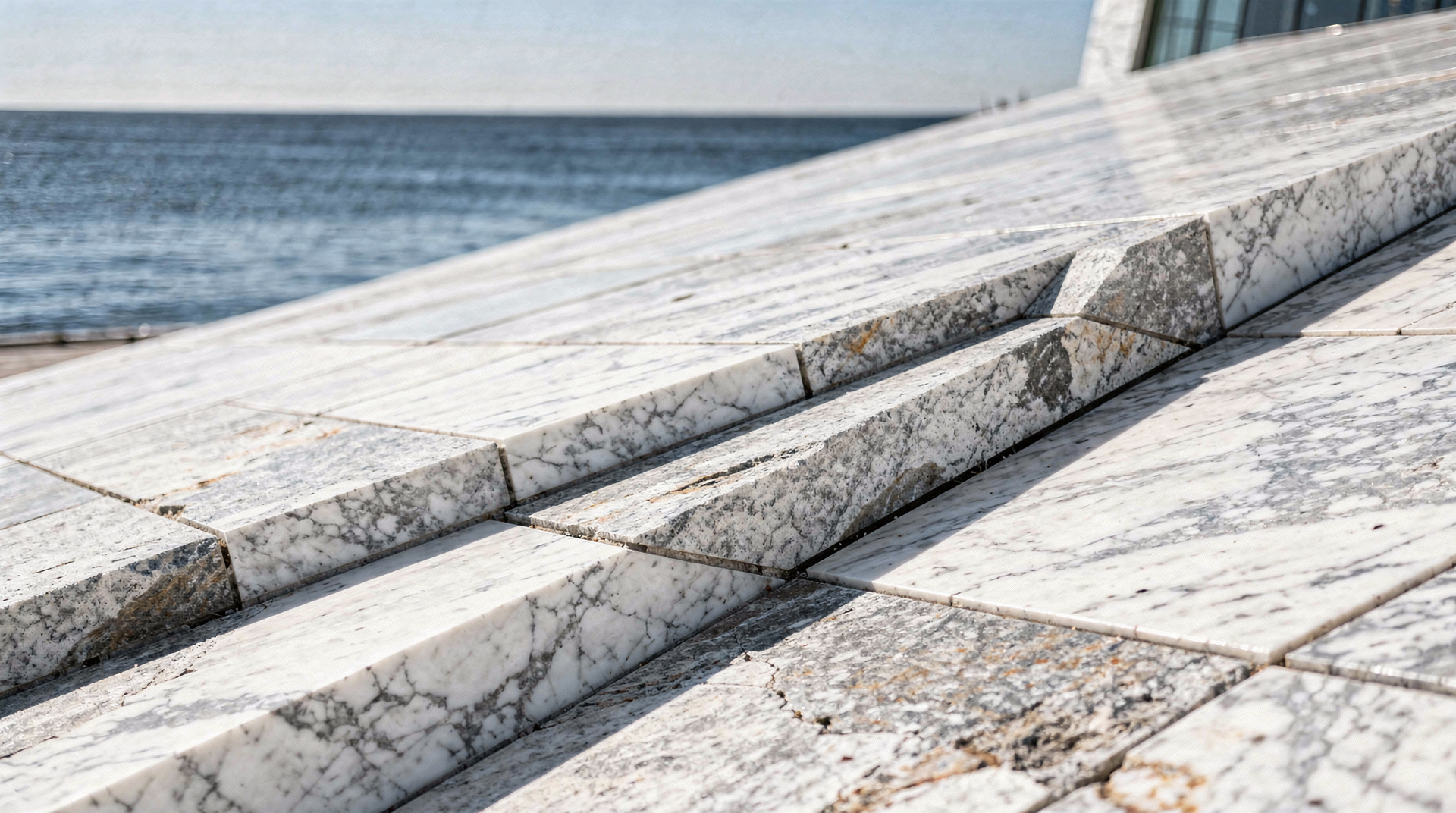
The roof is accessed from the waterfront on the south side of the building. There’s no entrance gate, no turnstile, no staff. Walk from the pavement onto the white marble slope and keep walking upward. The surface is textured to prevent slipping in rain.
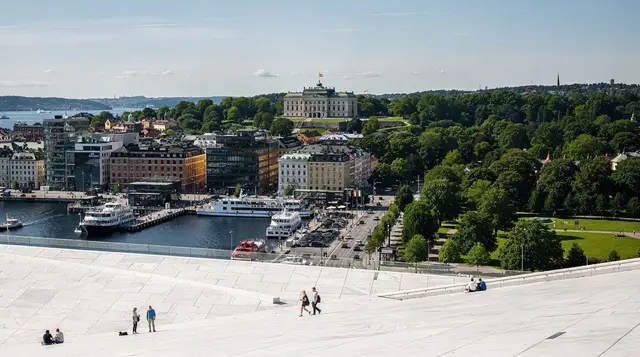
The peak of the roof sits 22 metres above sea level. From the top you look out in three directions:
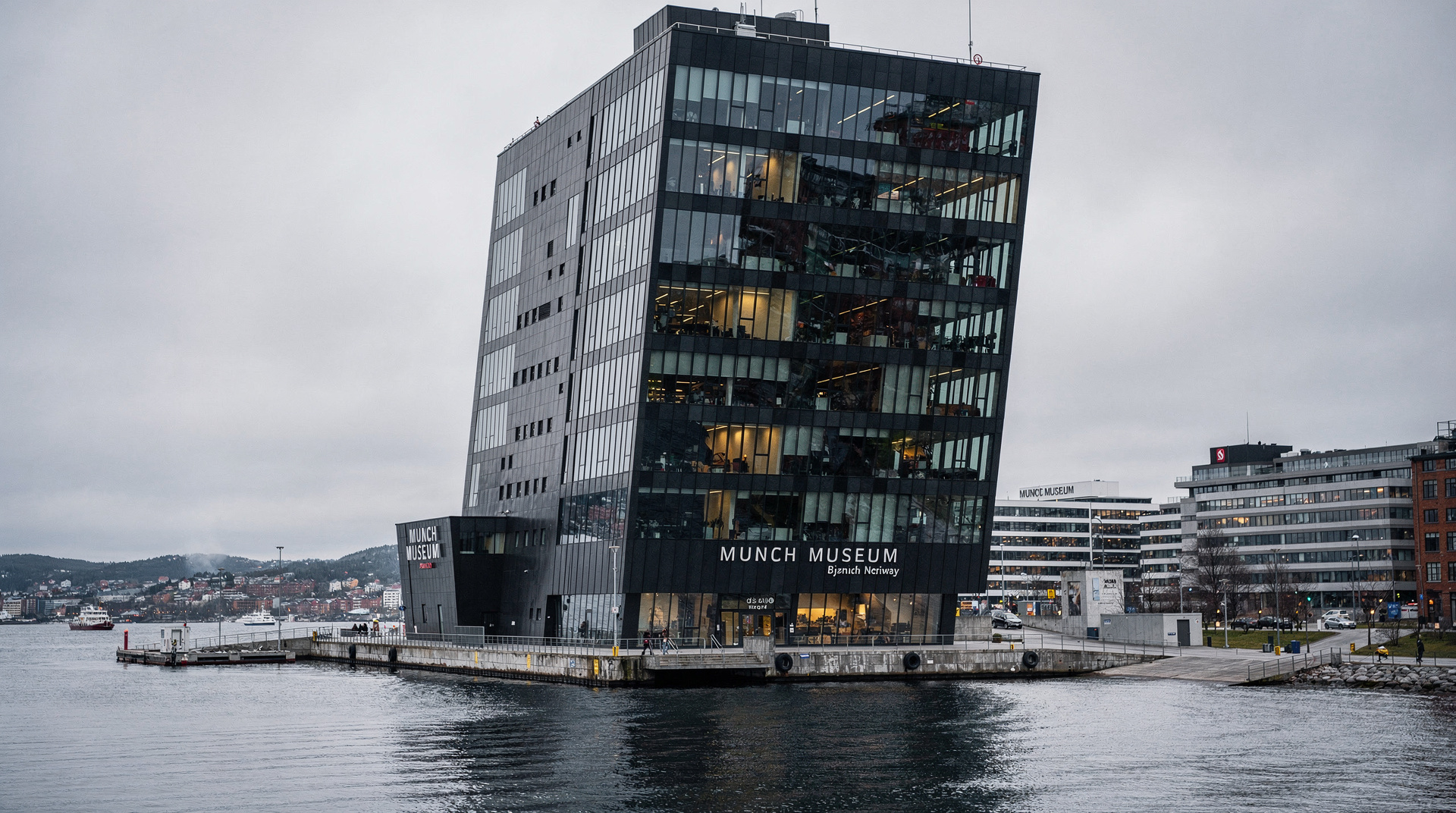
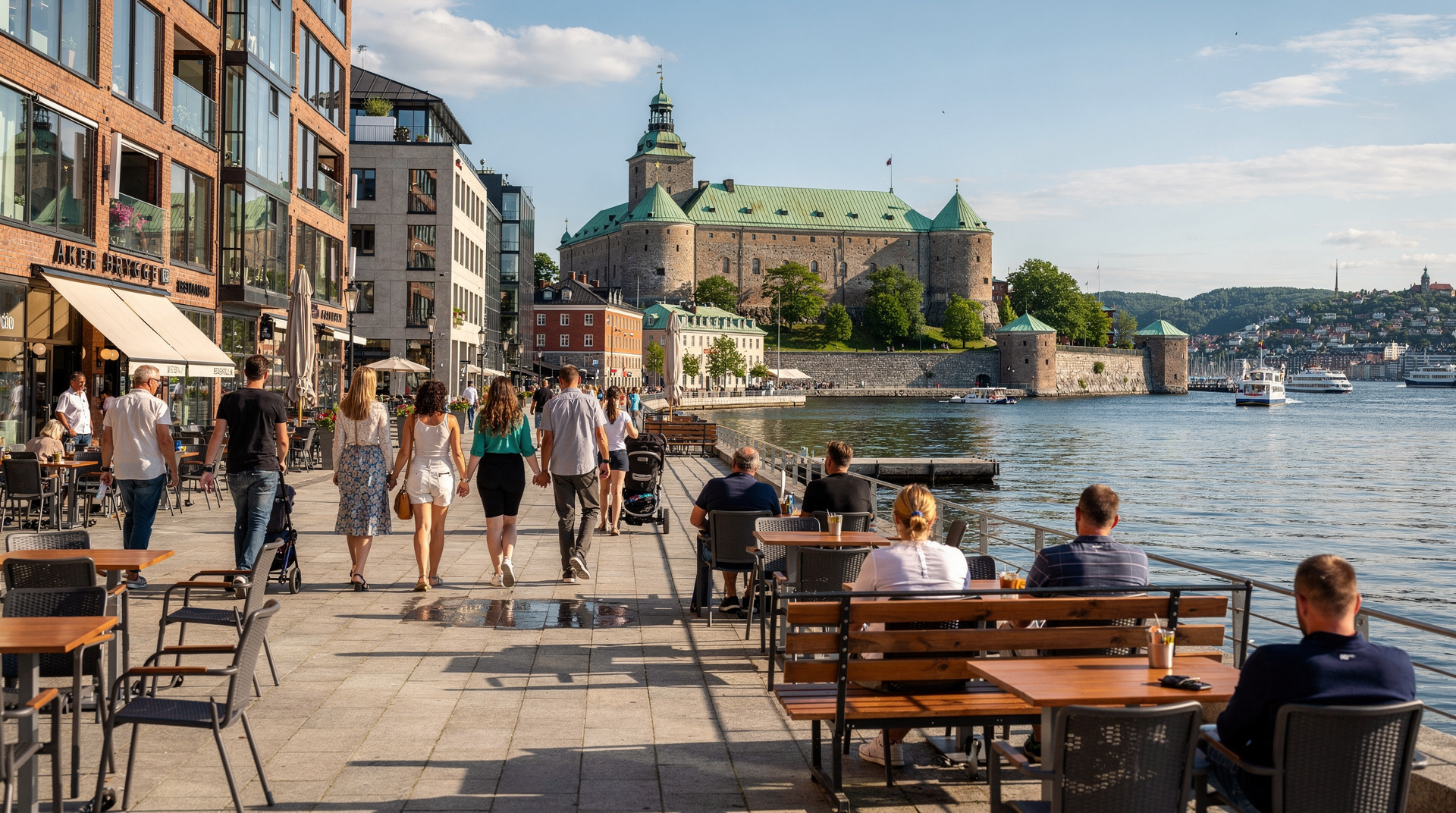
East: The Bjørvika canal, the new Munch Museum tower, the Barcode office district behind it. West: The Oslofjord, Akershus Fortress on its headland, and Aker Brygge in the distance. North: The city centre and the wooded hills behind Oslo (Holmenkollen is visible on clear days).
The roof surface is large enough that on a weekday morning you can be essentially alone at the top. On a Saturday afternoon in July you’ll share it with 100+ people, which is still a genuinely pleasant experience — the space is big enough.
Access: Open 24 hours. Free. No restrictions except common sense around the edges.
Inside the Opera House
The interior is open to visitors during the day without a performance ticket, as long as you don’t try to enter the auditorium. The main foyer is impressive: oak-clad walls, a curved wooden ceiling, and the sense of an expensive instrument well-maintained.
Guided tours are available in Norwegian and English, typically lasting 60 minutes. They cover the main stage, backstage areas, the machinery for scene changes, and the history of the building. Book through operaen.no. Cost approximately NOK 150 to 200 (USD 16 to 22).
Performances: The Norwegian National Opera and Ballet performs here. The programme runs September through June with a lighter summer schedule. Ticket prices range from NOK 250 (budget seats) to NOK 1,100 (USD 27 to 118) for the best positions. Opera in Oslo is significantly cheaper than London, Vienna, or Milan. Supertitles in Norwegian and English are standard.
The main auditorium holds 1,364 seats. The acoustic design uses a traditional European horseshoe shape rather than the fan-shaped formats common in newer houses. The result is warm and intimate for a hall of its size.
The wave wall: One of the interior’s memorable details is the undulating oak wall behind the main stage — a single surface of Norwegian oak carved into a wave form that wraps around the back of the house. It’s visible from the foyer and worth seeing even if you don’t enter the auditorium.
Architecture: what Snøhetta was solving
The building sits on what was, until 2008, a functional but aesthetically bleak industrial harbour. The design brief required integrating a major cultural institution with Oslo’s waterfront while making the building accessible to people who would never buy an opera ticket.
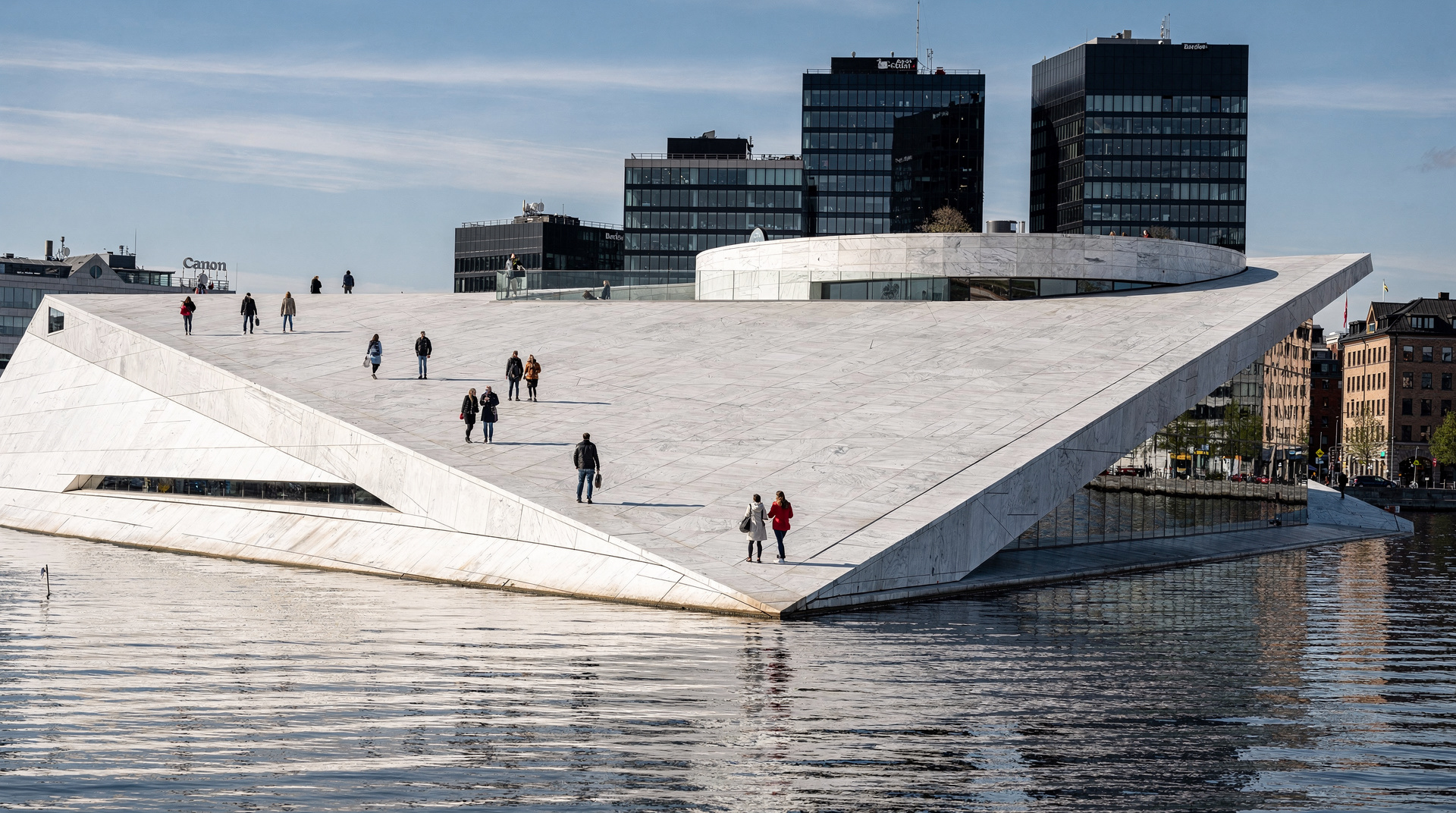
Snøhetta’s answer was to treat the roof as topography rather than building. The sloping surface connects the sea level to the building’s main entrance and continues over the top — making the roof a pedestrian landscape rather than a service area. The building appears to emerge from the harbour like an iceberg.
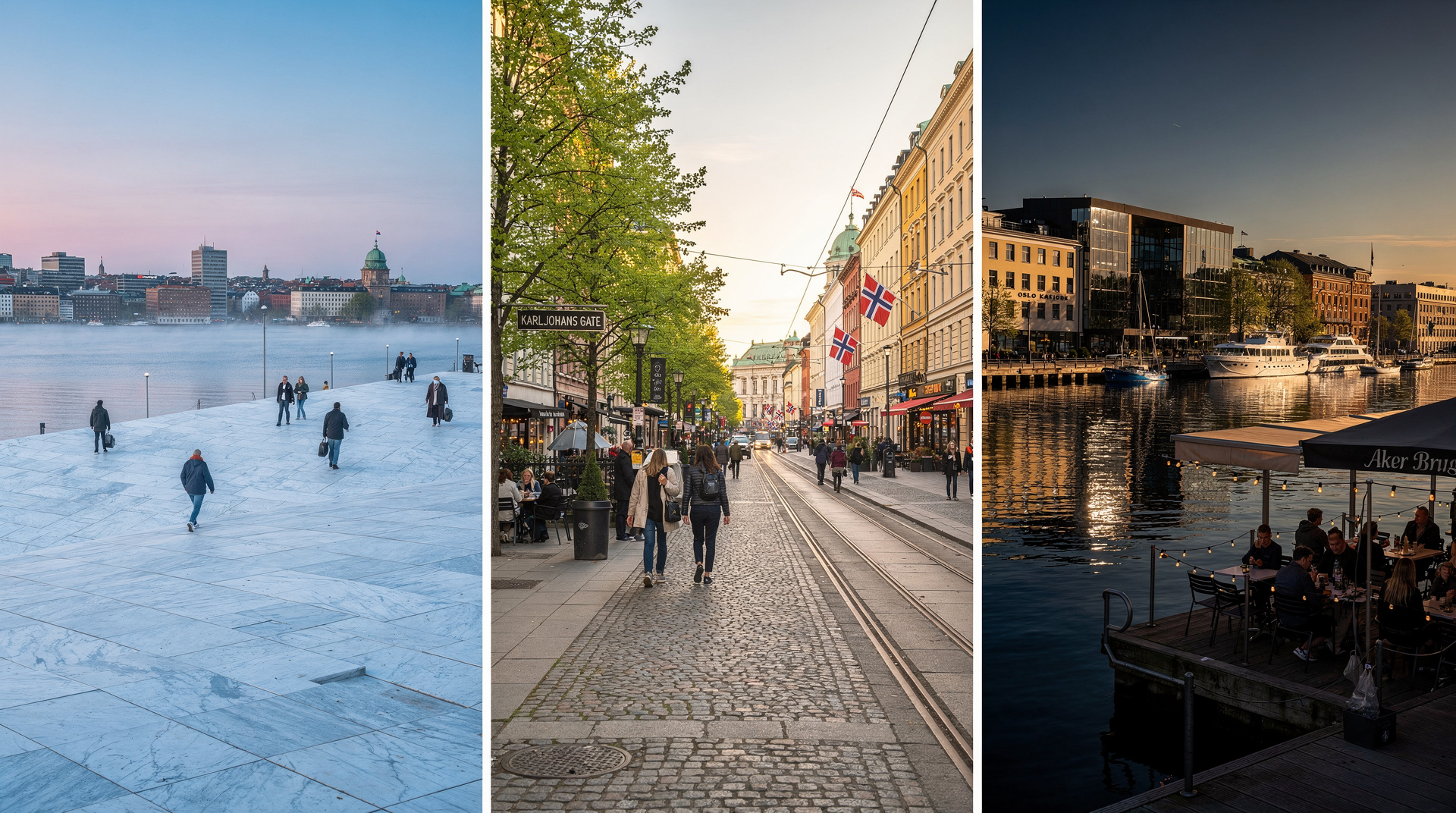
The white stone cladding (Carrara marble and Italian granite) was controversial at the time — Norwegian architects argued for Norwegian stone. Snøhetta chose Italian materials for their colour consistency and their ability to reflect changing sky conditions. In morning light the roof glows amber. In overcast light it turns grey-blue. In summer evening light it turns amber again and the fjord reflection lights the marble from below.
The building won the Mies van der Rohe Prize in 2009 — the European Union’s most prestigious architecture award.
Bjørvika: the neighbourhood around the Opera House
The Opera House anchors a larger regeneration project. In 2008, Bjørvika was a motorway junction and container port. By 2026 it’s Oslo’s most architecturally ambitious neighbourhood. The Bjørvika and Barcode destination guide covers the wider district in full; worth knowing here:
Munch Museum (Lambda): The 13-storey Munch Museum, opened in 2021, is five minutes’ walk east along the waterfront. It’s the world’s largest Munch collection. See the full Munch Museum guide.
Deichman Bjørvika: The new central public library, opened 2020, is immediately behind the Opera House. Eight floors, free entry, excellent fjord views from the roof terrace. One of Oslo’s best free buildings. Worth an hour.
Sørenga: Walking further east from the Munch Museum, Sørenga Sjøbad is Oslo’s most popular outdoor swimming area — free public bathing pontoons with ladders into the fjord. Open May through September. See the Oslo swimming spots guide.
The Barcode: The row of slim glass towers behind the Opera House is Oslo’s most discussed recent development. Opinions divide sharply between those who see urban density done right and those who feel it overwhelms the harbour scale. Worth seeing as a decision the city made deliberately.
The opera programme itself
If you want to attend a performance, the Norwegian National Opera and Ballet uses the building as its home stage from September through June, with a reduced summer season in July and August. The programme includes traditional opera (Mozart, Verdi, Puccini in the mainstream repertoire; Peer Gynt and other Norwegian works regularly scheduled), ballet (Norwegian National Ballet performs classical and contemporary works), and operetta.
Ticket prices range from NOK 250 for the cheapest seats to NOK 1,100 (USD 27 to 118) for premium central stalls. These prices are significantly lower than comparable productions in London, Vienna, or Paris — Norwegian opera is subsidised by the state at a level that makes it accessible.
Language note: All Norwegian opera productions use Norwegian supertitles above the stage. English supertitles are provided for most standard repertoire (Verdi, Mozart, Puccini, etc.). For obscure Norwegian works, English translations may not be available. Check the programme at operaen.no.
Dress code: There is no strict dress code. Business casual to formal evening dress all appear in the audience. Nobody will turn you away for jeans, but most people make some effort for major productions.
Booking: Book at operaen.no well in advance for premium performances. Last-minute rush tickets are sometimes available at the box office an hour before curtain but are not guaranteed for sold-out productions.
The architectural debate that preceded construction
The Oslo Opera House was not universally welcomed before it was built. When Snøhetta won the architectural competition in 2000, several competing firms and critics argued that the design was too monumental, too centred on a single building rather than an urban fabric of streets and public spaces.
The counter-argument, which has aged well: by making the roof into public topography, Snøhetta created something a collection of smaller buildings could not — a single clear reason to come to Bjørvika, a landmark visible from the fjord, an anchor for a neighbourhood that had no previous identity. The subsequent development of Bjørvika (Munch Museum, new library, Barcode, residential towers) has confirmed that the Opera House was the right kind of anchor.
The debate about the Barcode office towers behind the Opera House is less settled. Critics argue the towers are too dense and too commercial for a waterfront cultural district. Defenders say that Oslo needed to concentrate employment near central transport rather than spreading it outward. The argument continues.
Photography tips for the roof
The Opera House roof is one of the most photographed locations in Norway. A few practical notes for better shots:
Morning light (before 10am): The sun hits the south-facing roof surface from the east. The marble glows warm amber. Good for architectural photography showing the texture of the stone.
Evening light (after 7pm in summer): The sun drops toward the west and illuminates the roof from behind the Aker Brygge side. The fjord becomes a mirror. The silhouettes of the Barcode towers against the evening sky appear behind the Opera House outline.
Overcast days: Flat light removes the glare from the marble and allows the texture to read more evenly. Architecture photographers often prefer overcast conditions for exactly this reason.
People in frame: The Opera House roof is most alive as a photograph when it has people on it — their scale against the enormous marble slope communicates the building’s size better than empty architecture shots.
From the water: The Opera House is beautifully photographed from the Ruter ferry to Bygdøy, which passes the building’s south face at water level. The angle shows the marble slope emerging from the harbour, which is Snøhetta’s intended reading of the building.
Best time to visit
Summer evenings (June-August): The sun sets late — 10pm in midsummer — and the light on the marble at dusk is extraordinary. This is the Opera House at its best. Most locals are on the roof between 8pm and 10pm in summer.
Early morning any season: Before 9am, you’ll often have the roof to yourself. The light in the morning is different from evening but equally good.
Winter: The marble is exposed to the elements and can be icy — wear shoes with grip. The building glows differently against grey winter skies. Post-concert evenings in winter have their own atmosphere.
Avoid: midday in July (crowds, harsh light), and immediately before and after performances when the foyer is restricted.
Getting there
The Opera House is at Kirsten Flagstads plass 1, a five-minute walk south from Oslo Central Station. Walk through the Bjørvika underpass (a pedestrian tunnel under the motorway) or use the street-level crossing.
From Aker Brygge: a 15-minute waterfront walk east, or tram 12 to Jernbanetorget and then walk.
The nearest metro is Jernbanetorget (all lines).
Combining with a day itinerary
The Opera House and Bjørvika work naturally as a half-day combination with the Munch Museum next door. A full morning: arrive at the Opera House at 9am for the uncrowded roof, explore the interior foyer, then walk to the Munch Museum for 10am opening. After the museum, walk to the new Deichman library for lunch (there’s a café) before taking a tram to your afternoon destination.
For families, the combination of the free roof walk, the Munch Museum, and the library makes an excellent full morning that suits both adults and older children. The waterfront between the Opera House and Sørenga is also good for outdoor swimming in summer — see the Oslo swimming spots guide.
See the Oslo in 1 day itinerary for a complete timed plan that incorporates the Opera House into a full day of Oslo’s waterfront highlights.
Opera House vs. other Oslo view points
Several spots claim to offer Oslo’s best view; here’s honestly how the Opera House roof compares.
| Viewpoint | Cost | Effort | What you see |
|---|---|---|---|
| Opera House roof | Free | None — flat walk-up | Fjord, Barcode, Bjørvika at water level |
| Holmenkollen jump tower | NOK 185 | T-bane + lift | Panoramic city and fjord from above the treeline |
| Ekebergparken | Free | Tram + short walk | City skyline and fjord from a hillside |
| Vettakollen (Nordmarka) | Free | 45-min hike from Frognerseteren | Forest and distant city, no fjord close-up |
The Opera House wins on convenience and cost; Holmenkollen wins on sheer height and drama if you have a half-day to spare.
Where the Opera House fits in your wider plan
The roof works best as one stop in a longer day rather than a destination on its own. If you only have a day in the city, the Oslo in 1 day itinerary and the top things to do in Oslo both place it alongside the other waterfront highlights. With more time, the Oslo in 2 days plan lets you slow down and return for an evening visit. Travellers watching their budget will like that it sits on the free things to do in Oslo list, and the Oslo Pass guide is worth a glance if you plan to pair it with several paid museums.
Architecture fans can go deeper with our blog piece on the Oslo Opera House architecture, which looks at the design choices from a more personal angle. Nearby on the same stretch of waterfront, the Akershus Fortress guide covers the medieval headland you can see from the roof, and the Viking Planet guide is a useful stop if you want history after the modern architecture.
To move between these places without fuss, see the guide to getting around Oslo and the Ruter public transport guide.
Practical tips for a first visit
A few things that catch first-time visitors out: the marble roof has no barriers at the edges in most places, so supervise children closely near the upper section. There are no public toilets on the roof itself — use the ones in the foyer before heading up. And if you’re combining the visit with a performance, arrive at least 30 minutes early, since the ticket check and cloakroom queue can take longer than expected on a full house night.
Frequently asked questions about Oslo Opera House guide
When is the best time to visit the Oslo Opera House roof?
Sunrise and late evening are the best times for photography and atmosphere. In summer (June-August), the sun sets between 10pm and 11pm — an evening visit offers extraordinary light. Early morning (7-9am) means almost no crowds. Midday in July is the busiest and least atmospheric.Do you need to book to visit the Oslo Opera House?
No booking is needed to walk the roof — it's always free and open. To see a performance inside, book through operaen.no well in advance; the Oslo National Opera performs in Norwegian, with supertitles. Guided interior tours are available with advance booking.Who designed the Oslo Opera House?
The Oslo Opera House was designed by the Norwegian architecture firm Snøhetta and opened in April 2008. The building cost approximately NOK 4.4 billion (roughly USD 473 million at 2008 exchange rates). It won the European Union Prize for Contemporary Architecture in 2009.What is the Oslo Opera House made of?
The exterior sloping roof is clad in white Italian Carrara marble and white granite. The main box of the building is wrapped in glass. The interior uses oak wood panelling extensively. The marble surface is textured to reduce slipping when wet.What's in the Bjørvika area around the Opera House?
The Opera House is the anchor of the Bjørvika regeneration area. Within a 10-minute walk: the Munch Museum (2021), the new Deichman Bjørvika Public Library (2020), the Sørenga outdoor swimming area, and the Barcode district of glass office towers. This is Oslo's most architecturally coherent modern quarter.Is there a restaurant or café at the Oslo Opera House?
Yes. The ground floor of the Opera House has a café and a more formal restaurant open on performance evenings. The café is open to non-ticket holders during the day. Prices are Oslo-standard: NOK 50 to 75 (USD 5 to 8) for coffee.How much time should I set aside for the Opera House?
30–45 minutes covers the roof walk and a look at the foyer. Add an hour for a guided interior tour, or a full evening if attending a performance. Combined with the Munch Museum next door, budget a half-day for the whole Bjørvika waterfront.Is the Oslo Opera House roof accessible in winter?
Yes, it's open year-round, but the marble surface can be icy — wear shoes with grip and take it slowly near the edges. Winter visits have their own atmosphere, with the building glowing differently against grey skies, and far fewer visitors than summer evenings.
Top experiences
Bookable activities with verified prices and instant confirmation on GetYourGuide.