Oslo to Bergen by train: the Bergen Railway, one of the world's great journeys
From Oslo: one-way self-guided tour to Bergen (rail and cruise)
Duration: Full day
- Scenic railway
- Fjord cruise
How do I take the train from Oslo to Bergen?
The Bergen Railway (Bergensbanen) runs from Oslo S (Central Station) to Bergen, covering 492 km in approximately 6.5-7 hours. Trains run 4-5 times daily. Book through Vy (vy.no) — tickets cost NOK 299-899 depending on how far in advance you book and which fare class. First class (Komfort) costs about NOK 100-200 more and includes table seats and more space.
| Distance | 492 km, Oslo S to Bergen Stasjon |
| Duration | 6.5–7 hours |
| Frequency | 4–5 direct services daily |
| Price | From NOK 299 (Lowpris, book early) |
| Highlight | Hardangervidda plateau, Finse (1,222m) |
Why the Bergen Railway matters
The Bergensbanen (Bergen Railway) is 492 km of track connecting Oslo and Bergen, crossing the Hardangervidda — the largest high-altitude plateau in Europe. It crosses the watershed between eastern and western Norway, climbs to 1,301 metres at Taugevann (the highest point on the main line), and descends through some of the most dramatic railway engineering in the world.
When it was completed in 1909, it was an engineering achievement that fundamentally connected eastern and western Norway for the first time in winter. The western approaches between Myrdal and Voss involved tunnels, spiralling descents, and structures that were extraordinary for their time. Today, 6-7 million passengers ride the line annually.
By the standards of scenic train travel worldwide, the Bergen Railway belongs in the top tier alongside the Trans-Siberian, the Glacier Express, and the Rocky Mountaineer — but it is significantly cheaper and easier to book independently.
The full journey: Oslo to Bergen
Oslo to Drammen (45 minutes)
The first section runs west from Oslo S along the Oslofjord, then turns through the forest hills behind the city. This is largely suburban and industrial — not the scenic section. Use the time to settle in, check your ticket, and buy from the dining car.
Drammen to Geilo (3 hours)
After Drammen, the railway climbs through the Numedal valley and into the forested mountains of eastern Norway. The landscape becomes increasingly wild: farms give way to forest, villages become smaller, and the hills turn into proper mountains. Norefjell and the surrounding area are popular ski destinations visible from the train in winter.
At Geilo — a major ski resort at 800 metres — the railway reaches the mountain region proper. If you are looking for scenery, Geilo to Finse is where to put the camera away and look out the window instead.
Geilo to Finse: the Hardangervidda crossing
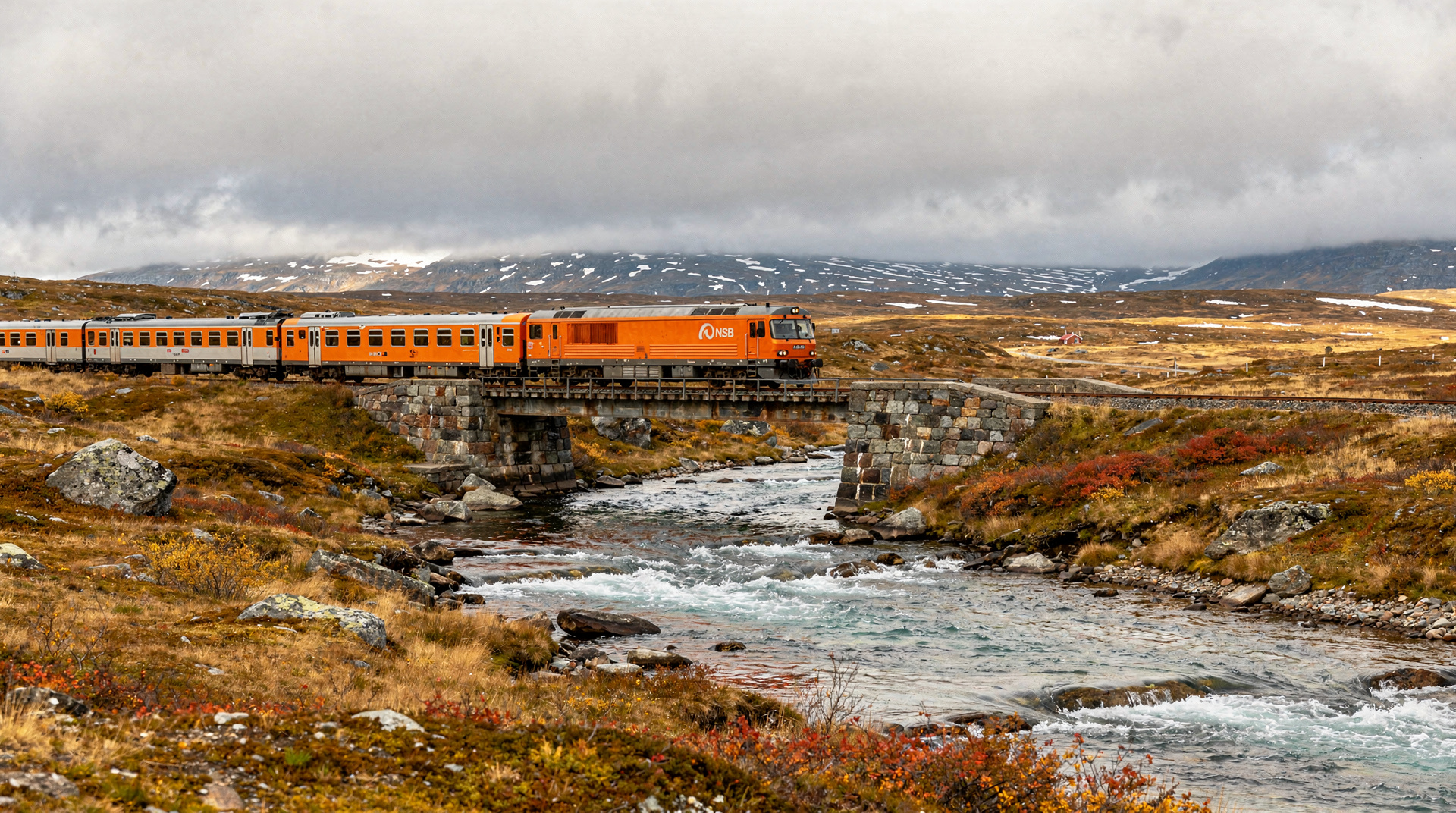
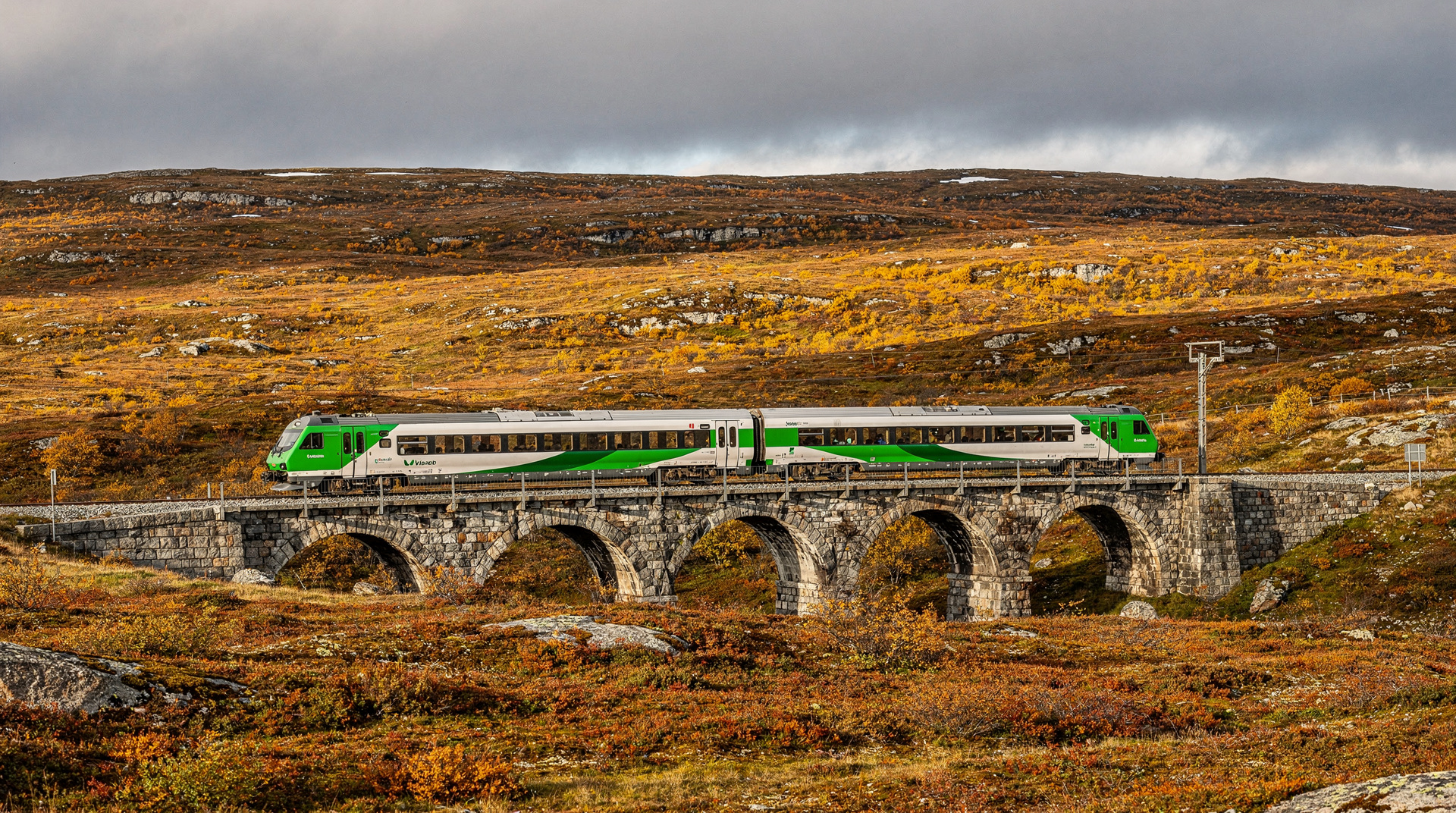
The Hardangervidda plateau is the defining section of the Bergen Railway. This 8,000 square kilometre plateau at roughly 1,000-1,300 metres is the largest high-altitude plateau in Europe and one of the few genuine wilderness areas accessible by rail anywhere in the world.
At Finse (1,222 m), the train reaches the edge of the Hardangerjøkulen glacier — one of Norway’s largest glaciers, visible from the station. In late spring and early summer, the glacier’s blue-white surface is often close to the track. In winter, Finse is one of the most extreme railway station environments in western Europe: accessible only by train, surrounded by snowfields that can be metres deep.
The railway traverses the plateau through several long tunnels (avoiding the worst winter conditions), with open sections giving views across a treeless tundra of lakes, bogs, and lichen-covered rock. The scale is striking. On a clear day, the horizon in every direction is empty of human structures.
Practical note: Between Geilo and Myrdal, window-seat availability matters. If you booked an aisle seat and the window seats are empty after departure, move. On a busy July train this may not be possible; on a weekday departure it usually is.
Myrdal: the Flåm Railway junction
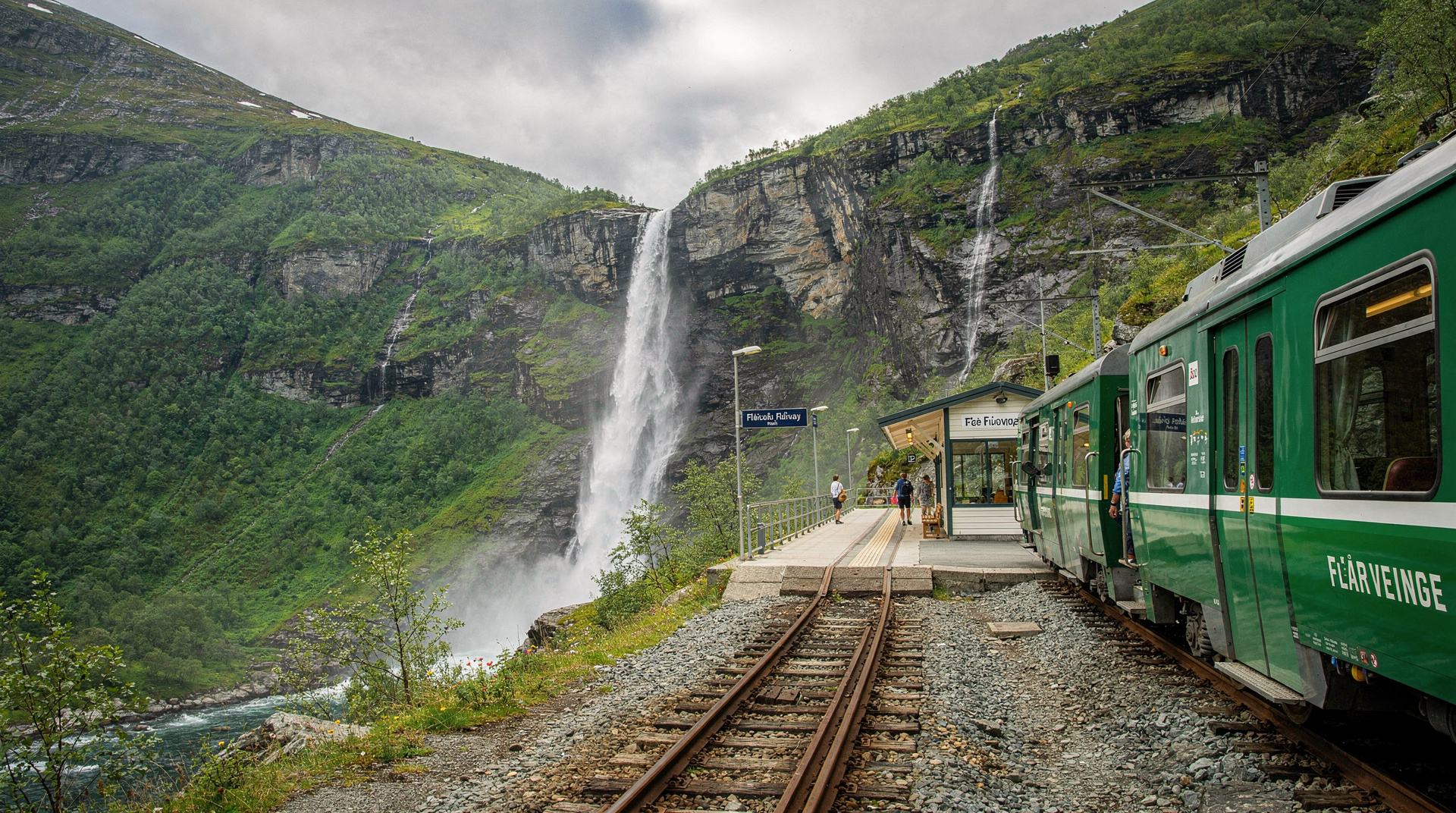
Myrdal is not a village — it is a junction station at 867 metres. Trains from Oslo stop here to allow passengers transferring to the Flåmsbana branch line to disembark. If you are doing Norway in a Nutshell, you get off here and descend to Flåm on the branch line.
If you are staying on the Bergen Railway, the train continues west. The next section — Myrdal to Voss — is the most dramatically engineered: the railway descends 600 metres in less than 30 km, using a series of horseshoe curves, long tunnels (including the spectacular Gravhalsen tunnel, which curves 180 degrees inside the mountain), and bridges over deep ravines.
Myrdal to Voss (40 minutes)
The descent from Myrdal to Voss passes through an enclosed, forested landscape — darker and greener than the plateau. The river valleys are narrow and steep. Stalheim, one of Norway’s most photographed views (a classic Norwegian valley seen from above), is visible briefly.
Voss is a significant station where some passengers disembark for skiing in winter. The city itself has a long fjord visible from the station.
Voss to Bergen (1 hour)
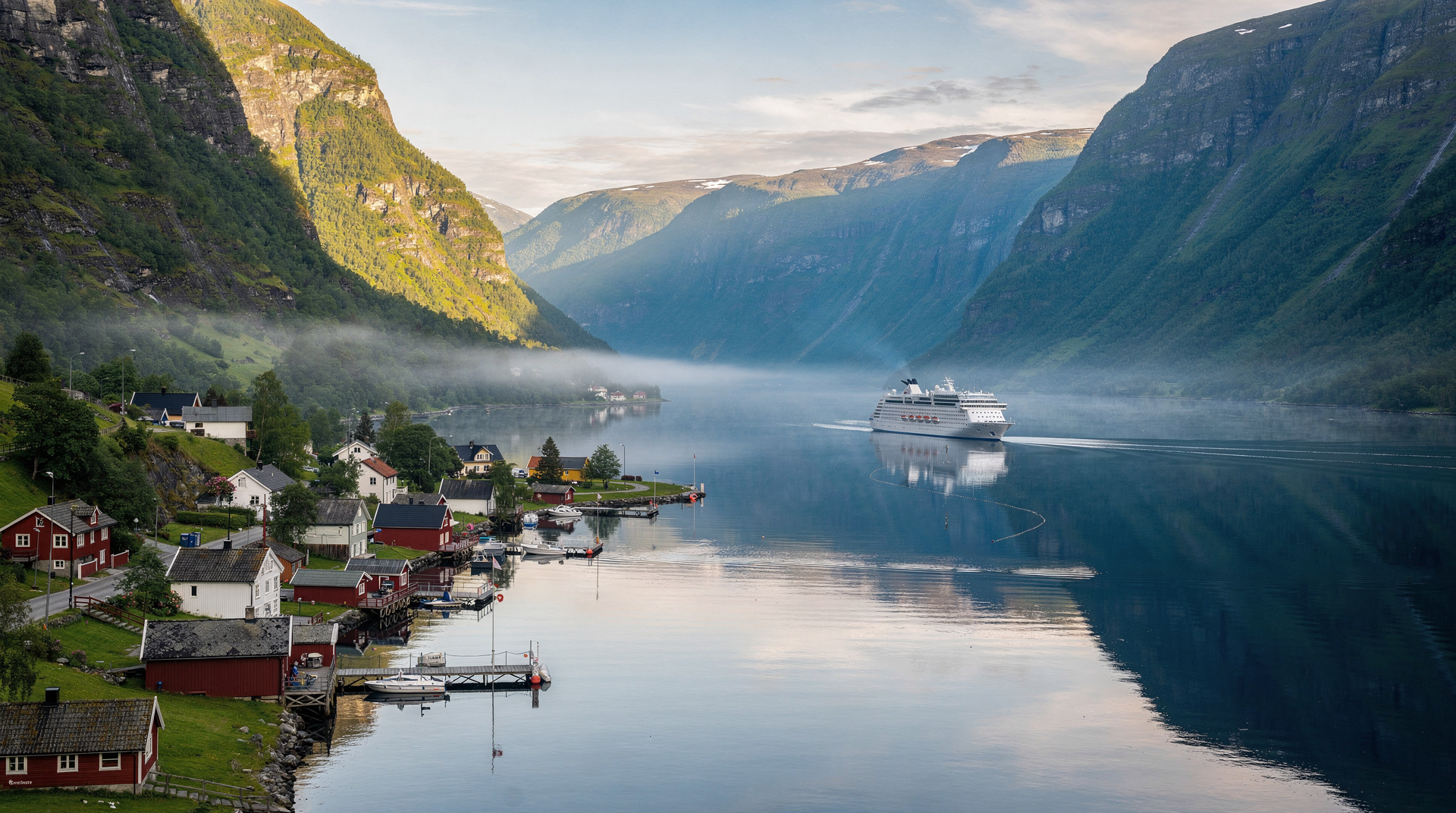
The final hour from Voss to Bergen runs through the fjordland of western Norway, following lake shorelines and fjord banks. The approach into Bergen through Bergensdalen gives views of the surrounding mountains — the seven hills that define Bergen’s geography — before arriving at Bergen Stasjon.
Tickets, prices, and booking
Where to book: Vy (vy.no) is the primary Norwegian rail operator. Tickets are available online up to 3 months in advance. International booking via Eurail/Interrail is also possible.
Fares (approximate, as of spring 2026):
- Lowpris (cheapest advance fare): NOK 299-499 (~USD 32-54) one-way. Very limited availability; book early.
- Standard fare: NOK 499-799 (~USD 54-86)
- Komfort (first class): NOK 699-999 (~USD 75-107). Includes a larger seat, table, and more legroom.
Return journey: A one-way ticket Oslo-Bergen is often cheaper if you have flexible dates and book Lowpris fares in each direction separately.
Booking advice: For July and peak summer travel, book 6-8 weeks in advance. For May, June, and September, 2-3 weeks is usually sufficient. The Lowpris fares sell out first; Standard fares remain available longer.
Choosing your seat
Seat configuration: Most Vy trains on the Bergen Railway use double-deck or standard coaches with 2+2 seating (A, B on one side; C, D on the other; E for middle seats in 2+3 configurations, if applicable).
For the Hardangervidda: Sit on the right side going from Oslo to Bergen (seats B or D) for the best views of the glacier approach at Finse. The left side (A or C) gets better views in a few specific spots.
Table seats: Komfort class has table seats in compartments of 4 facing each other. Standard class on some trains also has table configurations. These are preferable for long journeys and allow easy access to food and maps.
Where to sit for the descent to Bergen: Switch to the left side after Myrdal for the most dramatic valley views descending toward Voss.
Dining on the train
The dining car or food trolley typically sells hot meals, sandwiches, and drinks. Food quality is acceptable but not exceptional; prices are in line with Oslo (NOK 100-200 for a hot dish, NOK 50-80 for a sandwich). If you are doing a 7-hour journey, bring your own food as backup or buy a larger meal in the dining car.
Recommendation: Buy good Norwegian bread, cheese (Jarlsberg, brunost), and cold cuts from a grocery store near Oslo S before departure (Kiwi on the station concourse is convenient). Add a thermos of coffee. This is what Norwegian families do and it is significantly better than the food trolley.
Water and snacks: Bring a reusable water bottle — cafe car prices for bottled water are high relative to a Kiwi or Rema 1000 purchase before boarding. Norwegian confectionery (a bag of Kvikk Lunsj bars, the local Kit-Kat equivalent) makes a cheap, filling snack for a long journey and is a small piece of local food culture worth trying regardless.
The Oslo to Bergen journey as part of Norway in a Nutshell
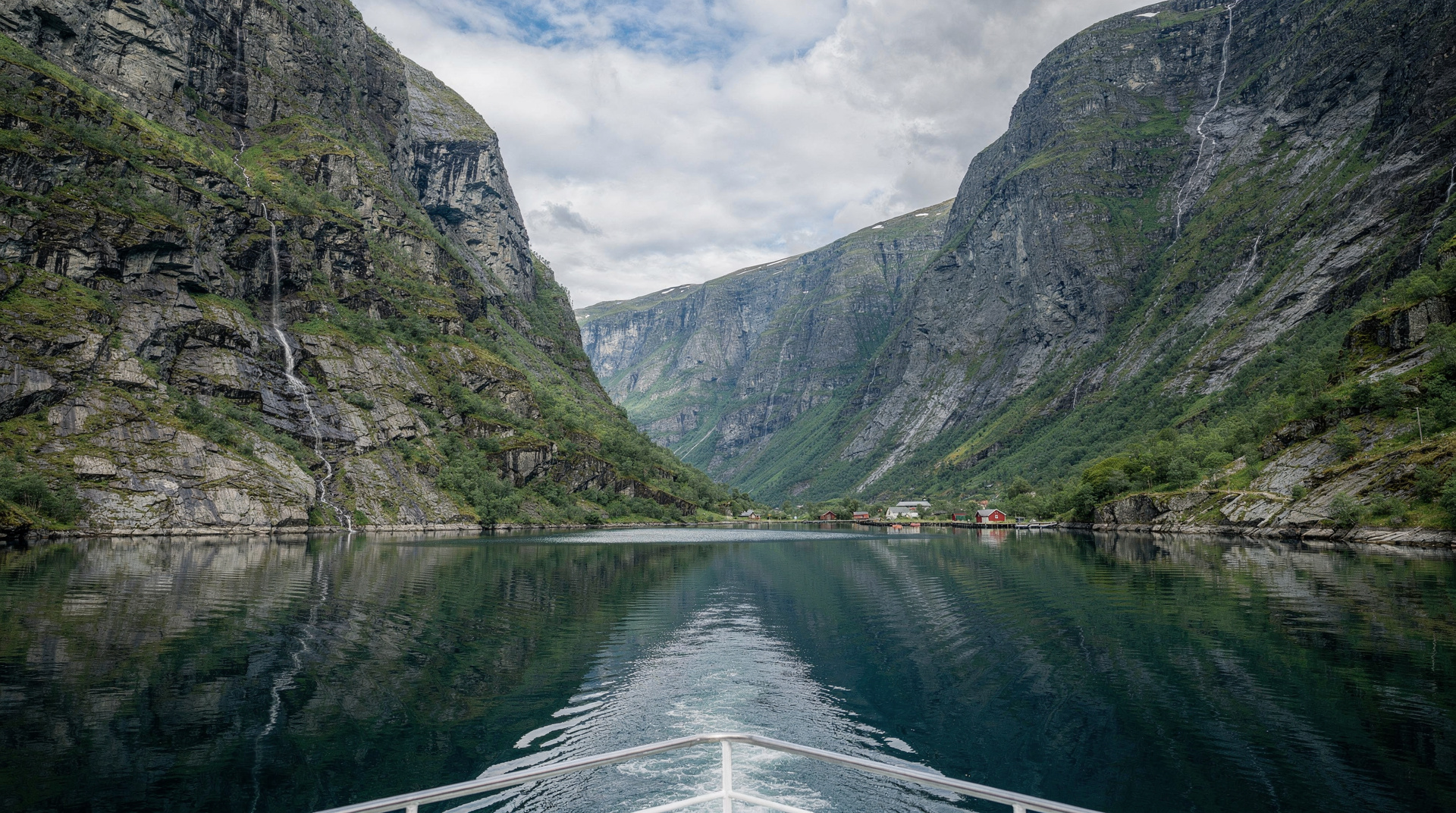
The Bergen Railway is the backbone of the Norway in a Nutshell route. If you have two days (rather than one), doing the route via Myrdal, the Flåmsbana, and the Nærøyfjord cruise is significantly more spectacular than the direct Bergen Railway alone.
For full details, see our Norway in a Nutshell guide and the dedicated Flåm Railway guide.
Train vs flight vs Norway in a Nutshell: the quick version
The Bergen Railway is one of three realistic ways to travel between the two cities, and it isn’t automatically the right choice for everyone. If time matters more than scenery, a 50-minute flight gets you there faster overall once you accept the loss of the journey itself. If you want the fjord scenery at its most dramatic rather than just the mountain plateau, Norway in a Nutshell via Flåm and the Nærøyfjord adds a full extra day of travel but delivers considerably more. The full Oslo to Bergen options comparison runs the honest numbers on all three.
Extending the trip: Bergen and beyond
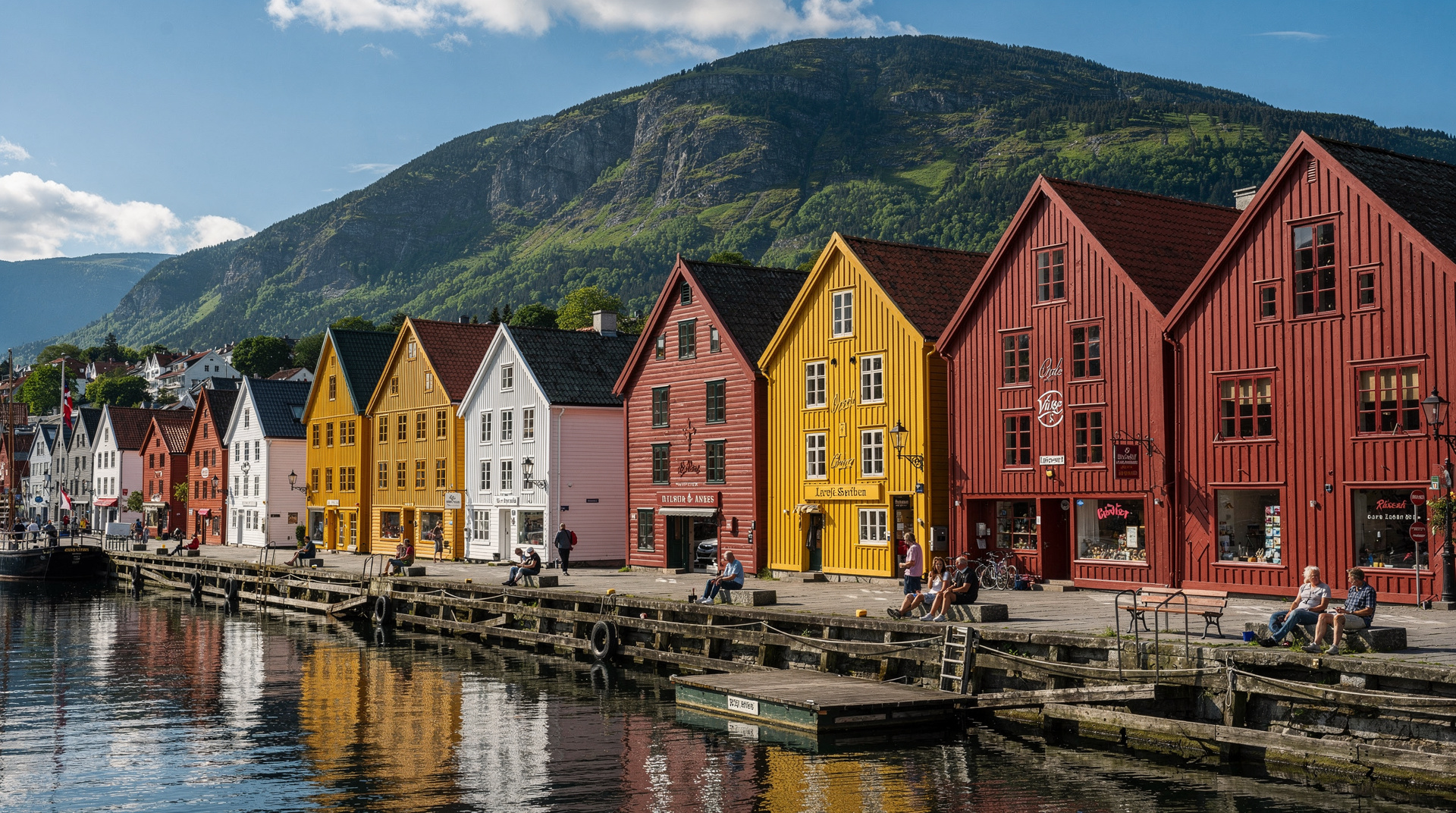
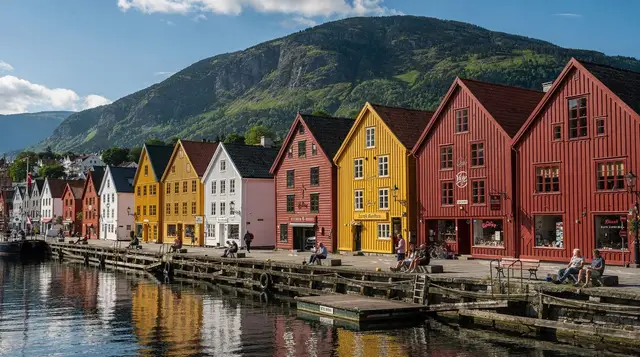
Most travellers taking the full 6.5–7 hour journey plan at least one night in Bergen before returning — a same-day round trip means over 13 hours of travel for a few rushed hours in the city, which undersells both ends of the journey. The Bergen from Oslo guide covers accommodation, the Bryggen wharf, and the Fløibanen funicular in more depth than the summary above. For travellers extending further west, Bergen is also a natural base for reaching the Hardangerfjord and other western fjords without backtracking through Oslo.
How to pace a long day on the rails
A journey this long is easier if you treat it as three different moods rather than one block of time. The first stretch out of Oslo is a settling-in phase: sort your bags, find your seat, and eat something before the scenery asks for your full attention. The middle stretch, from the mountains around Geilo to the plateau and on to Myrdal, is the part to watch with the window in front of you rather than a screen. The final descent toward the western fjords is a gentler, greener wind-down, and a good moment for a hot drink and a first look at your Bergen map.
Charge your phone and camera before you leave the hotel, because on-board sockets are not something to bank on in every carriage. Keep a layer within reach even in summer: the high plateau can feel very different from the platform you left in Oslo, and the stop at the highest stations lets cooler air into the carriage. Photography through train glass works best when you press the lens close to the window and avoid the flash, so reflections stay out of the frame.
If you travel with children, the table seats and the dining car break up the hours well, and a few games or a drawing pad go a long way. Our Oslo with kids guide and the family fjord activities page help you plan what comes before and after the train day.
Which season suits the Bergen Railway
The line changes character completely with the calendar. In summer, long daylight hours mean you see the whole route in light, and the plateau is a landscape of lakes, tundra, and lingering snow patches. Our Oslo in summer guide shows how to pair the train with the rest of a warm-weather trip. In autumn the colours on the lower slopes are a quiet bonus, and the Oslo in autumn guide covers what else the season offers.
Winter is the dramatic option: deep snow, short days, and a plateau that looks like polar country. Daylight is limited, so check the daylight hours by season page before you pick a departure, and prefer the earliest train so that the mountain section falls in the light. If you are weighing seasons in general, the best time to visit Oslo guide and the summer versus winter comparison give the wider picture, and winter activities in Oslo suggests how to fill the days around your departure.
Planning the days around the train
Because the train eats most of a day, the sensible approach is to build the rest of the trip around it. Spend your first days in Oslo seeing the essentials, then take the line west once you have a feel for Norwegian prices and habits. The how many days in Oslo guide helps you decide how long to stay before leaving, and the Oslo to Bergen Nutshell 2-day itinerary turns the scenic route into a ready-made plan.
Budget matters here too. Rail fares are only one line in the total, and Norway is not cheap, so the Oslo trip cost and is Oslo expensive pages are worth a look before you commit to hotels in both cities. If you want to compare the two destinations before choosing how long to give each, the Oslo versus Bergen comparison and the Bergen Railway scenic guide add context, and the Bergen destination page introduces the city you are heading to.
Finally, think about how you will use the arrival. Reaching Bergen in the afternoon or evening leaves you with a calm first night rather than a rushed sightseeing sprint. Check in, walk the harbour, eat somewhere simple, and let the next morning be the real start. That rhythm turns a long train day into the opening chapter of the west-coast leg rather than an endurance test.
Getting to Oslo S
Oslo Sentralstasjon (Oslo S) is the main rail hub, at Jernbanetorget in central Oslo. All Bergen Railway trains depart from here. The Flytoget airport express arrives here; the metro (T-bane) hub at Jernbanetorget gives access from all parts of the city.
See our Oslo airport to city guide and getting around Oslo for transport logistics.
Frequently asked questions about Oslo to Bergen by train
How long does the Oslo to Bergen train take?
The Bergen Railway journey takes approximately 6 hours 30 minutes to 7 hours depending on the specific train service. Some express services are slightly faster. The train makes stops at Drammen, Honefoss, Geilo, Myrdal (junction for the Flåm Railway), Voss, and Dale before reaching Bergen.Which side of the train should I sit on Oslo to Bergen?
Sit on the right side (window seat B or D in most Norwegian train configurations) for the best mountain views in the central section, especially around Finse and Hardangervidda. For the Bergen arrival — the Bergensdalen valley — the left side (A or C) is better. For a first trip where you will not have a second chance to compare, right-hand seats give the most iconic plateau views.What is the most scenic part of the Bergen Railway?
The highest section — Geilo to Finse to Myrdal — is the most dramatic. Finse station (1,222 m, the highest point) sits on the Hardangervidda plateau beside the Hardangerjøkulen glacier. In winter, Finse is surrounded by Arctic-like tundra; in summer, it is a high-altitude wilderness of lakes, tundra, and snow patches.Can I do the Bergen Railway as a day trip?
The Bergen Railway is best done as a one-way journey rather than a return in a day — 7 hours each way (14 hours return) with little time in Bergen is exhausting and misses the point. Either spend at least one night in Bergen, or do the Norway in a Nutshell route (Oslo to Bergen via Flåm and the Nærøyfjord), which turns the return journey into a different scenic experience.Is the Bergen Railway worth the full day it takes?
Yes, decisively. The journey from Oslo across the Hardangervidda plateau and down to Bergen is one of the top 10 most scenic train journeys in the world by most serious travel rankings. The Hardangervidda section alone — 4+ hours of high plateau wilderness — is unlike anything accessible by train in western Europe.
Top experiences
Bookable activities with verified prices and instant confirmation on GetYourGuide.
From Oslo: one-way self-guided tour to Bergen (rail and cruise)
- Scenic railway
- Fjord cruise
From Oslo: self-guided Norway in a Nutshell round trip (Flåm train and Nærøyfjord cruise)
- Flåm Railway
- Nærøyfjord cruise
From Oslo: train and bus tour to Bergen via Hardangervidda and fjord
- Hardangervidda
- Fjord views