Munch Museum Oslo ticket: review, tips and booking
Oslo: Munch Museum admission ticket
Duration: Flexible
- Skip the ticket line
- Instant confirmation
| Where | Edvard Munchs plass 1, Bjørvika, Oslo |
| Cost | Around NOK 160/adult; free with Oslo Pass |
| Time needed | 2–3 hours |
| Getting there | Tram 13 to Bjørvika, or 10-min walk from Oslo S |
| Best time | Weekday morning at 10:00 opening, before tour groups |
The building before the art
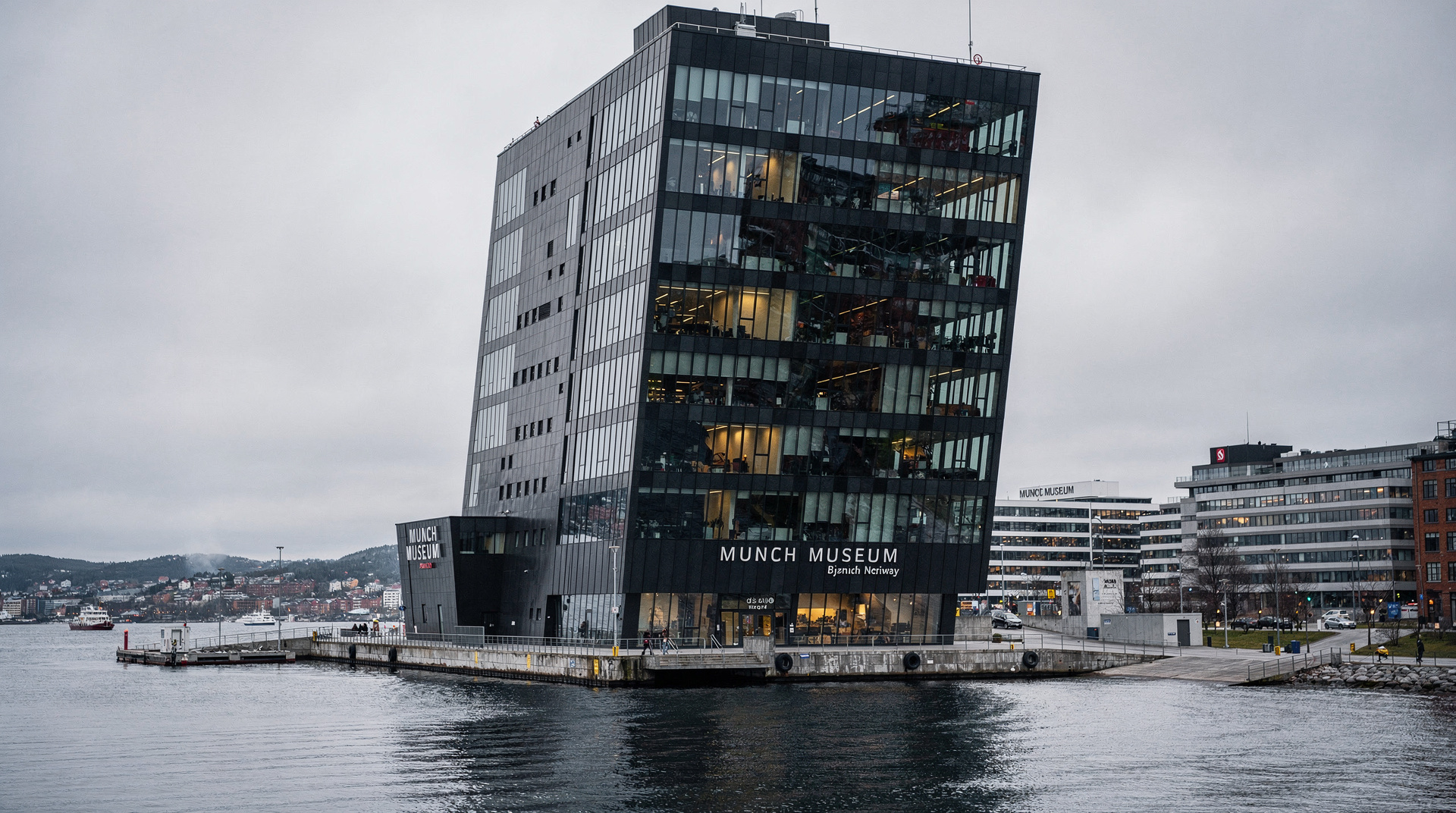
The Munch Museum that opened in 2021 — Lambda — is not a neutral vessel for art. The 13-storey tower by Estudio Herreros tilts dramatically toward the fjord at its upper floors, sheathed in a perforated aluminium skin that shifts in colour through the day. From the water it looks improbable; from inside, the angled windows on the upper floors frame the Oslofjord and the Opera House below in a way that would be extraordinary even without a single painting.
The building’s location in Bjørvika, at the edge of the old container port development that has transformed eastern Oslo since the early 2000s, is deliberate. Munch was born in Løten, grew up in Oslo, and died here in 1944. The city’s decision to anchor the museum in its newest, most architecturally ambitious neighbourhood positions Munch as a contemporary cultural asset rather than a historical relic.
The move from the previous Munch Museum building in Tøyen — a much smaller 1960s structure that held the collection for decades — was controversial. Tøyen residents argued that the museum belonged in their neighbourhood; architects and urban planners argued for Bjørvika’s waterfront prominence. Bjørvika won. The debate about whether the collection gained or lost something in the move is ongoing in Oslo cultural circles; the practical reality for visitors is a dramatically more ambitious building with significantly improved exhibition conditions.
What you actually see inside
Edvard Munch left virtually his entire estate — paintings, drawings, prints, watercolours, photographs, personal letters, and diaries — to the city of Oslo. The collection numbers over 26 000 works: the most complete archive of a single artist’s output held by any museum anywhere. At any given time the museum displays 400 to 600 of these, rotating between permanent and temporary galleries.
The permanent collection is organized thematically rather than chronologically. You move through rooms organised around themes: anxiety and isolation, love and loss, the body, death and the beyond. This approach can be disorienting if you expect a linear narrative of Munch’s development, but it creates concentrated emotional impact in each room.
The Scream is the obvious centrepiece. The Munch Museum holds the 1910 tempera-on-cardboard version, which some art historians consider more expressive than the 1893 version at the National Museum. The painting is housed in a dedicated gallery with controlled lighting and viewing distance — you can stand reasonably close without the claustrophobia of a dense crowd (book a timed slot that starts on the hour on a weekday morning for the best experience). For more on the painting’s context and meaning, see the story of The Scream.
Beyond The Scream, the rooms devoted to The Frieze of Life — Munch’s four-part cycle exploring love, anxiety, and death through paintings developed from the 1890s onward — are arguably more interesting for sustained looking. Madonna, Ashes, The Dance of Life, and Separation are among the works in this cycle, and their accumulative effect when viewed together is considerable.
The print collection is an underappreciated element. Munch was an exceptionally innovative printmaker — the woodcuts in particular use the grain of the wood as an expressive element in ways that were radical for the 1890s. The woodcut version of The Scream is displayed separately from the tempera painting and is in some ways more viscerally disturbing.
Pricing and how to book
Adult admission in 2026 is NOK 160 (about USD 17). Under-25s pay NOK 90; under-6s enter free. The Oslo Pass covers admission — if you are buying the pass and visiting multiple Oslo museums, this is one of the higher-value inclusions.
Timed-entry tickets are sold online and strongly recommended from May through September. Walk-up admissions in summer can involve a 30 to 60-minute queue. The museum’s own website (munchmuseet.no) and GetYourGuide both sell entry; the advantage of booking through GetYourGuide is integration with other Oslo activities in one booking flow.
A combined 3-museum tour (oslo-3-museum-explorers-tour) covers Munch alongside two other Oslo museums; worth considering if you want a guided introduction to Norwegian cultural history rather than independent exploration.
What the museum does well and less well
Strong points: the building itself; the Scream gallery setup; the print collection; the temporary exhibitions, which are typically well-curated and use the full thematic richness of the archive; the top-floor EIKA restaurant with its exceptional Oslofjord views; the museum bookshop, which carries a wide range of Munch scholarship and Norwegian art books.
Weaker points: the museum can feel overwhelming if you approach it without direction. 26 000 works in the archive means the selection on display, however impressive, is slightly arbitrary — you do not sense a clear editorial hand guiding you toward a coherent understanding of Munch’s development over time. The thematic organisation is intellectually interesting but requires more prior knowledge of Munch’s work to navigate meaningfully than a chronological hang would.
The audio guide addresses this: it provides a chronological layer over the thematic organisation and helps connect works across different rooms. Getting there when it first opens (10:00) on a weekday also helps by giving you quieter gallery access before the school groups and tour buses arrive.
Munch beyond The Scream: the wider context
Edvard Munch (1863 to 1944) is frequently reduced to a single image by non-specialist audiences, which is understandable but a significant loss. He was an extraordinarily prolific artist across six decades, and his development from the nervous tension of his 1890s Expressionist work through his post-breakdown mature style (he had a breakdown and spent several months in a Danish clinic in 1908) to the more serene late work of the 1920s and 30s is a fascinating artistic biography.
The Self-Portrait: Between Clock and Bed (1940 to 1943), painted when Munch was in his 70s and 80s, shows him standing between a clock with no hands and a patterned bedspread, apparently confronting mortality with an unusual calm. It is one of the great self-portraits in Western art and can be standing next to you in the museum alongside the images you already know. The gap between how famous Munch is as an artist and how little most visitors know of his work beyond The Scream is considerable — this museum narrows that gap significantly.
The photography collection is also underappreciated. Munch was an early and serious practitioner of photography, using the medium as part of his artistic research rather than simply as documentation. The museum holds over 800 photographs he took, some of which are displayed in the collection.
Visiting with the Oslo Pass: what changes
If you have an Oslo Pass, Munch Museum admission is free — swipe or scan at the entrance. This is one of the higher-value inclusions in the pass (NOK 160 per adult, roughly USD 17), alongside the National Museum (NOK 200) and the Norsk Folkemuseum (NOK 220). The Oslo Pass does not include timed-entry priority; you still need to book a timed slot online before visiting in summer, even with a pass.
For the honest calculation of whether the Oslo Pass makes financial sense for your Oslo visit, the Oslo Pass honest review and the Oslo Pass Calculator tool work through the numbers with your specific itinerary.
The neighbourhood: making a day of Bjørvika
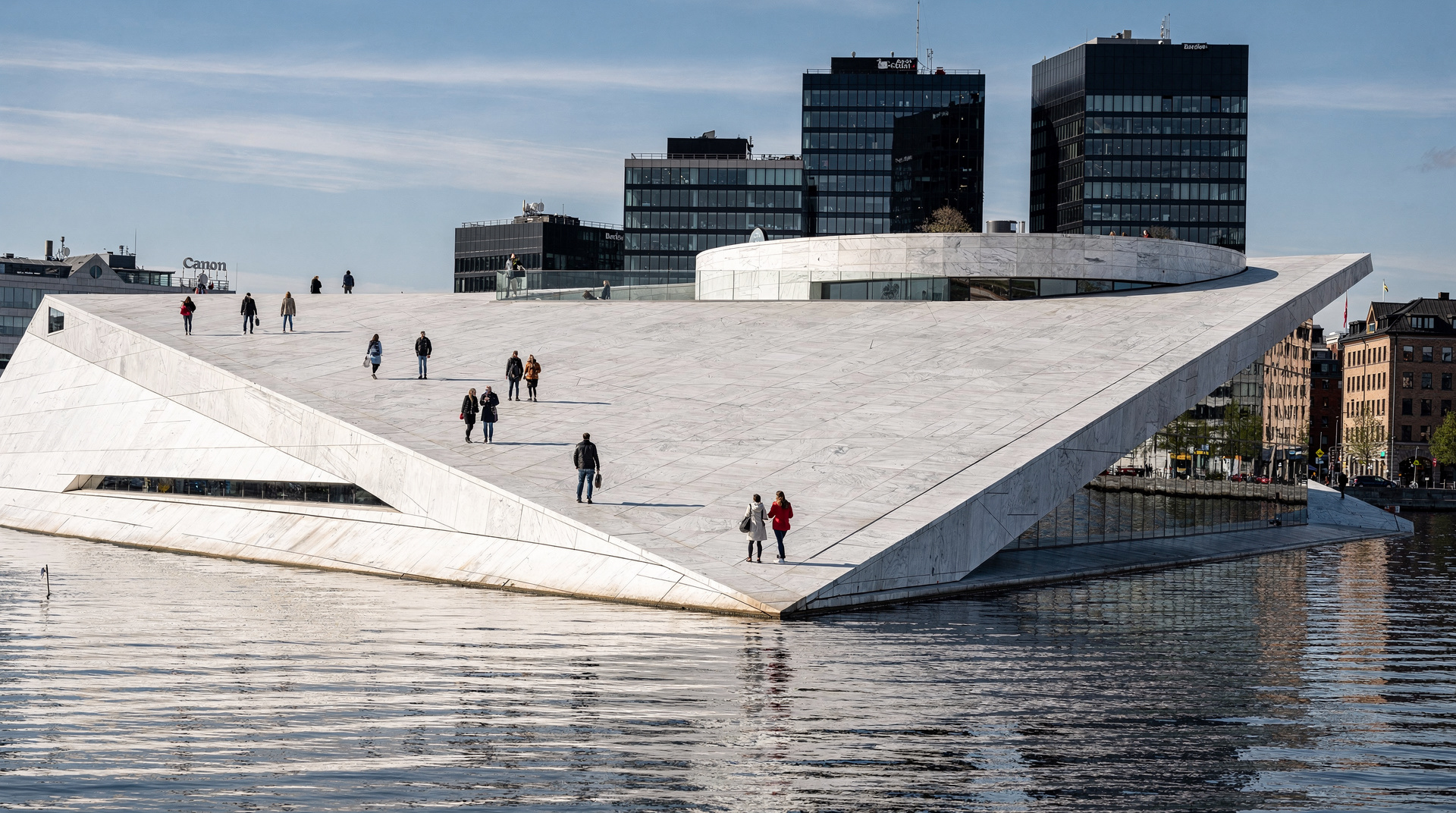
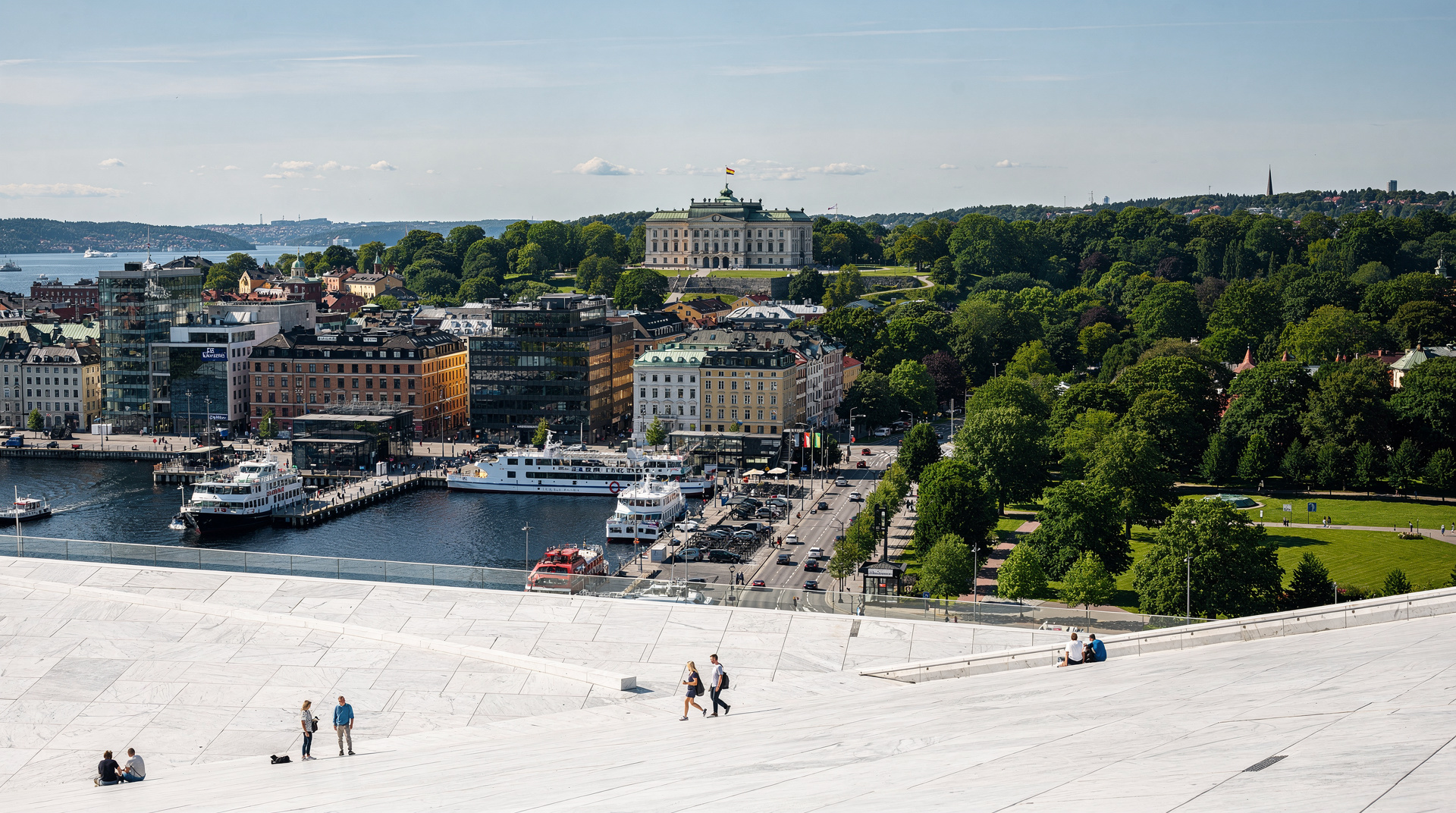
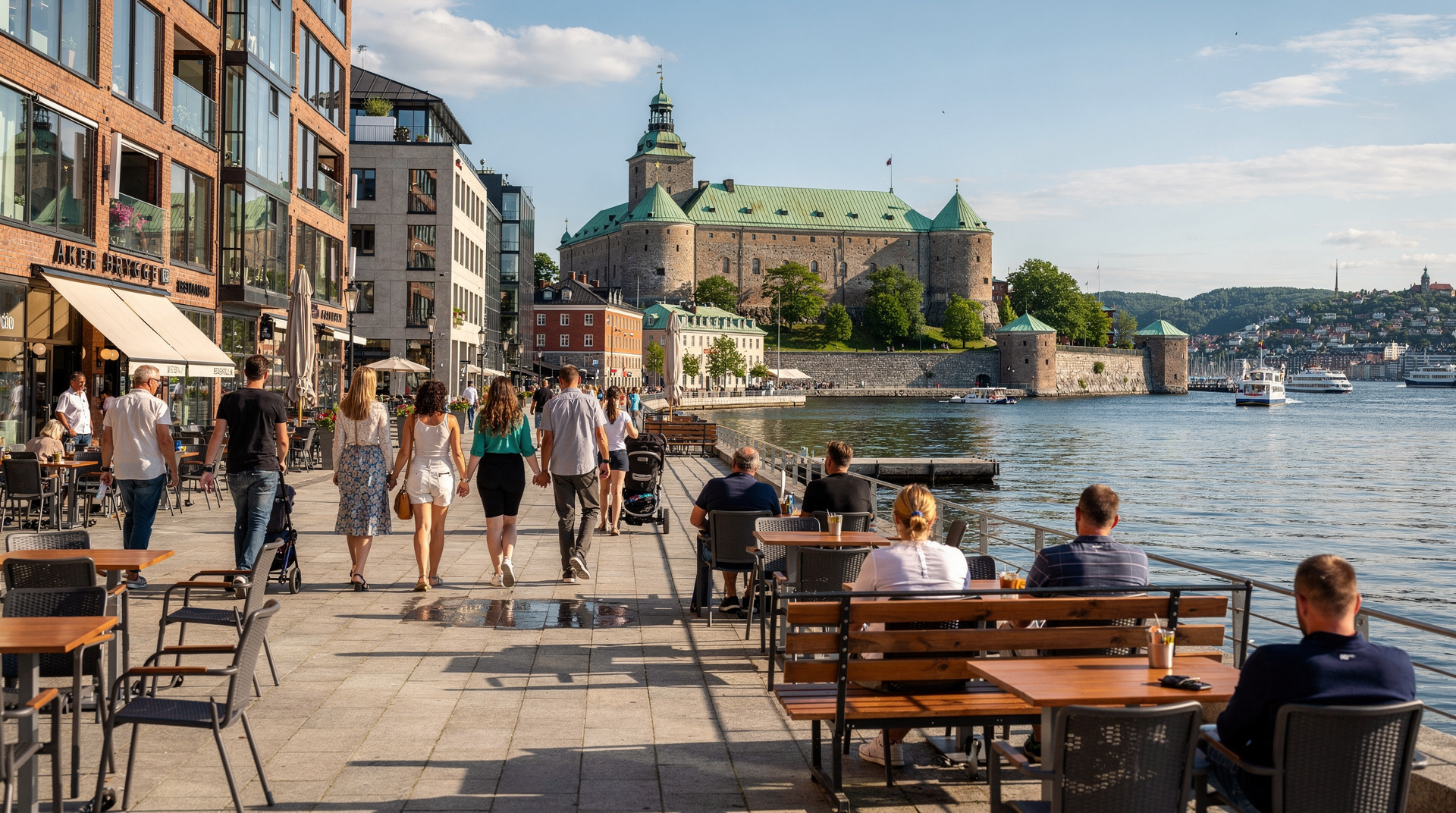
The Munch Museum sits in Bjørvika, Oslo’s most dramatic recent development zone. The Oslo Opera House — Snøhetta’s inclined marble-and-glass building, opened in 2008 — is a 10-minute walk west along the harbourfront, and its rooftop is freely accessible at any time. Walking up the sloped roof to the highest point and looking back toward the city and fjord is free, takes 20 minutes, and is one of the better spontaneous things you can do in Oslo.
The Deichman Bjørvika public library (opened 2020) is immediately adjacent to the Opera House — a spectacular building in its own right, with a rooftop café and free access. The Barcode project of parallel glass office towers visible above both defines the skyline of new Oslo and divides opinion; seeing it from the harbourfront gives you the full controversial effect.
Vippa, a street-food market in repurposed shipping containers on the Akershus side of the harbour, is a good lunch option before or after the museum. It is cheaper and more casual than Mathallen and reflects a younger Oslo food culture.
Comparing Oslo’s two great art museums
The choice between the Munch Museum and the National Museum is not really a choice — both are included in the Oslo Pass, and both deserve visits. The practical question is sequence.
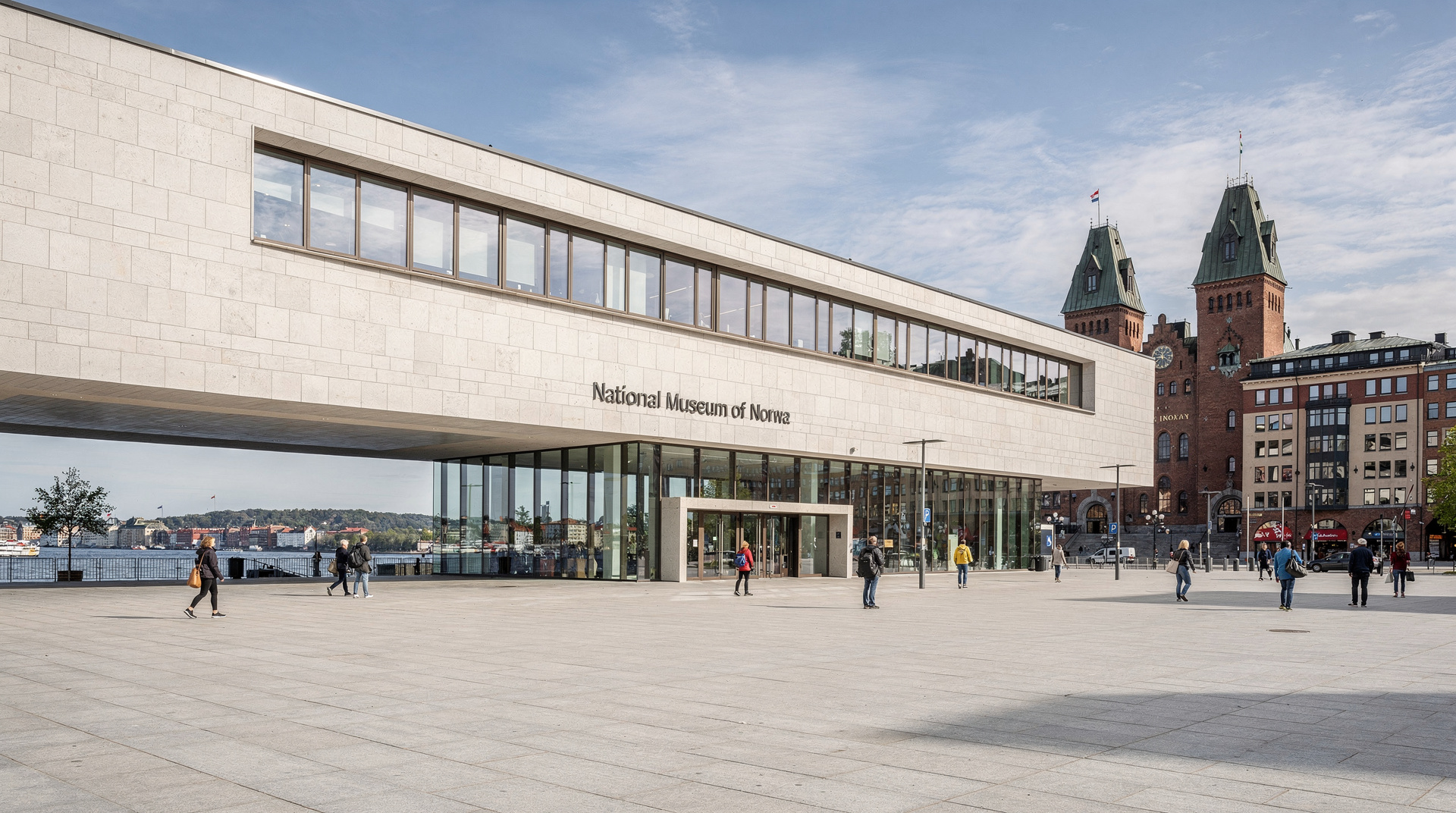
The National Museum on Tullinløkka (a 20-minute tram ride from Bjørvika on tram 12 or bus 31) reopened in a new building in 2022 and holds the 1893 Scream alongside an enormous collection of Norwegian and European art, design, and decorative arts. It is the largest art museum in the Nordic countries and covers considerably more historical and cultural ground.
The Munch Museum is focused and deep, looking at a single artist from every conceivable angle. If you are genuinely interested in Munch — or in Norwegian Expressionism’s relationship to European modernism more broadly — it is irreplaceable. If you have only one museum half-day in Oslo, the National Museum’s broader canvas might give you more overall context about Norwegian visual culture.
For those who want a guided introduction to both, the 3-museum explorers tour (oslo-3-museum-explorers-tour) combines Munch with two Bygdøy museums on a structured guided itinerary — useful for visitors who want interpretation alongside the collections.
For a full ranking of Oslo’s museums by visit-worthiness, admission value, and recommended time, the Oslo museums ranked guide is the best planning resource.
Note for visitors with limited time: if you must choose between the Munch Museum and the National Museum on a single half-day, the Munch Museum is the higher-impact choice for international visitors because the Scream has genuine global cultural recognition, and the building itself is worth the visit. The National Museum is better for visitors who want a broader survey of Norwegian visual culture and design history. Both are covered by the Oslo Pass.
Practical details
- Address: Edvard Munchs plass 1, Bjørvika, Oslo
- Opening hours: Tuesday to Sunday 10:00 to 18:00 (extended to 20:00 on Thursday evenings and some summer dates); closed Mondays
- Getting there: tram 13 to Bjørvika stop (2 minutes’ walk), or 10 minutes on foot east along the harbourfront from Oslo S
- Admission: NOK 160 adult, NOK 90 under-25, free under-6; Oslo Pass accepted
- Timed entry: required in peak season (May to September); book online at munchmuseet.no or GetYourGuide
- Audio guide: available in multiple languages; recommended for first-time visitors
- Café and restaurant: EIKA restaurant on floor 13 with Oslofjord panorama (advance booking strongly recommended for lunch or dinner); ground-floor café for lighter bites
- Accessibility: fully accessible; lifts throughout, wide corridors, audio and tactile accessibility provisions
- Museum shop: strong on Munch publications; good range of Norwegian design products
The Bjørvika and Opera Barcode guide covers the Opera House rooftop walk, the new library, Vippa market, and the full neighbourhood for anyone planning to spend a half-day in this part of Oslo around their museum visit.
Munch’s life beyond the museum walls
Munch’s biography maps onto Oslo (then Kristiania) more directly than most artists’ onto their home cities. He grew up in a series of modest apartments as the family moved through the eastern districts following his father’s naval doctor postings, and the childhood losses that shaped his art — his mother died of tuberculosis when he was five, his elder sister Sophie of the same disease when he was fourteen — happened in rooms not far from where the museum now stands. The anxiety and mortality that recur throughout the Frieze of Life were not abstractions for Munch; they were lived experience translated directly onto canvas.
His later decades were spent partly in Norway and partly abroad — Paris, Berlin, and a long period in Germany where his work was initially championed and later, notoriously, confiscated and labelled “degenerate art” by the Nazi regime in 1937. Munch spent his final years largely reclusive at his property in Ekely, on Oslo’s western outskirts, continuing to paint prolifically into his eighties. He died in Oslo in January 1944, during the German occupation, and left his entire estate to the city — the bequest that makes the present museum’s comprehensive collection possible.
The rooftop and views: an underused feature
Few visitors realise the Munch Museum has a publicly accessible rooftop terrace on the 9th floor, reached via the main lift, offering a different vantage on the Oslofjord and the Bjørvika skyline than the paid EIKA restaurant one floor above. Unlike the restaurant, the terrace itself requires only your museum admission, and on a clear day the view across to Hovedøya and the inner islands rivals anything from the Opera House roof. It is a good place to decompress after the emotional intensity of the Frieze of Life galleries before continuing to the print collection or the shop.
Compare alternative tours
Frequently asked questions about Munch Museum Oslo ticket
How much does Munch Museum entry cost?
In 2026, adult admission is NOK 160 (approximately USD 17). Under-25s pay NOK 90, under-6s enter free. The Oslo Pass covers entry. Online booking is recommended — it reserves your timed entry and avoids queues.How long should I spend in the Munch Museum?
Allow 2 to 3 hours for a thorough visit. The permanent collection alone justifies 90 minutes; add time for the temporary exhibitions and the rooftop restaurant views.Is The Scream in the Munch Museum?
One version of The Scream is in the Munch Museum; the other is in the National Gallery at the National Museum on Tullinløkka. The Munch Museum's Scream (1910, tempera version) is the more dramatic and better-preserved of the two. Both are covered by the Oslo Pass.Where is the Munch Museum?
Lambda — the new Munch Museum building designed by Estudio Herreros — opened in 2021 in the Bjørvika neighbourhood, east of the Opera House. The address is Edvard Munchs plass 1. It is a 10-minute walk from Oslo Central Station or a short ride on tram 13 (Bjørvika stop).Do I need a timed-entry ticket?
Timed-entry tickets are strongly recommended in peak season (June to August) and on weekends. Walk-up entry is possible in the off-season and on quiet weekday mornings but is not reliable in summer.Is the Munch Museum good for children?
Yes, with caveats. Munch's work is emotionally intense — his themes of anxiety, illness, love, and death are not typical children's art museum fare. That said, the building has hands-on elements, and the visual power of the large canvases holds the attention of most children. Under-6s enter free.How is the National Museum different from the Munch Museum?
The National Museum on Tullinløkka holds the broader Norwegian art collection — from medieval icons through Romanticism and into the 20th century, including the 1893 tempera version of The Scream. The Munch Museum focuses entirely on Edvard Munch — over 26 000 works in the collection, though only a fraction are displayed at any time.Can I photograph the paintings inside the Munch Museum?
Non-flash photography is generally permitted throughout the permanent collection, including in the Scream gallery, though some temporary exhibitions restrict it — signage at the entrance to each gallery makes the current rule clear. Tripods and selfie sticks are not allowed.How does the Munch Museum compare in size to other Oslo museums?
The Munch Museum is one of Oslo's largest single-artist museums by floor area, spread across 13 storeys, though gallery space is concentrated on the lower and middle floors. It is smaller in overall collection scope than the National Museum but denser in focus, since every room concerns one artist rather than a broad survey.