Oslo hop-on hop-off bus: review, tips and booking
Oslo: City Sightseeing hop-on hop-off bus tour
Duration: Full day
- Instant confirmation
- Audio guide
| Where | City centre loop: Bjørvika, Frogner/Vigeland, Bygdøy branch |
| Cost | Around NOK 395–420/adult (24hr); NOK 495–560 (48hr) |
| Time needed | 75–90 min full loop; a day to hop on/off properly |
| Getting there | Board at Aker Brygge, Oslo S, or major hotels |
| Best time | First day of your trip, as an orientation loop |
What the hop-on hop-off bus is actually for
The hop-on hop-off bus solves a specific problem: Oslo’s main attractions are spread across a city that is not entirely walkable in a day. Vigeland Park in Frogner is 3 kilometres from the Opera House at Bjørvika; the Bygdøy museum peninsula is a 20-minute journey from the National Museum near City Hall. Public transport (the Ruter network of trams and metro) handles these connections perfectly adequately, but requires familiarity with the system. The hop-on hop-off bus offers a tourist-labelled alternative with audio commentary, bright open-top buses, and a simplified single-product experience.
That is genuinely useful for some travellers. It is less useful for others. This review tries to help you decide which category you fall into.
City Sightseeing vs Gray Line: the practical differences
Two operators run hop-on hop-off services in Oslo. Both are established companies with global operations; the Oslo network for each is a small part of their wider portfolio. Neither is dramatically superior to the other — the route, frequency, and audio commentary quality are broadly comparable. The practical decision often comes down to which is cheaper on the day you book, or which has the departure time that works for your morning.
In practice:
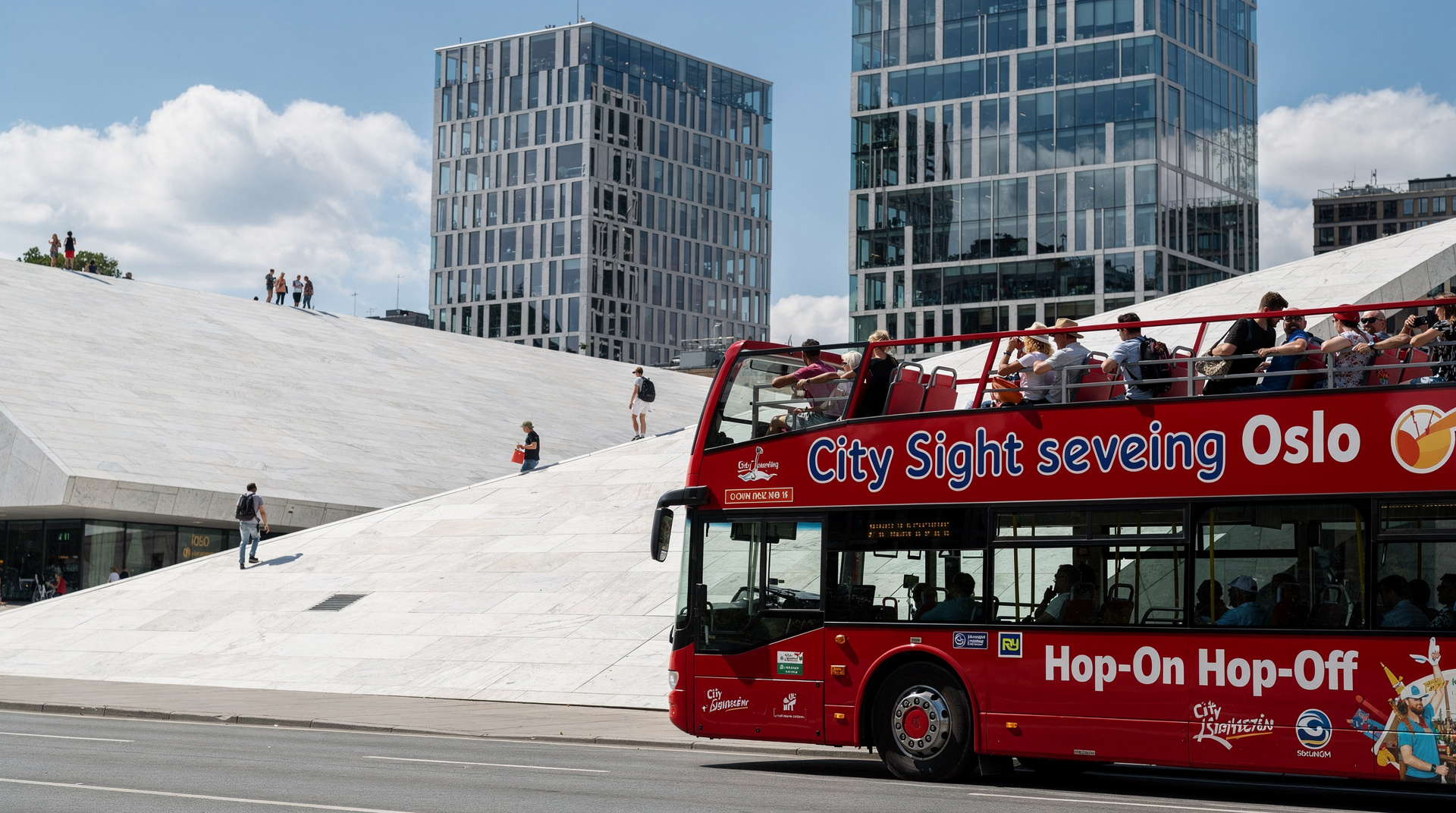
City Sightseeing (red buses) operates the larger network. The main loop covers the city centre and the eastern waterfront (Opera House, Munch Museum, Bjørvika) as well as Frogner and Vigeland Park. A separate branch serves Bygdøy. The 24-hour ticket is around NOK 395 to 420 (USD 43 to 45) per adult; 48-hour passes are available.
Gray Line (green buses) runs a competing route covering broadly similar stops, often with slightly different routing or stop positioning. The pricing is comparable. Where Gray Line differentiates is in occasional combined packages: some Gray Line tickets can be bundled with a fjord cruise or a museum entry.
In practice, if you simply need a hop-on hop-off bus to move around Oslo’s tourist attractions, either operator works fine. The frequency difference matters more: in peak summer both run every 20 to 30 minutes on the main loop, which is acceptable. In shoulder season or winter, gaps can extend to 45 minutes, which makes hopping on and off less practical.
What the audio commentary is like
Both operators provide audio commentary via headphones in multiple languages (English, French, German, Spanish, Norwegian, and others). The quality is competent but not exceptional — a pre-recorded script covering the major sights as you pass them. You hear facts about the Oslo Opera House as you pass it, information about Akershus Fortress as you round the headland, commentary on Vigeland’s sculptures as you approach the park.
The commentary does not adapt to questions, does not personalise, and occasionally lags behind what you are actually looking at if you are on a busy route with variable timing. Compare this to the silent electric fjord cruise, which uses a live guide who can respond and adapt — the difference in engagement is real.
If engaging narrative is your priority, a guided walking tour will serve you better. The hop-on hop-off is a transport product with commentary rather than a tour product with transport.
The audio commentary does score well in one area: it is patient and repeatable. You can rewind sections, listen to the same stop’s commentary twice if you missed something while the bus was turning, and you can choose to skip commentary on stops that do not interest you. For travellers with hearing impairments, visual commentary scripts are sometimes available in the app.
The panoramic bus: different product, different use case
The panoramic bus tour (oslo-panoramic-bus) is worth separating out from the hop-on hop-off. This is not a catch-and-release bus pass; it is a single loop guided tour by bus, typically 3 to 4 hours, with a live guide, visiting Holmenkollen, Vigeland Park, and Aker Brygge on a fixed itinerary. You cannot hop off mid-tour; the whole loop is the product.
The panoramic tour gives you Holmenkollen (the ski jump and surrounding hills), which the standard hop-on hop-off routes often do not cover adequately. If Holmenkollen and Vigeland in a single half-day is your objective, the panoramic bus does this more efficiently than assembling a hop-on hop-off journey.
Is the hop-on hop-off bus worth buying?
Honest answer: it depends entirely on your Oslo plan.
The hop-on hop-off makes sense if:
- This is your first day and you want a visual overview before diving into specifics
- You are not confident navigating Ruter’s tram/metro system
- You have limited time and want to see many parts of the city from the seat of a bus before selecting where to spend time on foot
- You are travelling with elderly family members or young children who cannot walk long distances between sites
The hop-on hop-off does not make sense if:
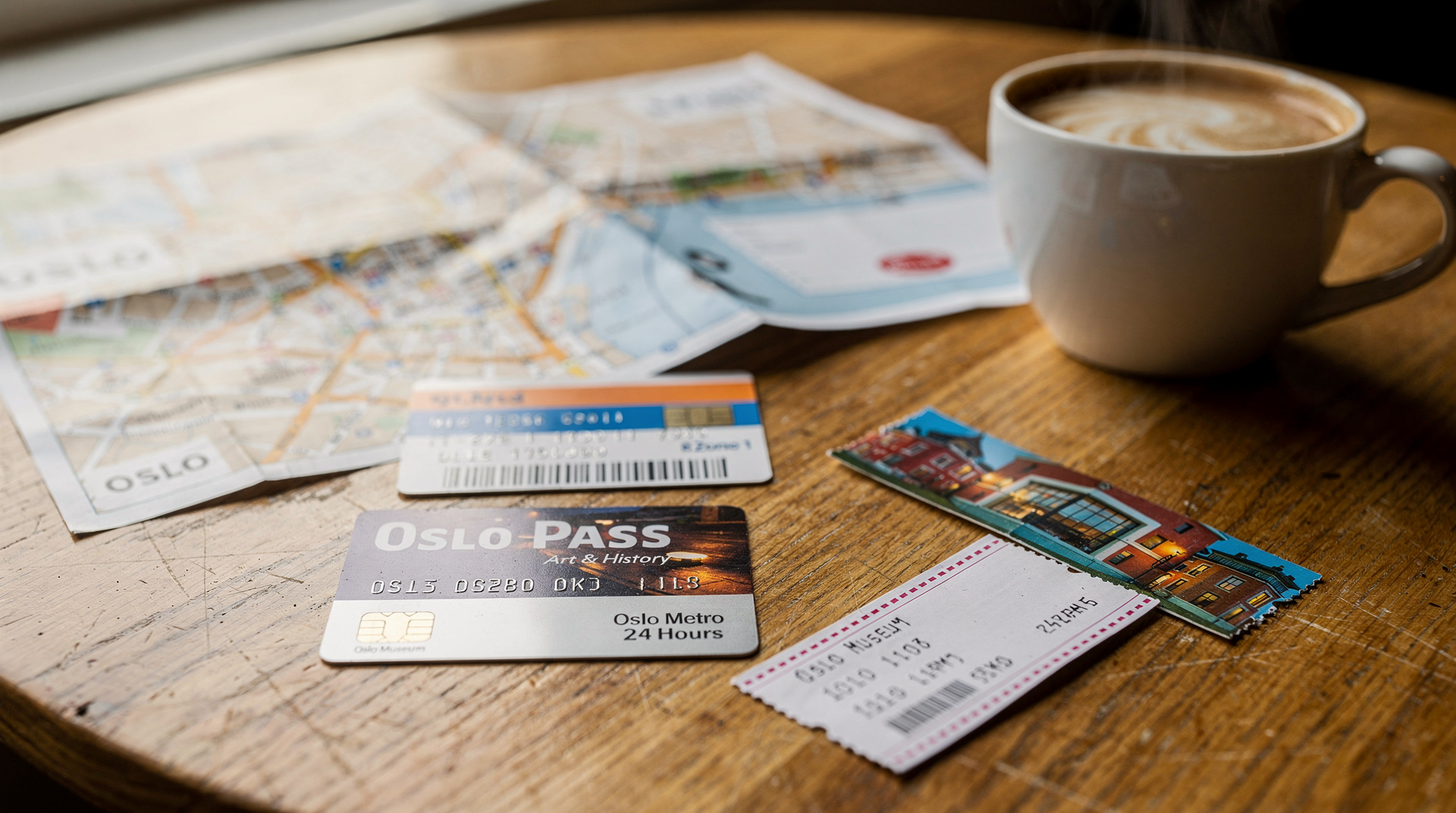
- You have an Oslo Pass (the regular Ruter system is included — metro line 1 to Holmenkollen takes 30 minutes from Majorstuen, tram 12 goes to Aker Brygge, the Bygdøy ferry is seasonal but included)
- You are comfortable using apps for route planning
- Your Oslo itinerary focuses on depth in a few places rather than breadth across many
- Budget is tight: at NOK 400-plus, the hop-on hop-off is not a trivial purchase
A note on budget: The regular Ruter 24-hour day card costs NOK 135 (about USD 14.5). This covers all trams, metro, buses, and local ferries. It does not include audio commentary or tourist labelling, but it gets you everywhere the hop-on hop-off goes — and to Holmenkollen on metro line 1, which the standard hop-on hop-off does not serve at all. For confident travellers, the day card is the better-value choice.
For the full cost breakdown and whether Oslo generally delivers value for money, the Oslo on a budget guide and the Oslo trip cost guide have current figures across transport, accommodation, and activities.
Which stops matter most
If you do buy a hop-on hop-off pass, the highest-value stops are:
Aker Brygge / City Hall: the logical starting point. The Nobel Peace Center, Oslo City Hall (free entry with extensive Edvard Munch and Henrik Sørensen murals), and the harbourfront are all walkable from here. The floating saunas at Tjuvholmen are a 10-minute walk west.
Vigeland Park / Frogner: allow at least 90 minutes for a proper walk through the Vigeland Sculpture Park, from the main gate to the monolith. The park itself is free and never closes; the hop-on hop-off gets you there without navigating trams.
Munch Museum / Opera House: the Bjørvika cluster at the eastern end of the harbourfront. The Munch Museum (NOK 160 per adult, covered by Oslo Pass) and the Opera House rooftop (free, open all day) justify at least 3 hours here.
Bygdøy museums: Norsk Folkemuseum (open-air museum of Norwegian folk architecture, NOK 220), Fram Museum (polar exploration vessel, NOK 195), Kon-Tiki Museum (NOK 150) — all within walking distance of each other on the Bygdøy peninsula. The hop-on hop-off bus serves Bygdøy from spring through autumn; in summer the Ruter Bygdøy ferry from Aker Brygge is faster. Allow a minimum of a half-day for two museums.
The free alternatives: when you do not need the bus
One useful reality check: Oslo’s Ruter public transport network — all trams, buses, metro, and local ferries — costs NOK 40 per trip via the app (NOK 64 at machines). A 24-hour Ruter day card is NOK 135. If you already have an Oslo Pass, Ruter is included.
The key routes for the main tourist attractions: tram 12 from Jernbanetorget (Oslo S) runs directly to Aker Brygge (15 minutes). Tram 12 continues to Vigeland Park (Frogner) in another 10 minutes. T-bane (metro) line 1 runs from Majorstuen to Holmenkollen in 10 minutes. For Bygdøy, the number 30 bus from Nationaltheatret runs to the museum peninsula in 20 minutes, or take the seasonal Ruter ferry from Aker Brygge pier 3 (summer only).
For travellers who are comfortable with apps and basic route planning, these connections work well and cost considerably less than a hop-on hop-off pass. The pass is a genuine shortcut when you do not want to research individual routes.
Using the bus to plan your visit
One underappreciated use of a hop-on hop-off pass is a single non-stop loop on day one of your visit, before you hop off anywhere. Spending 75 to 90 minutes seated on the upper deck listening to the audio commentary as you pass through the city centre, Frogner, Holmenkollen (if included), Bygdøy, and Bjørvika gives you a spatial understanding of how the different parts of Oslo relate to each other. Which districts are near each other, which require transport, where the hills are, where the waterfront extends.
After this orientation loop, your subsequent days are easier to plan. You know where you want to spend more time and what to skip. In this sense the hop-on hop-off is a planning tool as much as a transport product.
Combining with a fjord cruise
Some Gray Line and City Sightseeing packages bundle the hop-on hop-off bus with an Oslofjord cruise for a combined price. If you were going to book both independently, the bundle can represent a saving of NOK 100 to 200. Check the specific package content carefully — the cruise included is usually a standard 1 to 1.5-hour inner harbour tour rather than the premium guided electric boat cruise.
For a higher-quality fjord experience, booking the silent electric cruise separately gives you a live guide and a better boat.
Practical details
- Main operators: City Sightseeing (red) and Gray Line (green)
- Route coverage: city centre, Bjørvika, Frogner/Vigeland, Bygdøy branch, sometimes Holmenkollen (check current map before booking)
- Frequency: 20 to 30 minutes (summer), 30 to 45 minutes (shoulder/winter), limited in deep winter
- Ticket types: 24-hour and 48-hour passes; some combined packages with fjord cruise
- Audio: multi-language pre-recorded commentary via headphones on board
- Not included: Oslo Pass, museum entries, premium sightseeing cruises
- Price: approximately NOK 395 to 420 per adult for 24-hour pass; NOK 495 to 560 for 48-hour
- Booking: online in advance for best prices; tickets also available at major hotels, tourist centres, and at Oslo S
For a complete overview of how to get around Oslo — tram lines, metro, ferry routes, and when to walk — see the getting around Oslo transport guide. For a comparison of all Oslo sightseeing tour types, the Oslo walking tours compared guide covers the full spectrum from bus to bike to foot.
If you decide against the hop-on hop-off and want to explore Oslo’s neighbourhoods on foot, the free things to do in Oslo guide covers which of the city’s most significant attractions require no ticket at all.
Hop-on hop-off vs Oslo Pass vs Ruter day card
| Hop-on hop-off | Oslo Pass | Ruter day card | |
|---|---|---|---|
| Cost (24hr) | NOK 395–420 | NOK 595 | NOK 135 |
| Includes museums | No | Yes (~30 attractions) | No |
| Includes transport | No (own route only) | Yes, all Ruter zones | Yes, all Ruter zones |
| Commentary | Yes, audio | No | No |
| Best for | First-day orientation | Museum-heavy days | Confident independent travellers |
Buying tickets: online vs at the stop
Both operators sell tickets through their own websites, through GetYourGuide, at kiosks near major stops (Aker Brygge, Oslo S), and directly from the driver on boarding. Online purchase in advance is consistently a few percent cheaper and lets you skip any queue at the first stop of the day, which matters most in peak July when the first departures of the morning can have a short line. If your plans are flexible and you are not committed to a specific day, buying at the stop itself carries little downside beyond the modest price difference. Digital tickets on both operators’ apps display a QR code that staff scan on boarding, so there is no physical ticket to lose or forget at your hotel.
Weather and seasonal comfort on an open-top bus
The upper open-air deck is the main draw for photography, but Oslo’s weather is genuinely changeable even in summer — a sunny departure can turn to light rain 20 minutes later. Most vehicles provide a covered lower deck as a fallback, and some upper decks have partial canopy coverage, but dressing in a layer you do not mind getting slightly damp is sensible for any season. In winter, the open-top experience is considerably less comfortable and some operators reduce or suspend upper-deck seating; check current conditions when booking a winter departure if the open-air element matters to you.
Compare alternative tours
| Tour | Duration | Rating | Price | Highlights | |
|---|---|---|---|---|---|
| Oslo: 24 or 48-hour hop-on hop-off sightseeing bus (Gray Line) | Full day | — | — | Free cancellation · Multiple stops | Check |
| Oslo: panoramic sightseeing bus with Holmenkollen and Vigeland Park | 3 hours | — | — | Hotel pickup · English guide | Check |
| Oslo: Oslo Pass with public transport and free museum entry | 24-72 hours | — | — | Instant confirmation · Free public transport · Skip museum queues | Check |
Frequently asked questions about Oslo hop-on hop-off bus
How much does the Oslo hop-on hop-off bus cost?
In 2026: City Sightseeing 24-hour ticket is around NOK 395 to 420 (USD 43 to 45); 48-hour passes are available from both operators for NOK 495 to 560 (USD 53 to 60). Gray Line runs similar prices. Buy online for the best rate.Does the hop-on hop-off bus include museum entry?
No. The bus is a transport and commentary product only. Museum admissions are paid separately. If you want combined transport and museum entry, the Oslo Pass is more relevant, though the two products serve different purposes.How often do the buses come?
In peak summer (June to August) buses run every 20 to 30 minutes. In shoulder season (April, May, September) frequency drops to every 30 to 45 minutes. In winter, services run less frequently and some routes are reduced.How long does the full hop-on hop-off loop take?
A single non-stop loop on the main City Sightseeing route takes around 75 to 90 minutes. The Gray Line route is similar. If you hop on and off at multiple stops, allow a full day to do it properly.Is the hop-on hop-off bus included in the Oslo Pass?
No. The hop-on hop-off buses are not part of the Oslo Pass program. The regular Ruter public transport network (metro, trams, buses, local ferries) is included in the Oslo Pass but not these tourist sightseeing buses.What is the main route like?
The City Sightseeing route covers Aker Brygge, Akershus Fortress, the Opera House, Bjørvika, Munch Museum, Botanical Garden, Vigeland Park, Frogner, the Royal Palace, and the National Museum. Key stops for Bygdøy museums are usually on a separate branch or require a short walk.Is the panoramic bus tour a better option?
The panoramic bus tour is a single fixed-route guided tour rather than a hop-on hop-off system. It gives you a more structured narrative but less flexibility. Better for people who want a one-shot overview; the hop-on hop-off is better for those who want to stop and explore multiple sites.Is the hop-on hop-off bus wheelchair accessible?
Most City Sightseeing and Gray Line vehicles in Oslo have low-floor access and a designated wheelchair space, but availability varies by specific bus on a given day. Contact the operator ahead of your visit to confirm accessible departures if this is a requirement.Can I buy a hop-on hop-off ticket on the bus itself?
Yes, tickets can typically be purchased directly from the driver or an onboard conductor, though online purchase in advance is usually slightly cheaper and avoids any queue at the first stop.