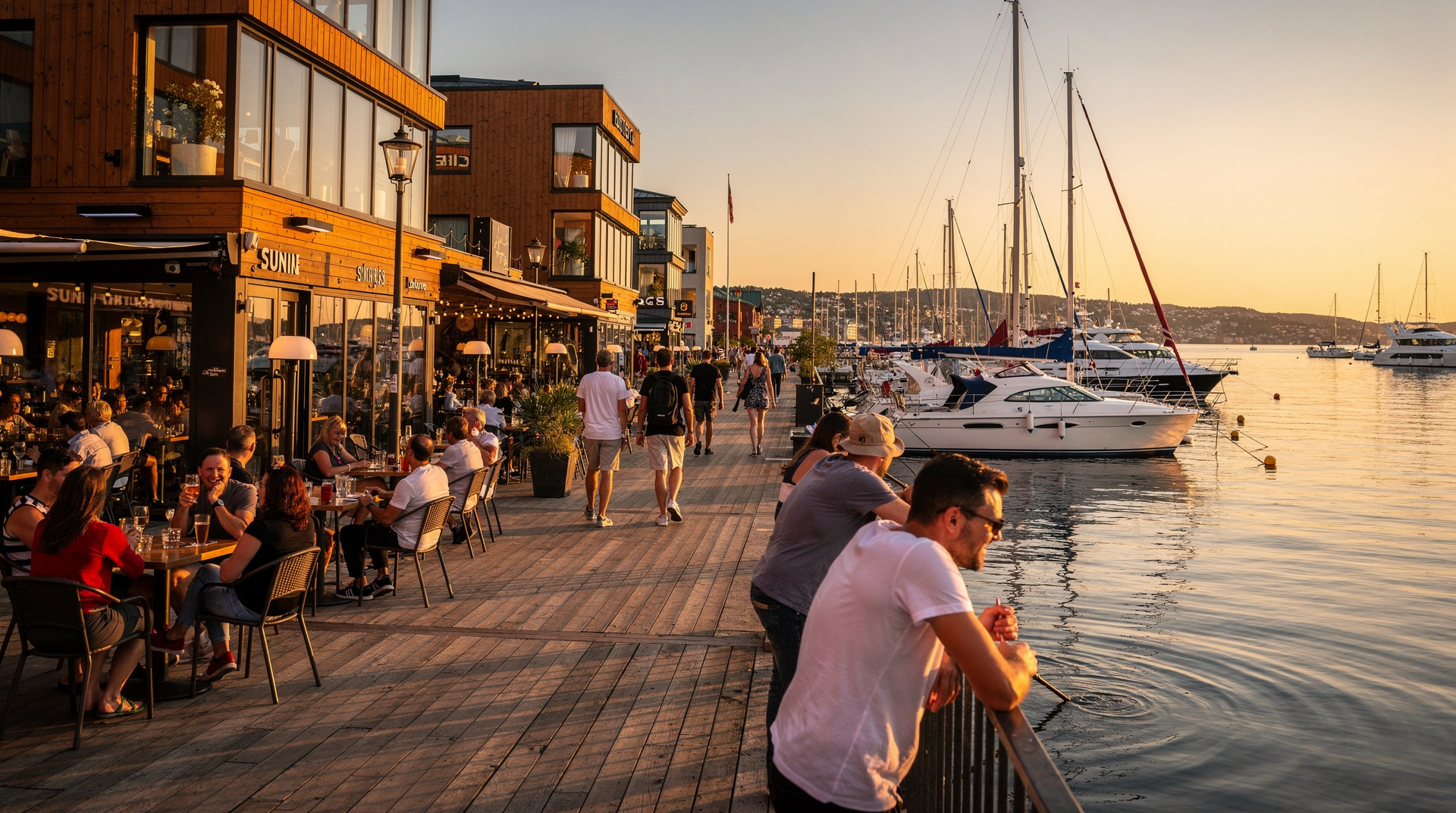
Sea kayaking on the Oslofjord — how to do it from Oslo
Oslo: 3-hour kayaking trip on the Oslofjord
Duration: 3 hours
- Kayak + gear
- Guided
Can you kayak on the Oslofjord from central Oslo?
Yes. Guided sea kayak tours depart from Sørenga and Tjuvholmen in central Oslo, and kayak rental is available from May through September. The inner Oslofjord is calm enough for beginners in good weather. A 3-hour guided session is the best starting point.
Paddling in the shadow of the Opera House
| Where | Sørenga or Tjuvholmen, central Oslo |
| Cost | Guided 3h: NOK 750–950; solo rental 2h: NOK 400–550 |
| Season | May–September (core: late June–August) |
| Experience needed | None for guided tours; basic self-rescue for solo rental |
| Booking | Advance recommended in July, especially weekends |
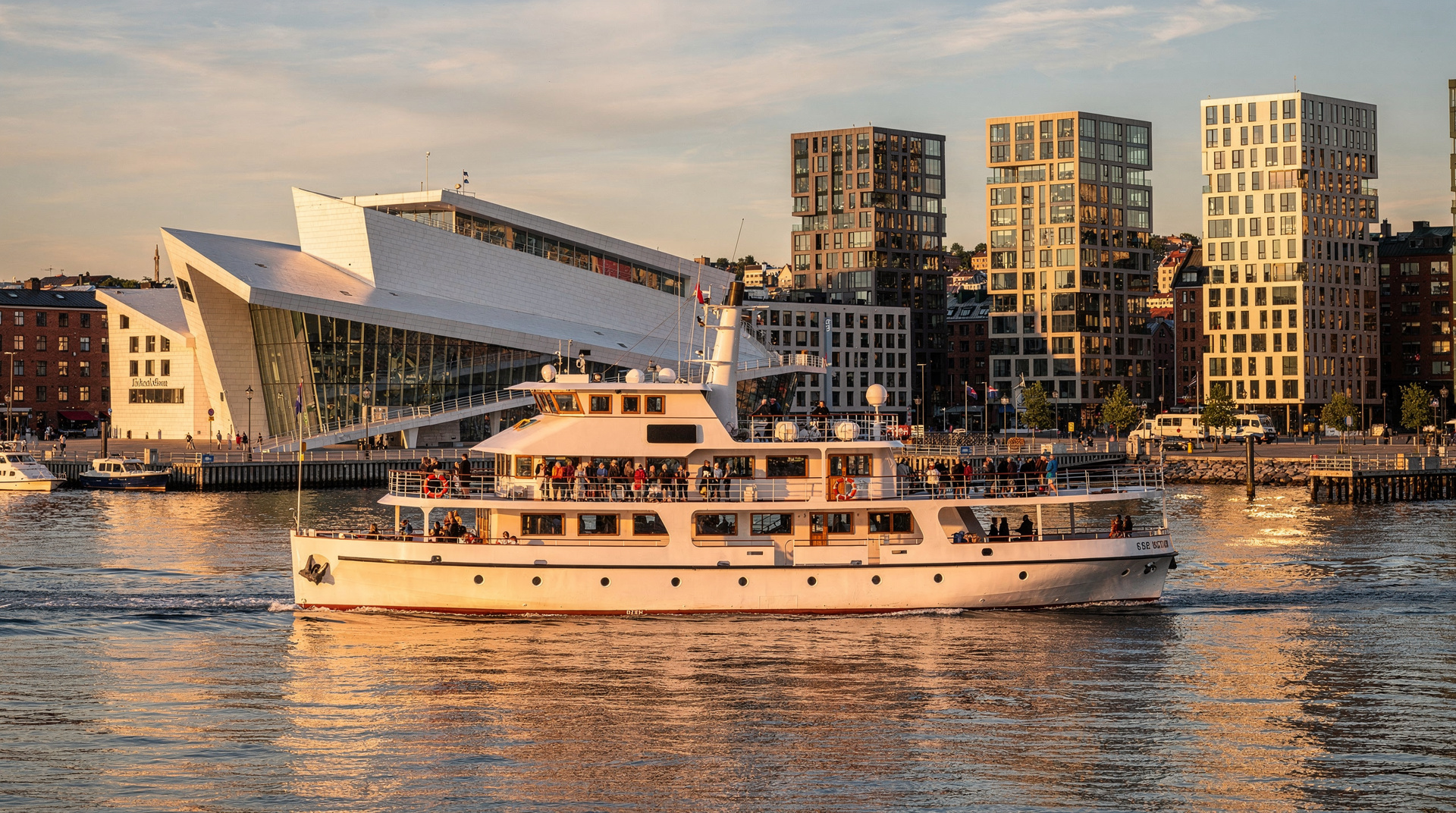
Oslo’s relationship with the Oslofjord is central to the city’s character. The waterfront has been redeveloped dramatically over the past two decades — the Opera House, Bjørvika, Sørenga floating baths — but the fjord itself remains the same cold, clear, traffic-free body of water it has always been. Seen from a kayak at water level, with the city skyline behind you and the islands ahead, Oslo reveals a version of itself that no land-based tourist activity delivers.
The inner Oslofjord is genuinely accessible to kayakers. It is sheltered from the open sea by a system of islands and narrows, the tidal range is minimal (under 0.5 metres), and on typical summer days the water surface is glass-calm until afternoon breezes develop. This guide covers everything you need to know to get on the water, from guided tours to solo rental to multi-day adventures.
Launch points in central Oslo
Sørenga
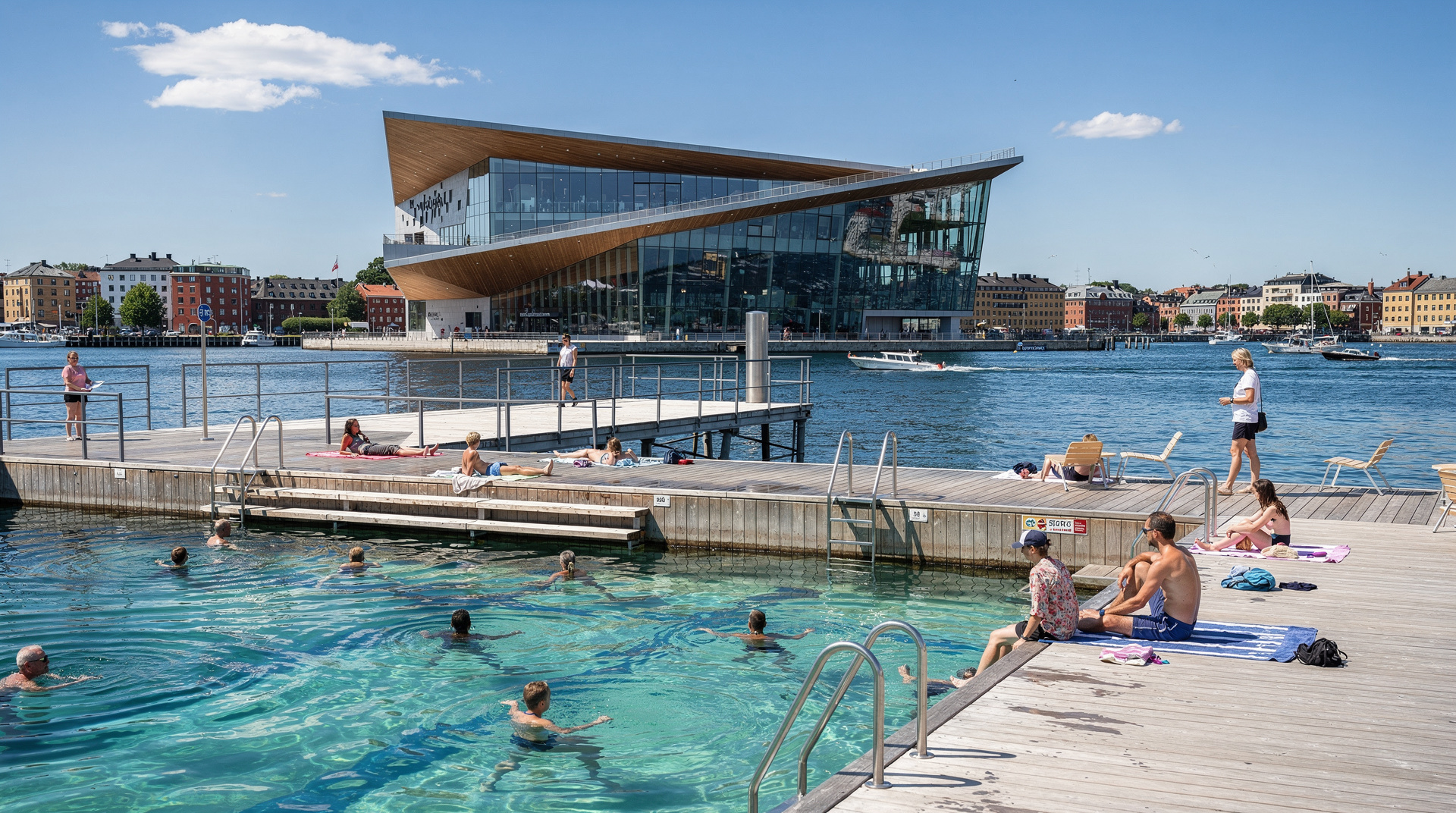
Sørenga is the eastern harbourfront, east of the Opera House in Bjørvika. It is Oslo’s main kayak hub. The Sørenga Sjøbad (floating seawater pool) occupies the centre of the area, but kayak operators run alongside it. The water here is well-protected, and the launch into the fjord is immediate — no paddling through commercial boat traffic required. Sørenga is roughly a 15-minute walk from Oslo Central Station (Jernbanetorget) or 5 minutes from Bjørvika tram stop.
Tjuvholmen and Aker Brygge
The western harbourfront at Tjuvholmen and Aker Brygge also has kayak rental options. The water here is slightly more exposed to ferry traffic from the island ferries, but the scenery of launching between the Astrup Fearnley Museum and the fjord is dramatic. Good for those combining a kayak session with an afternoon at the Tjuvholmen restaurants or a sauna at one of the floating saunas.
Further options
Adventurous paddlers looking for more remote conditions sometimes access the fjord from Bygdøy peninsula beaches. These are quieter but lack rental infrastructure — you would need your own equipment or a guided tour that departs from here.
Guided kayak tours
Standard 3-hour guided group session
The most popular format for visitors. A qualified guide takes a group of 6–12 people from a central launch point, provides instruction on basic paddling technique and safety, and leads the group around the inner harbour and towards the nearest islands or waterfront viewpoints. Groups paddle in stable recreational kayaks — wide, forgiving, unlikely to tip in calm conditions.
Typical route: Sørenga launch → Bjørvika waterfront (view of the Opera House roof from water level) → south towards Gressholmen or Nakholmen islands → return via Filipstad or Aker Brygge. Depending on group fitness and conditions, you may reach an island for a short break.
Price range: NOK 750–950 per person (USD 81–102) including equipment and wetsuit if needed.
City and fjord combined tour
Some operators offer a 3-hour tour that emphasises the city skyline from the water — paddling past the Opera House, the Munch Museum tower, and the container cranes — before turning south toward open water. This is the tour for people who want to understand Oslo’s urban waterfront as much as the natural fjord.
Self-guided kayak camping trip
For experienced paddlers, a multi-day self-guided trip through the Oslo archipelago — camping on permitted island beaches, paddling between Nakholmen, Gressholmen, Lindøya, Bleikøya, and Langøyene — is one of Oslo’s most unusual outdoor experiences. Our Oslo islands guide covers the islands in detail. Camping on designated spots in the archipelago is free; island ferries provide an emergency return route if conditions deteriorate.
Solo kayak rental
Rental without a guide is available from May through September for paddlers who can demonstrate basic competence. Most operators ask you to sign a form confirming you can self-rescue (wet exit and re-entry) and have paddled before. They will not quiz you intensively — it is a liability disclaimer more than a skills test — but you should be honest about your experience level.
Rental prices (approximate):
- Single sea kayak, 2 hours: NOK 400–500 (USD 43–54)
- Single sea kayak, half day (4 hours): NOK 650–800 (USD 70–86)
- Tandem kayak, 2 hours: NOK 500–650 (USD 54–70)
- Stand-up paddleboard, 2 hours: NOK 350–450 (USD 38–48) — see our dedicated SUP guide
All rental includes paddle, life jacket, and basic drybag. Wetsuit rental is typically NOK 100–150 (USD 11–16) extra.
Safety on the Oslofjord
The inner fjord near Oslo is relatively safe for beginners in calm summer weather. The main hazards are:
Wind: The fjord can develop significant afternoon chop on warm summer days as sea breezes pick up. If you are renting solo, check the forecast and plan to return before 14:00 on warm days. The Norwegian Meteorological Institute (Yr.no) gives reliable hourly forecasts including wind speed for the Oslo fjord.
Commercial traffic: The inner harbour has regular ferry traffic to the islands and across to Nesodden. Stay out of the main ferry lanes (marked on maritime charts and clearly evident from the permanent ferry wakes). Ferries cannot manoeuvre for kayaks.
Hypothermia: In June and early September, water temperatures are cold enough for hypothermia risk if you capsize and cannot self-rescue quickly. Guided tours provide wetsuits. Solo paddlers should either wear a wetsuit or be confident in cold-water self-rescue.
Sun: The fjord surface reflects UV strongly. Sunscreen, hat, and protective clothing are important on clear summer days — more so than on land.
The islands as destinations
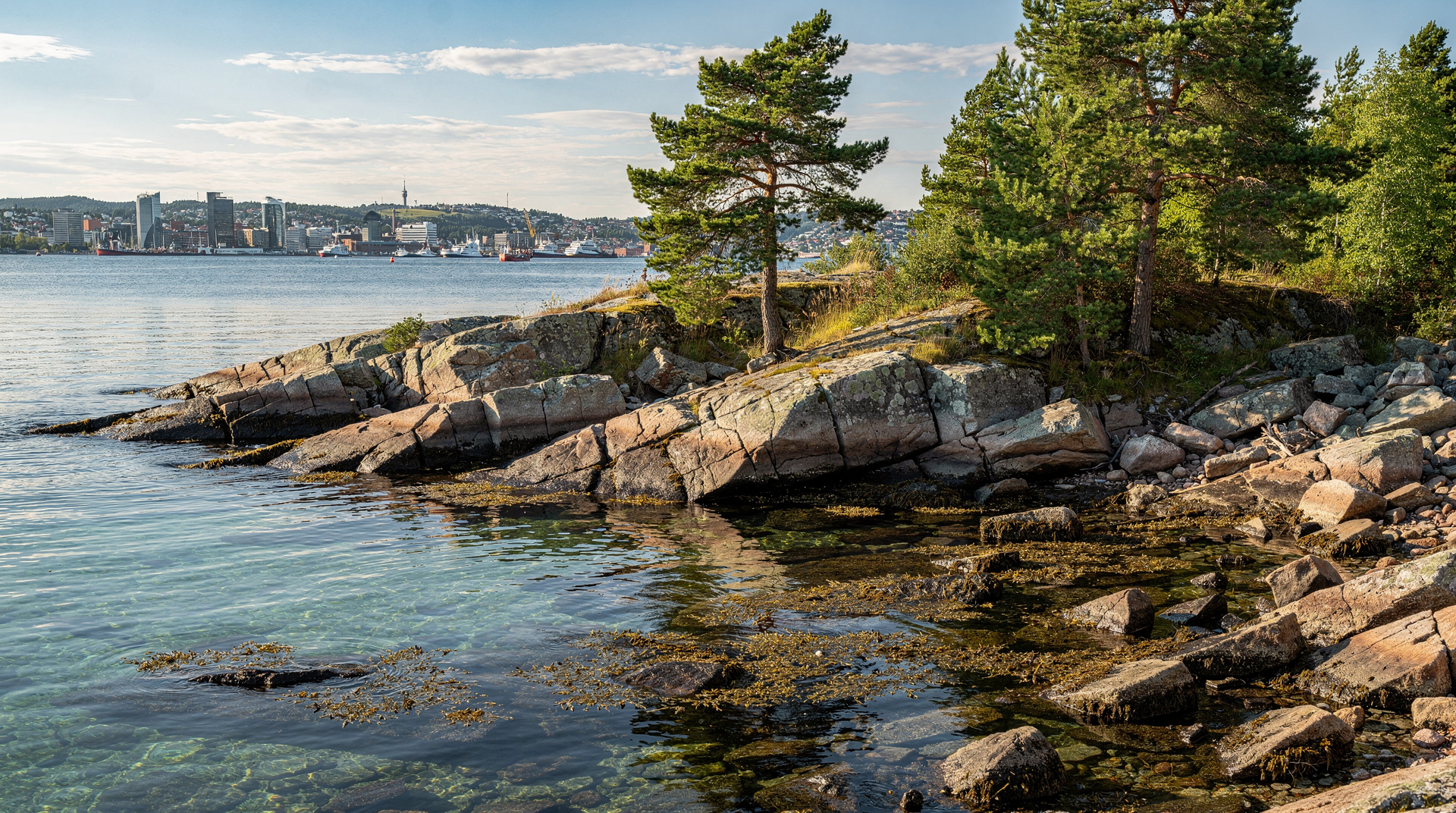
The Oslo archipelago islands are the natural targets for a half-day paddle. The closest — Nakholmen and Gressholmen — are 3–4 km from Sørenga, achievable in 40–60 minutes of comfortable paddling. Nakholmen and Lindøya have summer cottage communities; Gressholmen is an official nature reserve with restricted landing spots but excellent birdwatching. Langøyene, the southernmost large island at 7 km from the city, has the archipelago’s only free camping area with basic facilities.
The island hopping guide covers these islands from the perspective of ferry travel — but many of the swimming spots and picnic areas are the same whether you arrive by kayak or public ferry.
When to book
Summer is the obvious season but the window is specific. May and September are fine for experienced paddlers and guided groups with wetsuits. The core season — when solo rental is carefree and the water is genuinely warm enough for swimming stops — is late June through August. July is peak season for Oslo water activities; book guided tours a week or more in advance if your dates are fixed.
For a complete picture of outdoor Oslo in summer, pair a kayak session with the best Oslo hikes — morning on the water, afternoon in the forest (or vice versa) makes a strong active day. The summer fjord and city itinerary builds kayaking into a five-day programme.
The Oslofjord from a kayak — what the water reveals
Paddling the Oslofjord at water level provides a perspective on Oslo that no land activity matches. The most striking thing most kayakers notice is how clean the water is. The inner Oslofjord was severely polluted by industrial discharge in the mid-20th century, but decades of environmental investment have restored water quality dramatically. You can see the seabed clearly in the shallower bays near Bygdøy and the inner islands, and the jellyfish that drift past your hull in July are a sign of biological richness.
The second thing many visitors notice is the silence. The kayak paddle is essentially quiet; the electric ferries and sailing boats that use the inner fjord contribute almost nothing to noise. On a weekday morning the inner harbour can be genuinely peaceful — the city visible and close but its noise absorbed by distance and water.
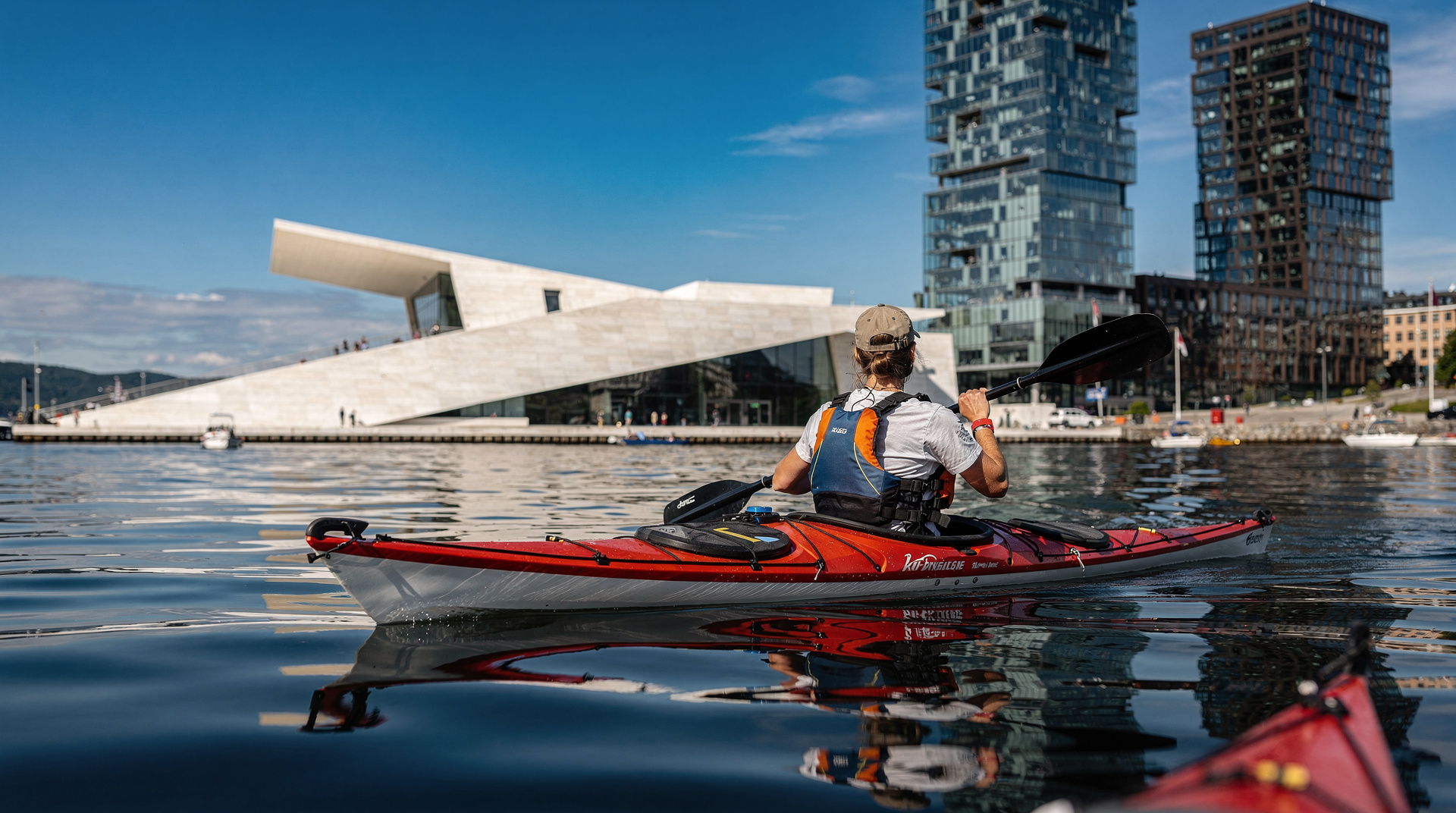
The third discovery is scale. Oslo looks different from the water. The Opera House, so dramatic when approached on foot across the harbourfront plaza, appears from a kayak as a long white slope at water level — an architectural object designed to be read from the sea as much as from the land. The forested Bygdøy peninsula, a 10-minute paddle across the inner harbour, appears much larger than it does on the map. The islands, once you start paddling toward them, seem both nearer and more separate than you expected.
Responsible paddling on the Oslofjord
The inner Oslofjord has rules that protect both the ecosystem and other water users.
Wildlife: Several of the inner islands have seabird nesting areas, particularly Gressholmen. Kayakers should maintain at least 50 metres from nesting areas from April through June. Signs mark restricted areas on the island approaches. Seals occasionally rest on rocks near the outer islands — maintain distance (100 metres) and do not approach.
Ferry lanes: The regular passenger ferries to the islands run on published schedules and cannot change course for kayaks. The ferry lanes are clearly indicated on maritime charts and obvious from the regular wake patterns. Cross lanes quickly and at right angles; never linger in them.
Marine protected areas: Sections of the inner Oslofjord have seasonal restrictions on anchoring and motorised access. Sea kayaks are generally unrestricted, but check the Kartverket maritime maps for the specific areas near the islands you plan to visit.
Leave no trace: The beaches and rocky shores of the Oslo archipelago are popular. Carry all waste back to the mainland — there are no bins on the small uninhabited islands.
Kayak camping in the Oslo archipelago
For those wanting a multi-day experience, the Oslo archipelago supports genuine kayak camping. The islands of Langøyene, Bleikøya, and Nakholmen have designated camping areas where overnight stays are permitted. Langøyene has the archipelago’s main camping ground with basic facilities (toilets, fresh water point) — this island is also accessible by regular ferry from Aker Brygge.
A two-night kayak camping trip through the archipelago — paddling from Sørenga on day 1, camping on Langøyene, paddling the outer islands on day 2, returning via Nakholmen on day 3 — is one of the most adventurous things you can do within 10 km of an OECD capital. The self-guided kayak camping option includes gear and route planning support from operators.
Total cost estimate for two-day self-guided kayak camping: NOK 1,800–2,500 (USD 194–269) per person including kayak, camping gear hire, and operator briefing. This compares favourably with equivalent outdoor experiences in other Scandinavian capitals.
Kayaking in the Norwegian context
Norway’s relationship with small boat travel is ancient. The Vikings built their civilisation around hull-shaped craft on exactly these waters — the fjords and skerries of the Norwegian coast. The Oslofjord has been a maritime highway for 3,000 years. Kayaking it is, in a small way, participating in that long tradition of humans moving through this landscape on water.
The modern sea kayak is a different object from the hide-covered Greenlandic kayak or the clinker-built Norse vessel, but the physics are the same: a narrow hull, a double-bladed paddle, and the specific pleasure of reading the wind and current and moving with them rather than against them. Oslo’s harbour provides all of this within the city limits. Few European capitals can say the same.
For context on the broader Oslofjord — its geography, islands, ferry network, and history — see our Oslofjord destination guide and the island hopping guide.
Gear and what to wear
A common question for first-time sea kayakers is what to wear. The answer depends on the season and the guided vs self-guided format.
Guided tours (equipment provided): The operator provides a dry suit or wetsuit, spray skirt, paddle, life jacket, and the kayak itself. For a summer guided tour, you need only to arrive in clothes you are comfortable getting slightly wet — shorts and a T-shirt are fine under the provided wetsuit. Bring sunscreen, sunglasses with a strap or floating strap, a hat for sun protection, and a small waterproof bag for your phone and keys. Most operators have lockers.
Self-guided rental (bring your own): Summer (July–August): board shorts or quick-dry shorts, a rash guard or lightweight long-sleeve for sun protection, trail shoes or sandals that you can get wet. A thin windproof layer for the paddle back in the afternoon. May, June, September: wetsuit strongly recommended — rent it from the operator or bring a neoprene shorty at minimum.
Footwear: Water shoes or old trainers work fine for getting in and out of the kayak. Avoid open-toe sandals without a heel strap — they come off when wet exiting.
Hydration and nutrition on the water
A 3-hour paddle in summer sun is more physically demanding than it appears. Paddling uses the core, shoulders, and arms continuously; the reflection from the water intensifies UV exposure. Bring at minimum:
- 1.5 litres of water per person (more in hot weather)
- A snack — energy-dense food for the midpoint (nuts, dates, a sandwich)
- Sunscreen applied before departure and reapplied at the midpoint stop
Most guided tours include a natural stop point — at an island beach, a harbour wall, or a fjord-side rocky outcrop — where you can eat and drink without the kayak rocking. Solo rental paddlers should plan their own stops.
Eating while paddling is possible on flat water if your kayak is stable, but it is easier and more pleasant to raft up (two kayaks side by side) or pull to a shore.
What to do if you capsize
For guided tour participants: your guide will demonstrate the assisted rescue technique before departure. In practice, capsizing in a guided group session is rare — the recreational kayaks used are very stable — but the procedure is: stay calm, stay with the boat (it floats), signal the guide, and await the assisted recovery. The guide will be trained in T-rescue (using their boat to lever yours upright) and may have a pump to remove water.
For solo rental paddlers: you should be capable of a self-rescue (wet exit, swim the boat to shore, empty it, re-enter) before renting without a guide. Oslo’s inner harbour is not deep near shore and the water temperature in July (18–20°C) is manageable for a brief swim. In May or September, however, a capsize without a wetsuit requires fast self-rescue to avoid hypothermia onset.
If you are uncertain about self-rescue, take the guided tour format rather than solo rental. It is more expensive but provides the safety net of an expert nearby.
Value comparison: guided tour vs solo rental vs multi-day camping
| Format | Cost (per person) | Best for | Skill needed |
|---|---|---|---|
| Guided 3h group tour | NOK 750–950 (USD 81–102) | First-timers, families, anyone wanting instruction | None |
| Solo rental, 2h | NOK 400–550 (USD 43–59) | Confident paddlers wanting flexibility | Basic self-rescue |
| Private guided 3h (2 people) | NOK 1,800–2,500 (USD 194–269) total | Couples wanting a personalised route and pace | None |
| Self-guided 2-day camping trip | NOK 1,800–2,500 (USD 194–269) per person | Experienced paddlers wanting adventure | Strong self-rescue + navigation |
The guided 3-hour tour is the right default for most visitors: it’s the cheapest way to get genuinely useful instruction, and the recreational kayaks used are stable enough that capsizing is rare. Solo rental only pays off if you already paddle regularly and want more freedom over route and timing than a group tour allows.
What operators actually provide vs what you should bring
It’s worth being specific about the split between operator-provided gear and what you should pack yourself, since this varies more than first-time paddlers expect.
Always provided by reputable operators: the kayak itself, paddle, spray skirt (if needed), life jacket (buoyancy aid), and a basic drybag for phone and keys. Wetsuits are typically included for guided tours and available as a paid add-on for solo rental.
Sometimes provided, always worth confirming at booking: neoprene booties or water shoes, sunglasses with a floating strap, a dry top for cooler days. Don’t assume these are included — a quick email or booking-page check avoids an awkward gap on the day.
Always bring yourself: sunscreen (reapplied, not just applied once), a hat, your own water bottle beyond what’s provided, any medication you might need, and a phone in a case that survives incidental splashing even inside a drybag. If you wear prescription glasses, a retention strap prevents an expensive loss overboard.
Photography and phones on the water
Sea kayaks are genuinely wet environments even in calm conditions — spray comes over the bow regularly, and a capsize (rare but possible) submerges everything not secured. A drybag is not optional if you want to bring a phone or camera; even inside a drybag, keep electronics in a secondary zip-lock bag for a second layer of protection. Waterproof phone cases rated for kayaking (rather than just splash-resistant) are worth the investment if you plan to photograph extensively from the water — the images of the Opera House and skyline from kayak height are genuinely different from any land-based shot and worth protecting the gear to capture.
Combining kayaking with the rest of an Oslo day
A kayak session works well as either a morning or afternoon anchor for a broader Oslo day. Paired with a walk through Bjørvika before or after, or a visit to the Munch Museum nearby, the contrast between an active water session and an indoor cultural stop makes for a balanced day. For those staying longer, alternating a kayak morning with a forest hike the next day covers both of Oslo’s signature outdoor registers — fjord and forest — within a short visit.
Frequently asked questions about Sea kayaking on the Oslofjord — how to do it from Oslo
Do I need kayaking experience to paddle the Oslofjord?
Not for guided beginner tours — the operators provide full instruction and the inner fjord near the city is sheltered and calm in typical summer weather. Solo rental without a guide requires basic paddling competence as conditions can change.What is the water temperature in the Oslofjord?
In July and August the surface temperature reaches 18–22°C in the inner fjord — warm enough to swim in with acclimatisation. In June it is 14–17°C. From October to May the water is cold (4–12°C) and dry suits are required for solo paddling.How much does kayaking in Oslo cost?
Guided 3-hour group tours cost approximately NOK 750–950 (USD 81–102). Solo kayak rental for 2 hours runs NOK 400–550 (USD 43–59). Private guided tours are significantly more expensive — budget NOK 1,800–2,500 (USD 194–269) for a private 3-hour session for two people.Can you paddle to the Oslo islands by kayak?
Yes. The islands of Nakholmen, Gressholmen, Lindøya, and Hovedøya are 3–7 km from central Oslo — achievable for competent paddlers in calm weather. Allow 1.5–2 hours' paddling each way. Always check the weather forecast; summer afternoon winds can be significant on the open fjord.Is kayaking suitable for children?
Most operators offer tandem kayaks for adults paddling with children from age 6 upward. Solo youth kayaks may be available from age 12 with operator approval. Check with the specific operator at booking.What months is kayaking available in Oslo?
Guided tours and rental typically run May through September. Some operators extend to late April and early October. Outside this window, the water is cold and most rental operators are closed, though experienced paddlers in dry suits can access the fjord year-round.
Top experiences
Bookable activities with verified prices and instant confirmation on GetYourGuide.